
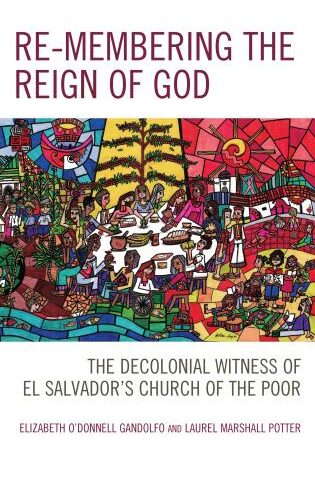
Symposium Introduction
Across many commentators of this book since its publication (now out in paperback format), all have lauded the ability of the authors to center the voices and lives of subaltern, marginalized communities. The panelists in this Syndicate Symposium are no exception.
In the comunidades eclesiales de base (CEBs) of El Salvador, Elizabeth O’Donnell Gandolfo and Laurel Marshall Potter found inspiration for Christian thought. However, unlike others who have found something similar, the authors also took the members of the CEBs to be their most invigorating interlocutors. The insights from the lived experience of the CEBs permeate throughout the almost 350 pages of text. In the opening pages of the introduction, the authors write, “We follow [the CEBs’] lead in our own methodological approach” (13). They apply this “see-judge-act” method, that they say the CEBs themselves use, in the overall structure of the book, but also in more subtle ways throughout the text.
In Part I of the book, the authors introduce us to the CEBs in a creative way that highlights not only the CEBs today and their witness, but their history and their own narratives. The libritos of Part I are twenty-two “sacred stories that are central to the Salvadoran base communities’ self-understanding, historical memory, and theological outlook” (19). Here, the reader gets an intimate look into the CEBs’ own attempts at keeping historical memory alive. These libritos tell many stories of the lives of the CEBs, but they are not historical records. Instead, the authors name this material as “theological witnesses.” The libritos are thus primary sources of theology, rather than for history or field notes in anthropology. They daringly call this section of their book “Un Largo Camino: Salvadoran Salvation History.”
Part II is comprised of more of Potter and Gandolfo’s own words, but still heavily reliant on the words of Salvadoran CEB members. The fundamental argument being made is that the CEBs are historical examples of Christian communities making a “decolonial turn” (206). The authors articulate what they mean by “decolonial turn” through the framework of thinker Nelson Maldonado-Torres’s work, who himself is drawing on Frantz Fanon and Steve Biko (188). The CEBs make the decision to turn away from systems that “dis-member and negate the very being of the colonized . . . through perpetual violence” (188). Instead, the damné struggles against this negation of their own being. The CEBs make this turn “with every step they take toward re-membering themselves as ecclesial subjects of the divine dream of abundant life for creation” (189). They are a decolonial sacrament insofar as the communities “incarnate God’s reign in their historical context” (189). Thus, the CEBs re-member the Reign of God on Earth.
In the first response, Ernesto Valiente situates the book within the larger context of Latin American liberation theology (LALT). The title of his essay “If it is liberating, it must be decolonial” points toward how the authors frame their relationship with LALT. Their work is indebted to the earliest generations of liberation theologians who nevertheless “only scratched the surface of the colonial matrix of power, thus leaving the complex, intersectional, and ontological depths of coloniality unscathed” (15). Decolonial theology, however, goes further, the authors argue. Theirs is therefore a critical legacy, then, of LALT’s earliest architects.
Judith Gruber takes a different entry point by considering the book through the lens of ambiguity, which she zeroes in on as a characterization of the political effects of Christianity. In this book in particular, Gruber notices, decoloniality plays out in the midst of coloniality for the CEBs, making their decolonial praxis an ambiguous reality, rather than “a clear delineation from coloniality.” Ambiguity is acknowledged and sustained for Gruber throughout the stories of the CEBs and also in the analysis of decolonial solidarity practices. This same ambiguity, however, is put aside on the constructive end of the project, argues Gruber. The Reign of God is juxtaposed to an anti-Reign of God where the former becomes extraordinary, thus reinscribing the matrix of colonial power that derives from a dichotomized understanding of the divine and history and a disembodied understanding of the contents of the Reign of God. Gruber turns to the pitfalls of ethnographic work as one possible explanation for this shortcoming. For their part, the authors respond to Gruber in this symposium by first clarifying their own methods. They also reframe the tensions she names as difficulties in the task of deconstructing colonial power without stripping ourselves and communities of resources needed for resistance and survival. This exchange points to the timeliness of this book as decolonial thinkers and actors attempt to (de)construct the world in the face of globalizing death-dealing forces.
Annmarie Caño and Rufus Burnett’s contributions take the book out of its direct contexts of LALT and decolonial theology and into psychology on the one hand and Afro-pessimism on the other. First, Caño is a psychologist implementing in her own work the tenets of liberating psychology. Centering her response on questions of the praxis of love, Caño brings in reflections on the connections between love, conversion, and rage, all emotions she sees as present in the book’s narrative of the CEBs. Caño takes this book personally, so to speak, asking what it is that these stories and theological analysis say, if anything, to scholars attempting to create another possible world.
Burnett’s response was provocative in ways that the authors themselves admit will stick with them for the entirety of their scholarly careers. Burnett, true to his own style, begins by beautifully reflecting on the book as a “book of touch.” He writes on what he refers to as the “Roman Catholic sense of touch, that walks by sight, and makes little room for the reciprocity and consent on which intimacy can be cultivated through the sentience in touch.” He brings the book into contact with black studies’ treatment of anti-blackness through the “flesh-based sensory register of [Re-membering].” Burnett prods at the authors’ own conceptions of the possibilities of decolonial solidarity. Burnett ends his analysis with marking the book as a contribution to constructive theological work and decolonial thought. His writing, the final in this Symposium, leaves us on an open note about the possibilities and limits of decolonial work to engage the singularity of anti-blackness. It points toward larger questions and deeper connections, perhaps yet to be made.
This Syndicate Symposium is an example of the intricate nature of doing the work Potter and Gandolfo set out to do. The density of the back-and-forths here attests to the thick webs of colonial power that make up our quotidian lives and scholarly endeavors. Despite this complexity, all wrote with a sense of urgency, highlighting the need of re-membering the historical realities of “jodido” (screwed) history. Then, and only then, will Christian communities be able to re-member the Reign of God.
1.14.26 |
Response
If It Is Liberating, It Must Be Decolonial . . .
One of the features that caught my attention and sets Re-membering the Reign of God apart from other books is the manner in which the authors place the members of the ecclesial base communities (Comunidades Eclesiales de Base, or CEBs) at the center of the conversation. This must be said from the get-go: the methodology, style, and overall content of the book show a fierce commitment to honor the agency of its subjects and to let the poor speak in their own words, because in this project they are acknowledged as the holders and dispensers of wisdom.
To be sure, most of us set out to allow the main subjects of our study to speak for themselves, but this is often easier “said . . . than done” when engaging marginalized, or subaltern, populations.
Gandolfo and Potter succeed where many of us falter, in large part thanks to the fact that both authors lived among Salvadoran base communities for many years. Heeding the advice of liberation philosopher Ignacio Ellacuría, Gandolfo and Potter understand that theologians cannot remain distant observers or pretend to be impartial witnesses of reality, but rather must engage reality as participants who are embedded and active within its dynamism. Indeed, while their careful scholarship has resulted in a successfully articulated decolonial ecclesiology, the book also manages to capture a more personal and intimate dimension—the accumulated experiences of many close conversations that can only happen within the context of long-lasting friendships. Throughout the book the members of the CEBs emerge as the creative subjects who remember, argue, and celebrate together, modeling the path that the Salvadoran Church is to follow.
The authors’ commitment to a more faithful representation of the experiences and life of the poor informs every one of its arguments. An example of this comes in the first part of the book which Gandolfo and Potter describe as “Salvadoran Salvation History.” These twenty-two libritos (“little books”) are a collection of narratives, excerpts from primary sources, folk songs, and reflections that capture the history of the Salvadoran faith experience. They not only give us a picture of the development of the Salvadoran church from below and from within, they also illustrate how the CEBs truly stand in a long line of decolonial movements of liberation, even before texts on decolonial thought had been written.
I am grateful for the tremendous contribution that these sources bring to the study of Latin American theology in the contemporary English-speaking context (and you can be sure I will be using these great sources in my future courses). To me, these narratives enable those who may not speak the Spanish language to study and share in the struggles of the Salvadoran people and rediscover the dynamism of the CEBs as they continue to struggle to build a new future in spite of their challenges and betrayals from the political right and left, and even the hierarchical church. It is in this resilience, tested for many years by empires, oligarchs, dictators, earthquakes, and now populist autocrats, that we witness the paradox of how hope and the cross come together in the Christian life.
Enlisting a decolonial lens, Gandolfo and Potter briefly explain the impact that the Spanish and Portuguese empires and their European Christianity had on the vanquished Latin American continent. Drawing on scholars like Aníbal Quijano, Walter Mignolo, Sylvia Wynter, and Nelson Maldonado-Torres, the authors synthesize the central insights of decolonial thought on the reality of coloniality and its legacy in Latin America and the Caribbean. From the different elements in the colonial matrix of power, they focus on the domination related to human subjectivity and knowledge, which is connected to the “imposition of Christian doctrine and devotion on Indigenous people and enslaved Africans . . . at the heart of the coloniality of knowledge and being” (6). Gandolfo and Potter acknowledge that insofar as Christianity can be understood as a Eurocentric epistemology, it restricts the places and experiences that nurture thought. As Christian theologians, they also see their “task to confess and stress that . . . Christian supremacy and epistemic control persist as a binding force among the nodes of the colonial matrix of power in our world, particularly in the Americas, today” (7). Hence, they explain that a process of decolonization requires a “delinking from” or an “unlearning” of the hegemonic epistemology that can characterize the practice of Western Christianity. To my mind, the language of unlearning and delinking points to the Christian hermeneutical process that places Jesus’s life as its central criterion to empower an authentic Christian life, and the realization that all truth claims, including those present in our sources of revelation, must be contextualized and critically appropriated by the Christian community. It also seems to me that, for Gandolfo and Potter, the question is not whether Christianity has the necessary resources to discern what elements in the European articulation and praxis of Christianity are oppressive and which might be liberating. Rather, they question whether the current ecclesiological structures of the Catholic Church are conducive for such a task.
When Gandolfo and Potter examine the lived faith of the Salvadoran base communities, they reject the view implied by some decolonial thinkers that Christian communities are incapable of practicing decoloniality. As the authors make clear throughout their book, most CEBs from their inception have actively sought to delink themselves from the practices of Catholic colonialism and to connect with their most authentic selves. This means recovering the wisdom of their indigenous heritage and, even more importantly, grounding their lives in the proclamation and life choices of the anti-imperialist Palestinian tekton, un hacelotodo, named Jesus. These communities consider themselves Christian because they have made a commitment to Christ and a commitment to themselves. In the words of the authors, they are poor who believe in the poor. “The church of lxs pobres,” contend Gandolfo and Potter, “is a decolonial church in so far as its relinking with the story of Jesus is accompanied by the delinking from colonial frameworks of theological knowledge and ecclesiastical authority” (216).
Although some decolonial scholars have argued that Latin American liberation theology is limited or incapable of contributing to the decolonial project due to its European roots, Gandolfo and Potter do not shy away from upholding the legacy of this important theological movement. They aver that “the first generation of professional Latin American theologians wrote under the inspiration and activity of the Spirit at work in both the ecclesial base communities and in the larger movements for social transformation . . .” (13). Having acknowledged the contribution of the founding generation of liberation theologians, the authors then argue that today “the rich diversity and more thoroughly decolonial nature of contemporary Latin American theology—feminist, queer, Indigenous, Afro-descendent—is eclipsed by the problematic prominence of these men, however admirable they may be” (15). I am grateful to the authors for pointing out the problematic of how the legacy of these male theologians still controls the conversation, particularly the English language discourse. Nevertheless, like Gandolfo and Potter, I remain critically indebted and inspired by the contribution of these earlier theologians, who I believe stand in close relationship with contemporary decolonial efforts. Indeed, you can find numerous contemporary proponents of feminist, queer, Indigenous, and Afro-descendent theologies who acknowledge the important legacy of the first generation of Latin American liberation theologians even though their lens would prove insufficient. The old motto is still valid: All theologies are contextual and thus temporal.
Participants who are inspired by the decolonial movement and those rooted in movements of Christian liberation find a common ground in their solidarity with the oppressed and their liberating response to the negative forces of Western modernity and its colonial patterns of power. These basic criteria help the authors appropriate and expand on the Christian legacy of liberation theology and engage this theology in a constructive dialogue with decolonial theory. I would suggest that in this excellent book the fruits that emerge from the confluence of these two movements are articulated in three common tasks: (1) the commitment to confront reality honestly and expose the multiple layers of violence and oppression that continue to afflict the subaltern population, (2) the recovery and embrace of the theological wisdom offered by marginalized communities, and (3) the empowerment of a prophetic praxis that heals, challenges, and liberates the Christian church.
Finally, I would like to say a word about the important prophetic message put forth by this book. Gandolfo and Potter’s work offers an incisive critique of the unjust social and economic structures that have shaped the lives of most Salvadorans since the colonial period. They bring this denunciation into the present, illustrating for us the contemporary effort of the CEBs to transform political power through their denunciations of political corruption and their resistance to human rights violations, so evident in the last year of the current Salvadoran administration and particularly in the recent introduction of the so-called “state of exception.” That said, the authors are also careful to identify some of the constructive prophetic ways in which the CEBs generate hope today: the narratives, art, crafts, and music that express their new decolonial vision and their celebration of life, their economic arrangements rooted in cooperation and solidarity, and their alternative ecological practices that seek harmony with nature.
And yet, prophetic voices have a way of making us feel uncomfortable and this is particularly true when they question institutional authority. It is not surprising then, that a liberating and decolonial ecclesiology may unsettle a traditional institutional church that has historically taken the side of those in power and that has been slow—much too slow—to learn and change. It was fifty years ago that the final documents of Medellín lauded the base communities as the “initial cell of the ecclesiastical structures and the focus of evangelization, and . . . as the most important source of human advancement and development.” Yet, since the appointment of Monsignor Sáenz Lacalle as Archbishop of San Salvador in 1995, the support of the Salvadoran institutional church toward the CEBs has greatly diminished, if not disappeared altogether. As Gandolfo and Potter explain, the “third generation” of CEBs, from the 2000s to the present, has been marked in many instances by separation from the local parish, resulting in their isolation from the structure of the church. This separation reflects a deep division within the Salvadoran church between the hierarchy and the church of the poor.
While the authors appreciate the positive impact of Francis’s papal ministry and are optimistic about the renewed relationships between the CEBs and the current Salvadoran archbishop, they rightly warn us that the church’s internal structures inhibit its mission in and for the world. Indeed, with the base communities, they contend that “while some progress has been made toward the decolonization of Roman Catholic ecclesiology ad extra, the state of Roman Catholic ecclesiology ad intra remains mired in the muck of colonial power dynamics” (303). Thus, the efforts to become a liberating and decolonial church are “structurally impossible, or at least unsustainable within the reigning institutional power structures of Roman Catholicism” (306).
The title of the first chapter of the book is formulated as a crucial question: “Is An-Other Church Possible?” I believe that the authors’ analysis of Christian life nurtured by and in the Salvadoran base communities has demonstrated that such an “other” church is truly possible. Such possibility, however, requires a deep conversion that must move to taking on the interior structures of the church.
1.19.26 |
Response
Salvific Ambiguities
Re-membering the Reign of God brings past and current voices from El Salvador’s CEBs into conversation with decolonial theorists to re-read the country’s traumatic history as salvation history. Carefully attending to the ways in which lxs pobres defiantly and creatively survive in a world that is marred by ongoing colonial violence, it discovers in their experiences epistemic, aesthetic, and political practices that de-link individuals and communities from the colonial matrix of power and so present building blocks toward a counter-world “which break[s] hierarchies of difference that dehumanize subjects and communities and destroy nature” (7). Building on the far-reaching insight of decolonial theory that theological knowledge has been instrumental in establishing and maintaining colonial power, the authors argue that the experiences of lxs pobres of El Salvador are also of theological significance. Carving out the theological dimensions of their struggle for decolonization allows them to paint a nuanced picture of the profoundly ambivalent political effects of the Christian tradition: Christian theologies have provided patterns of reasoning that are constitutive of the necropolitics of empire, and at the same time, they can inform decolonizing practices of delinking from the life-negating force of coloniality. Identifying Jesús’s promise of God’s coming reign as a decolonial vision of an-other possible world allows the authors to theologically dignify the CEBs as sacramental witnesses of God’s liberating presence in the world, and it further pushes them to ask in which ways CEB experiences can be put toward a decolonial reconfiguration of established ecclesial structures that are firmly entrenched in the colonial matrix of power. From their thoughtful theological study of the complex experiences of the Salvadoran Church of the Poor, the authors carefully distill a tentative roadmap toward the “transcendent telos of life together in God’s presence” (200), in ways that equally give hope for the possibility of transformation and are honest about possible failure. I offer the following thoughts with admiration for their painstaking intellectual labor, and in gratitude for their visionary theology that allows us to see God’s liberating presence in this colonial world.
I would like to zoom in on the ambiguous, simultaneously life-giving and death-dealing, political effects of Christian theologies that the authors trace in their case study. For me, it is one of the crucial questions for theologians today to ask if, and how, we can give a theological account of this ambiguity—and what kind of theology emerges when we really make the variegated complexity of embodied experiences the point of construction for theology. Ultimately, the question is whether we can fully acknowledge history, in all its messiness, as a locus theologicus—or whether we, silently or explicitly, hold on to a deductive style of theologizing that relies on a given notion of theology that is used to speak into the messiness of reality. Turning to twentieth-century theologies that seek to reckon with theological complicity in traumatic histories such as the Holocaust, Sarah Pinnock shows that there has been a tendency to protect and, ultimately, purify theology from its complicity with systems of oppression. Addressing “the institutional and doctrinal inadequacies exposed” by histories of trauma, they relegate perpetrator theologies to a realm outside “theology proper” and “attempt to retrieve a ‘moral [or historical] core’ of Christianity that is innocent of such abuses. In making constructive moves, these thinkers seek an ‘authentic’ Christian faith based in the distant past that is untainted by exclusionary prejudice.”1 As I aim to show below, such a deductive approach, that seeks to reify a normative understanding of Christianity, reinscribes coloniality. (Only) by paying theological attention to the irreducible ambiguity of God-talk in history can we unsettle the theopolitically produced cosmovision that underpins the colonial matrix of power.
Reading Re-membering, I found myself in the palpable tension between these two theological approaches: on the one hand, the book offers a nuanced ethnographic reconstruction of the messy reality of life in the wake of colonial trauma which it seeks to make the basis of theologizing. On the other hand, it puts forth a normative understanding of theology as—ultimately, eschatologically—unambiguously decolonial. The richly textured case study of Salvadoran CEBs portrays decoloniality as a profoundly ambiguous phenomenon—here, decolonial “de-linking” does not occur as a clear delineation from coloniality, but emerges “in the midst of coloniality” (201), profoundly shaped by the conditions of colonial power that it transforms. This ambiguity of decolonial liberation is a recurring theme in the literature that the authors use for building their theoretical framework, both decolonial and theological. Maldonado-Torres asserts that “decoloniality is never pure or perfect” (201); following Jon Sobrino and Pedro Trigo, the authors conceptualize the CEBs as a “locus for theological reflection” because they speak to the “experience of God from within a context of life amid death” (14, italics mine). This theme of ambiguity as constitutive of decoloniality reverberates strongly with the ethnographic data, which document performances of epistemic, aesthetic, and political transformation “in the midst of an enduringly colonial church and world” (189), within a reality that is profoundly “‘jodido’, or ‘screwed'” (206) by the annihilating force of colonial power. The example given for North American practices of solidarity with the church of the poor, too, points to the profound ambiguity—and really, impossibility—of delinking practices from the matrix of colonial power. In effect, the case of the Ignatian Family Teach-In for Justice is a story about a decolonial moment that is lost, sucked back into the overpowering matrix of ongoing colonial power. It is a story about failed decoloniality—unless we find ways of conceptualizing decoloniality as a disruptive event that dis/appears within and is contingent upon coloniality.
The authors recognize this ambiguity as an integral component of decolonial practice. It features, perhaps more implicitly, in their ethnographic reconstruction of the CEB experiences that narrates an ongoing and all too often failing struggle against oppression in El Salvador, and it becomes an explicit theme in their reflection on decolonial solidarity practices. However, it does not find its way into their constructive theological proposal for a decolonial understanding of the Reign of God. Proceeding dialectically, they conceive of the reign of God as “antithesis of Empire” (11). Describing it as “an-other world of flourishing diversity and freedom” (7) that is situated beyond/outside the colonial matrix of power (cf. the graph on 339), they install it as a “utopian” vision (204). Thus, literally, abstracted from the place of its emergence, the theological concept of the Reign of God becomes an ahistorical and disembodied norm that orients and informs the ethnography of de/colonial struggles in El Salvador. In its desire to validate the CEB practices as sacrament of the Reign of God, understood as utopian antithesis to empire, Re-membering ends up erasing the complexity of the embodied experiences of the poor in the wake of colonial trauma. Their experiences of the ambiguity of life within colonial death, that shines through the ethnographic data, does not become the starting point of theological construction. Instead, they appear only insofar as they fit—and can be made fit and molded into—a pre-given theological master narrative of the Reign of God as decolonial.
This erasure of ambiguity may be the result of a risk inherent to ethnographic research that Sherry Ortner terms “ethnographic refusal,” summarized by Alexandra Crampton as the “failure . . . to engage with cultural dynamics and intragroup politics that would offer a more complex understanding of resistance than what [Ortner] views as ‘romanticism’ and ‘politically sanitized’ representations of how people resist domination.” Motivated by “a fear that this information could be used to rationalize or legitimize domination, . . . the full humanity and subjectivity of those who are oppressed is lost in the construction of innocent victims,”2 who, in our case, are subsequently identified as sovereign agents of God’s Reign in history. This ethnographic erasure of ambiguity dovetails with a distinct style of theologizing, described above by Pinnock, which purifies theology from the messiness of history by way of a teleological eschatology that allows one to imagine pure beginnings and perfect endings beyond the colonial matrix of power. Re-membering does assert that “in human history, the reign of God is never pure nor perfect” (201, italics mine). However, it anchors this history in a historical construction of Jesús as the ideal decolonial subject that is unaffected by the ambiguities of life under colonial rule (cf. in contrast Tat-siong Benny Liew’s more complex account of Jesus as a postcolonial subject3), and it orients it toward the “telos” of “an-other world” that overcomes coloniality. Ultimately, salvation in the Reign of God here takes place outside history. It offers a transcendence from history that is conceived as extraordinary—apart from and purified from colonial order. Rather than tracing the divine within the “jodido” in ways that resonate with the CEBs’ experiences of life within death, it splits transcendence from immanence in ways that separate the divine from what is “jodido” (cf. 206).
Holding on to a binary theological reasoning that separates salvation from the profanity of history by imagining transcendence as extraordinary, Re-membering ultimately reinscribes, rather than unsettles, the theopolitical cosmovision that undergirds the colonial matrix of power. The separation between the sacred and the profane has been at the heart of colonial order, providing a basic distinction that has served as blueprint for categorizing the world into saved/damned, Christian/heathen, colonizer/colonized. In line with, rather than in disruption of this binary theo-logic, Re-membering continues to imagine a pure space of the sacred, in which those who are considered as saved participate—and from which, conversely, the damned are excluded. The book excels in its sharp historical critique of the legacies of colonial theology, and is relentless in doing the important work of exposing how it continues to inform practices of exclusion in the global church today, highlighting that tradition has been “used as a weapon to convert Indigenous peoples into colonized damnés not even worthy of the sacraments they were forced to accept as necessary for salvation” (273). Its theological ethnography of Salvadoran CEBs seeks to reverse this judgment and include lxs pobres of El Salvador into this pure realm of the sacred. However, precisely by pursuing this goal, it does not unsettle the theopolitical separation between transcendence and immanence that lies at the foundation of the colonial cosmovision. Instead, holding on to a space of salvation purified from the colonial matrix of power, it shores up a core asset that theology provides for the maintenance of colonial power. As Gil Anidjar has argued, the Christian narrative of salvation has offered a foil for believers to identify with/as innocent victims,4 with the upshot that Christians are predisposed to misrecognizing themselves as weak and have not developed sustainable tools for recognizing and managing power, even as they gained positions of religious, political, and societal influence.5 Such innocence—which, really, is a violent ignorance—with regard to power is a core component of colonial hegemony and white supremacy.6 Insofar as Re-membering imagines God’s Reign as a utopian space purified from the colonial matrix of power, it ultimately continues to leave us without resources to responsively embrace—rather than gloss over—the ambiguity of theopolitical power stored in (any) cosmovision.
Yet, this is not the only account of soteriology that we can find in this rich book. Underneath its theological master narrative of God’s Reign as ultimately, unambiguously decolonial, more complex imaginations of salvation emerge from the struggle of lxs pobres for life amid death, for liberation that keeps failing, for transformation that remains fraught by the pervasive force of colonial power. As the authors highlight with Pope Francis, these embodied practices of lxs pobres “may be troublesome, and certain ‘theorists’ may find it hard to classify them” (326)—revealing the ambiguity of de/colonial life, they do not easily subject to a teleological narrative of liberation arching toward a counter-world beyond colonial power. Instead, they speak of decolonial practice as an “accidental, local and precarious activity, that is always close to disappearing. And therefore, also always close to reappearing.”7 If we make their ambiguous experiences of the im/possibility of decoloniality the starting point for soteriological reflection, we hear (again) stories of resurrection recognized through a veil of tears, stories of a new life marked by the pestering wounds of a violent “past.” We hear stories of liberation that takes place within and is conditioned by the colonial matrix of power. In short, more complex images of transcendence as “fully immanent but radically different”8 begin to emerge. When we theologically validate these decolonial practices as signs and effects of salvation in their full, complex, messy ambiguity, they may become resources to develop a soteriology that conceives of salvation not as an “extraordinary” state beyond history, but as “ordinary” events of disruption within history. In other words, speaking to salvation as contingent upon the world that it transforms, they may become resources to develop a soteriology that disrupts the sacred/profane binary that lies at the heart of colonial cosmovision.
My point here strongly resonates with a core argument of Re-membering: in the wake of empire, we have to theologically reckon with the fact that theological imaginations remain implicated in coloniality, even when they desire to be liberatory. Once we have recognized the profound entanglement of theological knowledge into coloniality, and if we want to hold on to a possibly transformative potential of theological practice, our decolonial critique has to affect, and reconfigure, our very understanding of God and God’s saving action in the world. When we find imaginations of unambivalent salvation at the foundation of the colonial matrix of power, then we have to consider embracing the impurity of salvation, as witnessed by lxs pobres in El Salvador, as a constitutive dimension of a soteriology that may have decolonizing effects. For decolonial theology to emerge, we may have to trade in soteriological unambivalence for a theology that has lost its innocence, i.e., a theology that refrains from creating a pure space beyond power for itself: (only) if it is willing to mess with the sacred/profane distinction may theology have transformative effects. Perhaps the greatest gift of lxs pobres to the church is not an unambivalent account of decoloniality/liberation/salvation that blends all too smoothly into colonial imaginations of a sacred utopia for those who consider themselves innocent of the ambiguities of power, but a witness to the irreducibly ambiguous realities of salvation in a world profoundly shaped by coloniality.
Sarah Pinnock, “Atrocity and Ambiguity: Recent Developments in Christian Holocaust Responses,” Journal of the American Academy of Religion 75 (2007): 502.↩
Alexandra Crampton, “Ethnographic Refusal as Research Method: Example from a Study of a Family Court Child Custody Mediation Program,” Qualitative Social Work 14, no. 4 (July 2015): 457.↩
Tat-siong Benny Liew, “The Gospel of Bare Life: Reading Death, Dream and Desire through John’s Jesus,” in Psychoanalytic Mediations between Marxist and Postcolonial Readings of the Bible, ed. Tat-siong Benny Liew and Erin Runions, Semeia Studies 84 (Atlanta: SBL Press, 2016), 129–71.↩
Gil Anidjar, Blood: A Critique of Christianity, Religion, Culture, and Public Life (New York: Columbia University Press, 2014).↩
Sonja Luehrmann, review of Blood: A Critique of Christianity, by Gil Anidjar, New Directions in the Anthropology of Christianity, https://www.new-directions.sps.ed.ac.uk/blood-critique-christianity-book-review.↩
Cf. Gloria Wekker, White Innocence: Paradoxes of Colonialism and Race (Durham: Duke University Press, 2016).↩
Jacques Rancière, “Überlegungen zur Frage, was heute Politik heißt,” Dialektik: Zeitschrift für Kulturphilosophie 1 (2003). My translation.↩
Bradley Johnson, “Doing Justice to Justice: Re-Assessing Deconstructive Eschatology,” Political Theology 12, no. 1 (2011): 19.↩
1.21.26 |
Response
The Sensory Register of Decoloniality
Blackness and the Possibilities of Solidarity
In the sensory scale of “races” . . . the “civilized” European “eye-man,” who focused on the visual world, was positioned at the top and the African “skin-man” who used touch as a primary sensory modality at the bottom. Societies that touched much, it was said, did not think much and did not bear thinking much about—except perhaps by anthropologists. To achieve respectability, societies needed to be seen to have risen above the “animal” life body [emphasis mine].
—Constance Classen, The Deepest Sense: A Cultural History of Touch1
Re-membering the Reign of God (RRG) is a book of touch, a sentient touch that guides thought. CEBs “touch much.” In their touches, they sense their calling to the Church of lxs pobres and the “Reign of God.” The touch of CEBs is narrativized in the authors’ reading of the role of local foodways in the eucharistic ritual known in some CEBs (Base Ecclesial Communities) as “the sharing of bread.”2 Food, and foodways, signal the flesh of human hands and their transformation of flora and fauna into edible creations to be shared. When the symbols of “the sharing of bread” have been ground, kneaded, and prepared by the local community, their engagement with the provisions of God’s creation—corn, water, rice, ginger, allspice, etc.—the members of the CEBs connect not only to the body and blood of Christ but the conviviality and ecology of the Last Supper. In touching the sacred foods of the “sharing of bread,” chilate and tortillas, they localize the meaning of the God of life such that it is situated in a material relationship and a materiality of space and place.3 This haptic reading of the “sharing of bread” shows the profound extent to which CEBs offer their unique touch which breaks with the touch that walks by the sight of the Euro-centered “eye man.” Sight tells us where to touch, but touch tells us how to touch. As such, touch by sight guarantees contact but not intimacy. This lack of intimacy in touch is reflected in the authors’ analysis of a colonial ecclesiology that centers the ontological superiority of unleavened bread and wine. When the sacramentality of tortillas and chilate are questioned, the sentience embodied in the touch of a people and thus their very being is questioned.
As the authors convincingly illumine, the missiology and vision of the Church in Latin America from the Doctrine of Discovery onward has been a dislocating vision that sees the touch of the church as unidirectional and secondary to orthodoxy and orthopraxis ad intra. It can be deduced from the authors that the Roman Catholic sense of touch, that walks by sight, makes little room for the reciprocity and consent on which intimacy can be cultivated through the sentience in touch. Intimacy, in this case, means working toward the cultivation of human dignity by embracing a sacramentality of local foodways and the “leadership” of the CEBs which embrace these foodways as worthy of symbolizing the sacred and grounding solidarity. So much of the authors’ argument is predicated on the problem of the coloniality of being which is all too often constitutive with the Church and thus belies what Walter Mignolo articulated as the colonial difference. In short, the colonial difference is an experience of variance (human, religious, political, social, gendered, racial, ethnic, and otherwise) that sets the colonial world apart from the modern world. In what follows below I want to consider an approach to the colonial difference, in line with the flesh-based sensory register of RRG. To do this, I draw upon insights from black studies, one of my intellectual homes, that I think are key in leveraging touch as a route toward solidarity amongst les damnés, lxs pobres, and the privileged. I aim to further consider the barriers to solidarity that extend the authors’ articulation of the differences amid les damnés, lxs pobres, the human, the overrepresentation of the human, and the overrepresentation of human subjectivity.4
Anti-blackness and Its Challenge to Solidarity
Following the insights of the authors, my task now is to bring the insights from black studies approaches to anti-blackness to bear on how solidarity in RRG is articulated as an alternative way of belonging to “the human.” Stated genealogically, my concern is twofold. First, I am concerned with how the work of Frantz Fanon in Black Skin, White Masks is integral to Sylvia Wynter’s theorization of Man as an “adaptive overrepresentation of the human”5 and thus the authors’ usage of Wynter’s work to construct a decolonial notion of solidarity, ecclesiology, and eschatology. For Wynter, decoloniality or decolonization is a new humanist project that attempts to establish a non-adaptive mode of the human, a humanity that is not an adaptation to Euro-centered encounters with the rest of the planet. Second, I am concerned with the alternative reception histories of Fanon within black studies that leverage Fanon to theorize anti-blackness rather than coloniality. My suggestion is that Fanon’s theorization of anti-blackness, as dereliction6 and abandonment by the world, has a reception history in black studies that is structurally consequential to, and distinct from, Wynter’s notion of dysselection as it is taken up in RRG and thus has implications for how the authors conceive of solidarity with lxs pobres, les damnés, and the Church of lxs pobres.
The authors of RRG overtly reference anti-blackness concerning dysselection when they, following Wynter, argue that “black bodies are at the bottom of the hierarchy of dysselection”7 and more concretely when they reference how CEBs are developing their stance against racism in El Salvador.8 Anti-blackness or the problem of anti-blackness, while mentioned by the authors, remains beyond the scope of decolonial solidarity amongst the dysselected and, as the authors of RRG conclude, the privileged beneficiaries of coloniality. The degree to which the positionality of blackness performs in excess to the problem of coloniality by virtue of its position at the bottom is, perhaps rightly, under-considered by the authors. In RRG it seems that the most salient difference that challenges solidarity is the difference between “lxs pobres” and “the privileged beneficiaries of the coloniality of power.” Accordingly, the authors argue for a two-way approach to “the human” in which lxs pobres move toward human dignity and an appropriate representation of their humanity, and the beneficiaries of coloniality move toward the human through a process of “recreation” that proceeds by divesting themselves of the privileges acquired from coloniality. While it is implied that these two processes will overcome the problem of anti-black dysselection, how such an event will occur is beyond the chosen scope of the authors’ argument. What’s missing are the structural dynamics of anti-blackness that exceed the market, labor, and land or how anti-blackness matters to the structural dynamics that constitute dysselection. Afro-pessimist thinker Jared Sexton articulates an approach to this issue in an article entitled “The Social Life of Social Death: On Afro-Pessimism and Black Optimism,” where he writes,
. . . black life is not social life [it is instead social death] in the universe formed by the codes of state and civil society, of citizen and subject, of nation and culture, of people and place, of history and heritage, of all the things that colonial society has in common with the colonized, of all that capital has in common with labor—the modern world system. Black life is not lived in the world that the world lives in, but it is lived underground, in outer space.9
For Sexton, the possibility, or impossibility, of solidarity amongst the dysselected and the privileged is read with respect not only to the relative dysselection experienced by “black bodies” (as articulated in RRG) but also the dereliction or abandonment experienced by black bodies. This dereliction, according to several thinkers in black studies and Afro-pessimism, has no analog within the hierarchy of the dysselected. Instead, racial slavery and thus anti-blackness is interpreted as a ground and means by which a hierarchy of the dysselected is made possible. For Sexton, blackness is not only opposed or abandoned by whites, but it is also opposed and abandoned by non-blacks. Some indigenous thinkers have troubled Sexton’s contention that the black is opposed and abandoned by the non-black insofar as they see settler colonialism and the dislocation of indigenous epistemologies, particularly concerning land, as foundational to racial slavery.10
One need not resolve the debate of foundations between theories of anti-blackness and anticolonialism to recognize how the respective realities of black and indigenous experiences of suffering can present profound challenges to solidarity. As articulated in RRG, the hierarchy of dysselection has to do with how the neoliberal global market economy; epistemological hegemony; and ecclesial authority overdetermine liberation and salvation. In addition to this, there is also the issue of land. While solidarity, as it is set out in RRG, is not exclusive of anti-black dysselection, it has yet to fully account for how indigenous and black struggles for dignity are beset by the spatial imagination of settler colonialism. As Sexton shows, those racialized as Black do not hold land “in common” with settler colonialists and indigenous peoples. As such, black subjectivity is the representation of landlessness.
One final way of communicating the challenge to solidarity invoked by black studies and Afro-pessimism is to consider the ontological difference invoked in the protest of Anita Landaverde, Pueblo de Dios en Camino, referenced in RRG:
“We are not the base of the institutional church, because we are not masa [the masses/dough]. Masa can be moved this way or that but not the ecclesial base communities.”11
In an almost contrapuntal turn, black studies scholar Zakiyyah Iman Jackson asks, what if blackness is a malleable positionality that belies form? Similar to Landaverde’s analogy of masa, Zakiyyah Iman Jackson uses her conceptualization of “plasticity” to name how “black(ened)” subjectivity is made ever more malleable to the demands of anti-black social order. To this point, she argues that to be “black(ened)” is to be:
. . . cast as sub, supra, and human simultaneously and in a manner that puts being in peril because the operations of simultaneously being everything and nothing for an order—human, animal, machine . . . blackened being is a statelessness . . . blackness is enfleshed in an ongoing process of wresting form from matter . . .12
As such, anti-blackness is the constant theft of form from black matter and thus the theft of what matters to Black persons. Plasticity describes the activity usually associated with dehumanization. In contrast to seeing anti-blackness as “dehumanization,” Jackson argues that “Slavery’s technologies [and their afterlives] were not the denial of humanity but the plasticization of humanity.”13 So much more can be said about the insights of black studies on blackness and anti-blackness that exceed explanations framed by colonialism. For instance, there are perspectives in black studies that read blackness through ideas such as fugitivity,14 stolen life,15 blues epistemology,16 and Africana religions.17 While these perspectives are beyond the scope of this dialogue, suffice it to say that black studies perspectives are diverse and some of them do not lead to the so-called impasse between anti-blackness and anticolonialism. Nevertheless, my aim in this brief treatment of the theorization of anti-blackness and blackness is meant to signal how collaboration with perspectives from black studies might contribute to the perspectives on solidarity illumined in RRG.
The ground upon which the hope for solidarity in RRG rests, the human, could, or could not be, troubled by a rigorous consideration or profound touching of anti-blackness and blackness exampled above via Jared Sexton and Zakiyyah Iman Jackson. Their claims are about an anti-black/black difference rather than a colonial difference. While an engagement with black studies and, perhaps further, the emerging conversations between black studies, black theology, and the study of black religion are rightfully beyond the scope of RRG, I think the notion of solidarity and the dynamics of the subjectivities considered in RRG signal a longing for a mutual embrace between the theorization of anti-blackness/blackness and the theorization of coloniality/decoloniality. Such an embrace looks forward to a theological notion of embrace in which human fulfillment is a radical end to the sufferings of coloniality and anti-blackness and the beginning of an unimaginable future in which difference might embrace difference and all might be fulfilled.
Perhaps the most profound implication of RRG is how it looks to constructive theological reflection in ecclesiology and eschatology to point toward what a mutual embrace through, rather than in spite of, difference might feel like. As such, RRG is not simply a contribution to constructive theological thought but also decolonial thought. Such a contribution responds to the often-overlooked intersection between decoloniality and the faith of lxs pobres and les damnés. With this in mind, the authors of RRG might see decolonial theory and their theological intervention as already robustly inclusive of the problem of anti-blackness. Such a conclusion would not, from this reader’s perspective, undo the importance of touching and engaging anti-blackness and blackness as consequential to and in excess of coloniality and decoloniality. Recalling the insight of Classen, perhaps the sense of touch might also be helpful for this work as much as it was for a doubting Thomas who needed to touch the “plasticity” of a living, crucified, buried, and risen body, to know the Reign of God. Such a body might also be understood as “everything and nothing,” a matter constantly being evacuated of its form through the vacuum-like glance of “eye man.”
Constance Classen, The Deepest Sense: A Cultural History of Touch (Bloomington: Indiana University Press, 2012), xii.↩
Elizabeth O’Donnell Gandolfo and Laurel Marshall Potter, Re-Membering the Reign of God: The Decolonial Witness of El Salvador’s Church of the Poor (Lanham, MD: Lexington Books, 2022), 424.↩
Gandolfo and Potter, Re-Membering the Reign of God, 425–26.↩
Sylvia Wynter, “Unsettling the Coloniality of Being/Power/Truth/Freedom: Towards the Human, After Man, Its Overrepresentation—An Argument,” CR: The New Centennial Review 3, no. 3 (2003): 281, 317, https://www.jstor.org/stable/41949874.↩
Wynter, “Unsettling the Coloniality of Being/Power/Truth/Freedom,” 322–30. The understanding of dysselection is substantively connected to the replacement of scientific notions (Darwinian natural selection in particular) of dysselection that are race specific rather than human species specific. Following both W. E. B. Du Bois and Frantz Fanon, Wynter contends that African descended peoples are racialized as black and then over time become more and more dysselected from their non-black counterparts. In this move the non-black is seen as more fit for participation in the social order than the black. On this point Wynter is in line with the tradition of black studies in ways that distinguish her work from Latin American influences on decolonial studies.↩
Gandolfo and Potter, Re-Membering the Reign of God, 502.↩
Jared Sexton, “The Social Life of Social Death: On Afro-Pessimism and Black Optimism,” InTensions, no. 5 (November 2011): 28, https://intensions.journals.yorku.ca/index.php/intensions/article/view/37359.↩
For more on the debate on anti-blackness and anti-settler colonialism, see Justin Leroy, “Black History in Occupied Territory: On the Entanglements of Slavery and Settler Colonialism,” Theory & Event 19, no. 4 (October 2016); Eve Tuck and K. Wayne Yang, “Decolonization Is Not a Metaphor,” Decolonization: Indigeneity, Education & Society 1, no. 1 (2012): 1–40; Tiffany Lethabo King, The Black Shoals: Offshore Formations of Black and Native Studies (Durham, NC: Duke University Press, 2019); Tiffany Lethabo King, Jenell Navarro, and Andrea Smith, Otherwise Worlds: Against Settler Colonialism and Anti-Blackness, Black Outdoors (Durham, NC: Duke University Press, 2020).↩
Gandolfo and Potter, Re-Membering the Reign of God, 317.↩
Zakiyyah Iman Jackson, Becoming Human: Matter and Meaning in an Antiblack World (New York: New York University Press, 2020), 54–55.↩
Jackson, Becoming Human, 101.↩
Stefano Harney and Fred Moten, The Undercommons: Fugitive Planning and Black Study (New York: Minor Compositions, 2013).↩
Fred Moten, Stolen Life: Consent Not to Be a Single Human Being (Durham, NC: Duke University Press, 2018).↩
Clyde Woods, Development Arrested: The Cotton and Blues Empire of the Mississippi Delta (New York: Verso, 1998).↩
Dianne M. Stewart Diakité and Tracey E. Hucks, “Africana Religious Studies: Toward a Transdisciplinary Agenda in an Emerging Field,” Journal of Africana Religions 1, no. 1 (2013): 28–77.↩
1.12.26 | Annmarie Caño
Response
Love and Rage
Decolonial Conversion and the Prophetic Imagination
I first became aware of Gandolfo and Potter’s Re-Membering the Reign of God: The Decolonial Witness of El Salvador’s Church of the Poor during a trip to the Bajo Lempa region of El Salvador with a delegation from my Catholic parish. Having served as a dean of a college of arts and sciences at a Jesuit university, I was embarking on a book project about the liberating witness and leadership of the martyred Jesuits who lived and worked at the Universidad Centroamericana (UCA) before and during the civil war. During my visit, two members of the Comunidades Eclesiales de Base (CEBs) recommended that I read Re-Membering the Reign of God. They thought it might be helpful to understand how ecclesial leaders worked with and learned from the CEBs. When I returned to the States, I immediately read the book. It changed the way I think of theologically informed leadership and solidarity.
Before I continue, it might be helpful to explain my orientation and positionality. The oppressions of imperialism, colonialism, and white supremacy as well as resistance in the forms of healing and survival played out (and continue to play out) in my own family—in my father’s experience of poverty in post–Civil War Spain and subsequent immigration to the United States and in my mother’s experience of family separation in Puerto Rico and subsequent migration to the mainland. I come to this book, not as a theologian, but a social scientist (a psychologist) who attempts to resist oppression by applying liberation psychologies (see Comas-Díaz and Torres Rivera 2020; Martín-Baró 1994) to my teaching, scholarship, and leadership; and as a Catholic Latina who continues to unpack the ways in which Church is a place of both freedom and oppression. I read this book as a woman who has been trained in Ignatian spirituality to accompany others to live lives of freedom and a person who tries to center lxs pobres in decision-making and accompaniment. As a discussant who is not a theologian, I hope to represent scholars who are facing structural sin in the institutions and disciplines in which the powerful do not truly welcome us; our scholarship, advocacy, and even our very existence have become a problem to be managed. I also hope to represent others, who may or may not be theologians or religious studies scholars, and who wish to do work that is truly in solidarity with lxs pobres and who are searching for concepts and language to describe attempts to co-create otros mundos posibles (other possible worlds).
Decolonial Praxis
The authors critique, with courage, early approaches to Latin American liberation which center powerful actors. As much as we honor the UCA Jesuits and Archbishop Romero of El Salvador, centering male clerics or affluent nations and institutions may encourage an attitude of saviorism (3). An inordinate focus on how the already powerful support “the poor” risks obscuring the rich experiences of those who are more directly affected by oppression. In contrast, Gandolfo and Potter’s decolonial praxis recenters poor and oppressed communities, reminding us that a preferential option for the poor is of the poor. Their approach also recognizes the messiness and discordance in the lives of lxs pobres; there is not one reality for all people.
I appreciated Gandolfo and Potter’s application of decolonial praxis in their scholarship, including first-person storytelling by the members of the CEBs, who are living their realities with hope for un otro mundo posible. Gandolfo and Potter “break the rules” of traditional scholarship by recognizing that the objects under study—the people of the Comunidades Eclesiales de Base—are the agentic subjects they have always been. For scholars who similarly wish to break the rules, what advice do the authors have for scholars similarly wishing to break the rules? What are the real challenges and rewards in seeking un otro mundo posible in scholarship?
Conversion as an Act of Love and Rage
Gandolfo and Potter state that the aims of decolonial praxis for the CEBs are to be known, re-created, and organized. That is, if we are to believe that God created us to love and be loved, then the work of love is to enter la lucha (the struggle) to bring the “kindom” (Isasi-Díaz 1996) of God on earth, where conditions allow for full human thriving as God intended. As Gandolfo and Potter write, “In this book, it is the Salvadoran church of lxs pobres that is a sign of God’s inbreaking reign in history today, and is thus a legitimate and necessary source for both eschatology and ecclesiology” (14).
For the CEBs, the act of “being organized” (organizarse) is an act of love (312). Thought of in this way, koinonia (communion) requires metanoia or conversion through being organized in the sense that one is oriented toward right relationship with oneself, one’s history, and one’s neighbor. One who is converted moves courageously against structural sin that blocks the reign of God and makes it difficult for oneself and others to be fully human. Love opens members of the CEBs to creatively face attempts to oppress and dehumanize them. Chicana poet-activist Gloria Anzaldúa has written that oppression is slippery and fluid (2012). Thus, creativity is needed to continue to adapt and create new methods of resistance. One might even posit that ongoing resistance is the result of divine creativity, born of Love and nurtured by faith and hope.
In decolonial and liberation praxis, a movement toward Love requires critical reflection to understand the reality of one’s situation. Indeed, the recovery of historical memory plays an important role both in decolonial praxis and liberation approaches. Sometimes called critical consciousness-raising (Freire 2000), it requires individuals and communities to understand the historical oppression and resistance that have brought people to the present moment. A decolonial approach to theology recognizes the historical and ongoing oppression that continues to affect communities of faith. Decoloniality “involves critical reflection on the (a) enduring reality of coloniality and western economics, politics, culture, and religion and the praxis of decoloniality embedded in myriad forms of resistance to Western modernity that are embodied in an active by historically marginalized groups and their allies” (4).
Through this recovery process, CEBs and their supporters learn that God wants them to be liberated from all that prevents fullness of life. But love is not the only ingredient required for the kind of sustained conversion that animates efforts to create another possible world. As Gandolfo and Potter write, the CEBs also enter la lucha with rage (188). Recovering historical memory reveals injustice and often leads to righteous anger that motivates action. While I was in El Salvador, I was struck by how resolutely loving CEB members were while also raging against the harms that had been and continue to be done to them. Rage is an often misunderstood emotion that invokes fear; however, the rage I witnessed did not feel chaotic or destructive. It was generative, and oriented toward love and justice.
While the liberating work of the CEBs and other marginalized communities is a work of love, others respond to the rage with fear, anger and retaliation, or even apathy. In examples provided by the authors, powerful others in the Church and in government refuse to be open to conversion and transformation; they refuse to love. They are closed off to the rage of love, in part, because of colonial dominance through the control of the economy, authority, heteropatriarchal norms, sources of information and epistemic exclusion (i.e., “colonial ways of knowing”; 6), and the control of nature and natural resources. The Church colludes with, and in turn, derives power from colonial dominance when ecclesial authorities use doctrine and practices to impose ways of knowing upon others, uphold power structures that oppress the already marginalized, and “bless” other methods of colonial dominance with truth and authority. Liberating challenges to authority are then interpreted as sinful when the truth is that the system itself is sinful. Even when people are open to critical reflection, they may experience defensive emotions like guilt when they realize how they benefit from colonial dominance. In turn, it may be difficult for them to sustain a critical stance or to experience the love in the resistance.
I wondered about the authors’ thoughts about the relationships among conversion, love, and rage. Confronting systemic and structural sin requires that individuals are 1) open to transformation through solidarity and witness and 2) undergo conversion. They must realize the need to be converted and transformed (loved) and recognize that conversion is never complete in this earthly life. How does this dynamic play out in the CEBs and in the Church? Are there other ways in which the decolonial witness occurs in the Church? I think about these questions often as I decolonize my own career as a scholar, psychologist, and a leader at a Catholic institution of higher education. For me, part of this transformation and conversion requires regular examination of conscience to root out what St. Ignatius of Loyola and the Jesuits refer to as “inordinate attachments” to power, riches, and honors, which can get in the way of love. In some ways, this kind of reflection fuels what Gandolfo and Potter refer to as “epistemic delinking,” which “opens up the space for multiple ways of knowing and being human” and a prophetic imagining of other possible worlds (7). How else might those wishing to be in solidarity delink from coloniality?
Conversion is not only a responsibility of the powerful. The authors describe several instances of CEB members realizing their own need for conversion and transformation. For solidarity and community-building to take place, everyone must do their part to turn away from systems, beliefs, and actions that dis-member and dehumanize, and turn toward that which humanizes and allows Love and kinship to reign. The CEBs view this work as a collaboration with Jesus. Can the authors speak more to how this ongoing conversion plays out among members of the CEBs? I am especially interested in this question as it pertains to the falling away of CEB members. Anecdotally from conversations with CEB members, it appears that some of the CEBs have experienced membership declines over the last decade or so. Is this a natural cycle of decolonial resistance, a function of how difficult it is to maintain rage long-term, or a response to the effects of ongoing oppression that has taken new forms (e.g., changes in migration patterns, government-sponsored media campaigns, the Salvadoran government’s “State of Exception” that was instituted in 2022)? What does this mean for the sustainability of decolonial witness in the Catholic Church in El Salvador, Latin America, and perhaps globally?
Closing Questions
As Gandolfo and Potter write, “decolonial courage requires the grace of divine love opening our hearts and minds to the abundant life that is available when we resign from coloniality and enter into solidarity with the damnés in their struggles for an-other world” (352). Being broken open and transformed in this way is a grace that is within everyone’s reach. We are all diminished as humans created in the image of God when we ignore the call or refuse to work toward un otro mundo posible.
My final questions are similar to the first set of questions I posed to the authors. Gandolfo and Potter remind us throughout their book that decolonial praxis is communal work. They also note that the other possible world to which they aspire is “an other-world in which many worlds are free and able to coexist” (7). How has engaging in this scholarship for an-other world together and with the CEBs transformed the authors themselves? How might scholars build communities in which there is the spaciousness and safety to experience the prophetic: emotions, critical reflection, and transformation?
—
References
Anzaldúa, Gloria Evangelina. 2012. Borderlands/La Frontera: The New Mestiza. 25th anniversary 4th ed. San Francisco: Aunt Lute Books. First published 1987.
Comas-Díaz, Lillian, and Edil Torres Rivera. 2020. Liberation Psychology: Theory, Method, Practice, and Social Justice. Washington, DC: American Psychological Association.
Freire, Paulo. 2000. Pedagogy of the Oppressed. New York: Continuum. First published 1970.
Isasi-Díaz, Ada María. 1996. Mujerista Theology. Maryknoll, NY: Orbis Books.
Martín-Baró, Ignacio. 1994. Writings for a Liberation Psychology. Translated by Adrianne Aron and Shawn Corne. Cambridge, MA: Harvard University Press.
1.12.26 | Elizabeth O' Donnell Gandolfo and Laurel Marshall Potter
Reply
Response to Annmarie Caño
Since its inception, decolonial scholarship has always been intentionally interdisciplinary, refusing to conform to the dichotomous and hierarchical logics of the Western academy. So it is with special appreciation that we receive Annmarie Caño’s response to Re-membering the Reign of God. As a scholar of psychology and former administrator in higher education, Caño brings a unique perspective to our theological project and the ecclesial praxis of the CEBs, focusing on the nature of decolonial scholarship, personal transformation, and liberative leadership. Her essay coalesces around a series of challenging questions, the full scope of which exceed the bounds of this venue. We see three main themes emerging from her various lines of inquiry and we will do our best to humbly address each of them in conversation with our own reflections on the nature of academic scholarship and the (im?)possibilities of decoloniality in higher education.
The first theme that we’d like to lift up from Caño’s essay emerges from questions that she raises about the nature of decolonial scholarship. Stating that our project “breaks the rules” of traditional scholarship by recognizing the people of the CEBs as “the agentic subjects that they have always been,” Caño wonders how other scholars might similarly “break the rules.” One difficulty in responding to this question lies in our own ambivalence around the extent to which we have actually broken the rules of traditional theological scholarship. On the one hand, yes, we have centered, listened to, and learned from the voices, experiences, and narratives of marginal ecclesial communities that have been invisibilized by the colonial power structures of the church and academy. Part I of the book, especially with its unique format patterned after the sacred texts of the Hebrew Bible and New Testament, certainly breaks the mold of “traditional scholarship.” On the other hand, as much as we have tried to avoid this, the rules of the academy have still placed us as scholars in the position of “authority” on the coloniality/decoloniality of the Salvadoran church, the CEBs, their theological reflection, and their ecclesial praxis. The constraints of time and the exigencies of the tenure clock, graduate program requirements, and daily life prevented us from taking the time and care that might have allowed for even greater delinking from the academic rules of coloniality through more sustained and direct dialogue with members of the CEBs as we prepared our manuscript. The rules of the academy also required that we engage other, more academically “legitimate” primary and scholarly sources, such as the Roman Catholic ecclesial tradition (e.g., Vatican documents and Canon Law) and the “cutting edge” work of interdisciplinary decolonial scholars whose work may contain great insights about coloniality/decoloniality, but which is also full of convoluted arguments, opaque jargon, and theoretical abstractions that are not always grounded in the lived reality of everyday people on the underside of modernity/coloniality.
While we do see some value in engaging these sources (having written tens of thousands of words that do so!), we also wonder how far scholarly transgression is allowed to go within the bounds of the academy. Is there room in Catholic theology for critical reflection that does not require at least some elements of conversation with such a thoroughly colonial tradition? Is academic theology simply a much smaller part of Catholic traditioning than theologians might want to admit, i.e., are the knowledge ways and sources of academic theology too limited to speak for the entirety of Catholic faith and belief? Is there room in the humanities or social sciences more broadly to center marginalized voices and experiences without finding ways to “fit” them into whatever theoretical mold might be en vogue at the moment? Again, it’s not that we haven’t learned a great deal from placing the CEBs in conversation with decolonial scholarship, but we do feel some discomfort around patting ourselves on the back for “breaking the rules.” This discomfort is furthered by the relative security that we as white North American scholars have had in our professional trajectories. While Liz was untenured and Laurel was applying for doctoral programs when we embarked on this project in 2017, the unconventional nature of our partnership and transgressive nature of our theological method were mitigated by our white privilege. There is a tendency in the academy for white scholars to receive praise and professional favor for “breaking the rules,” whereas scholars of color might have their scholarly legitimacy questioned for doing so. Again, these misgivings are by no means intended to call into question our entire project—we stand by our work! However, we do want to avoid any easy slippage into unambiguous self-satisfaction. So in response to Caño’s question about our advice for scholars similarly wishing to break the rules, our first thought is to never neglect a healthy dose of self-critique. We’re not suggesting that we all bury ourselves in guilt or that we practice intellectual self-flagellation. But we do think that all academics should constantly engage in a realistic reckoning with what’s actually possible in the academy, the distance between what appears on the published page and what is actually la realidad of marginalized communities, along with the limited and fallible (im)possibilities of decoloniality within the institutions that were designed to serve the perpetuation of coloniality in the world today. Caño also points to this need for self-critique in her emphasis on the ongoing nature of conversion and the role that examination of conscience plays in delinking from coloniality and all that stands in the way of love’s embodiment in the world.
Our misgivings about providing decolonial scholarly advice, therefore, are not unrelated to Caño’s questions around conversion and the sustainability of decolonial witness. She asks specifically about how the process of conversion plays out among members of the CEBs, particularly with regards to those members of the communities who “fall away.” While Caño rightly notes that Salvadoran CEBs have experienced membership decline in recent decades, it is not necessarily the case that folks who no longer participate in the ecclesial life of the CEBs are no longer animated by the process of decolonial conscientization and conversion that brought them to the CEBs in the first place. The CEBs are by no means the only site of decolonial witness afoot in El Salvador today and faith communities in general are no longer at the heart of social movements in El Salvador (or anywhere in the world at this point!). For example, in our response to Rufus Burnett, we highlight the work of Afrodescendientes Organizados Salvadoreños (AFROOS), which is a network of Salvadorans who are reclaiming their identity, culture, and dignity as Afro-descendant. Former CEB members may be involved in these other community-based forms of resistance to oppression or reclamation of human dignity and ancestral heritage. We don’t have data on whether former CEB members are actively involved in other decolonizing activities or not. Our point here is simply that the CEBs represent just a small fraction of decolonial praxis in El Salvador and that ongoing conversion may mean shifting the locus and/or focus of one’s energies from a Christian community to other modes of delinking and embodying alternative worlds. While the sustainability of decolonial commitment might be questionable for any given person (in the CEBs or elsewhere), and while decolonial movements may ebb and flow over time, decolonial witness has been a constant thread woven throughout the past 500+ years of coloniality in Latin America and beyond. The sustainability of decoloniality is rooted not in sustainable membership in any given community or organization, but rather in the yearning for freedom and dignity that is located deep within the human spirit across time and space.
The final question from Caño’s essay that we’d like to address has to do with our own experience of transformation in relation to this scholarly project. She concludes with this query: “How has engaging in this scholarship for an-other world together and with the CEBs transformed the authors themselves? How might scholars build communities in which there is the spaciousness and safety to experience the prophetic: emotions, critical reflection, and transformation?” Caño’s second question here is directly related to the first, for it is only in and through community that human transformation takes place. Long before the formal scholarship that went into this project, it was the CEBs that transformed both of us by welcoming us into their spacious, loving, and prophetic communities at deeply formative times in our lives. Furthermore, our own small community of two—as friends, colleagues, and co-authors—has been transformative in its own right. Whereas scholarly pursuits in the humanities are traditionally individualistic and can often encourage emotional distancing from one’s interlocutors, our shared work was deeply relational, dialogical, and even emotional. We shared a relational orientation to the CEBs and to our own work together that made this project profoundly personal. We arrived at lines of critical argumentation in conversation with one another and bounced them off of our friends and colleagues in El Salvador. We felt many of the highs and lows of scholarly enthusiasm and dejection together, and sometimes we relied on one or the other of us to pick up the slack and rally our forces in the face of fatigue, COVID chaos, family struggles, and other looming academic deadlines. Our experience throughout this process points to the need for mutuality and shared vulnerability as human beings first, not just as scholars, if we are going to build communities where there is “spaciousness and safety to experience the prophetic.” Higher education makes building such communities challenging, given the nature of the tenure system, cultures of competition and productivity, administrative ambitions and burdens, and the day-to-day circus of just keeping up with teaching, grading, committee work, conferences, etc. Annmarie’s own work in liberative academic leadership, therefore, is needed now more than ever as a guidepost for carving out such spaces in the midst of institutions that were not designed for interdependence, let alone shared vulnerability. Her inclusion of emotion and transformation in her question to us points directly to the kind of communities that we all need to flourish, to care for ourselves and one another well, and to do our best work as scholars. We are not just minds who engage in critical reflection. We are whole persons for whom emotions and transformative processes are constantly swirling inside and around us, with the potential to permeate our work in ways that open up our imaginations to the possibilities and presence of an-other world already in our midst.