
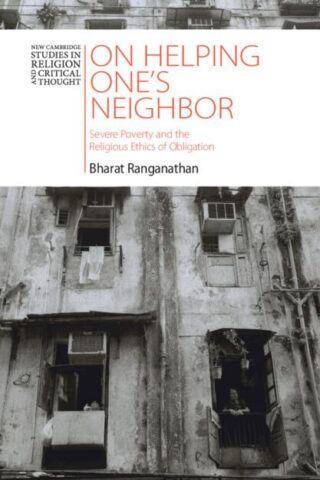
Symposium Introduction
Bharat Ranganathan’s thesis in On Helping One’s Neighbor is that affluent people have demanding moral obligations to combat the moral horror of severe poverty. These obligations must be fulfilled locally, nationally, and globally through both institutional and interpersonal action. Furthermore, he argues that these demanding moral obligations are compatible with our commonsense intuitions that we must care especially for our intimate relations and that we have a right to craft meaningful lives for ourselves. So, the obligation to aid the severely poor is demanding enough that the affluent must alter unjust institutional and interpersonal arrangements. But the obligation is not so demanding that affluent people must do injustice to their own good lives.
Ranganathan deploys the resources of Christian ethics, deontological and consequentialist moral philosophies, and liberal political theory. His argument for the obligation to eliminate severe poverty takes into account the global scale of human solidarity. The significance of this work is at least twofold. First, Ranganathan distills an expansive body of philosophical and theological thought into an argument that is both rigorous and accessible. In doing so, he is able to intervene in several ethical challenges that deserve both careful attention and broader publicity. This is an important feat in academic writing.
Second, Ranganathan remains focused on the question of obligation. One would think this focus is simply a basic requirement of his topic. True enough. But it is also the fruit of his refusal to be distracted from our obligations to the severely poor by academic questions of methodology, competing philosophical commitments, and intractable moral disagreements. As interesting and potentially important as such questions are, as fun as they are to argue about, Ranganathan works with an urgency appropriate to the horror at hand.
Each of the four symposium contributors—Per Sundman, Caroline Anglim, Elizabeth Block, and Matthew Whelan—is attentive to these contributions in different ways.
Sundman puts Ranganathan’s work in conversation with libertarian and liberal egalitarian philosophers, noting how Ranganathan grounds strong interpersonal obligations on a relatively thin account of the good. However, Sundman searches for clarity regarding Ranganathan’s use of “common sense.” And he questions whether the argument could be strengthened by a clearer account of how the rights of the absolutely poor and the relatively poor are related to the affluent and their obligations.
Anglim turns to the contemporary case of medical care for immigrants in the US who are suffering from end-stage renal disease (ESRD). Against statist and patriotic theories of obligation, she uses Ranganathan’s institutional-interpersonal hybrid account of human rights to justify our obligations to care for this suffering population, no matter their legal status.
Block sees Ranganathan’s work as a significant contribution to two areas of concern in contemporary ethics. First, Ranganathan provides us with a way to retain the moral significance of an individual agent’s actions despite the sometimes overwhelming reality of institutional and cultural forces that shape those actions. Second, Ranganathan intervenes in the debate about universal and particular ethics by offering a minimalist account of the human good rather than a comprehensive account of flourishing. It is an open question for Block whether Ranganathan’s Rawlsian approach to the good is sufficient.
Whelan finds Ranganathan’s argument persuasive but draws attention to three aspects of the work that deserve more attention. First, Whelan questions the relationship between religious ethics and Christianity and wonders whether Ranganathan’s use of Christian sources fairly represents the Christian tradition’s attention to poverty. Second, Whelan wonders whether Ranganathan’s argument could be strengthened by attention to the causes of severe poverty. And third, Whelan asks whether Ranganathan could give an account of the obligations the poor themselves have in response to the reality of severe poverty.
This symposium is an opportunity to think carefully about a grave moral issue that implicates most of us. Each contributor is in broad agreement with Ranganathan. But each one has provided him with an invitation to further conversation.

8.5.26 |
Response
The Ethics of Obligation to Undocumented Immigrants with End-Stage Renal Disease
As I have been thinking about the moral horrors of severe poverty through Bharat Ranganathan’s On Helping One’s Neighbor: Severe Poverty and the Religious Ethics of Obligation, I have found myself circling an issue closer to home, where our unjust social and political institutions disempower severely poor people as they move across our national borders in search of work and security. Migration is one topic to which Ranganathan turns at the end of his monograph as he invites further theoretical and practical reflection on the human costs of our failures to meet our obligations to severely poor people in our globalized and interconnected world (Ranganathan 2024, 170). Ranganathan makes a case to citizens of countries with significant financial resources to accept more migrants displaced by climate change, political conflict, and severe poverty, suggesting that otherwise legitimate claims to state sovereignty meet their limit when the “extensive and intensive suffering” of the migrant is “at our very doors” (Ranganathan 2024, 173). In short, affluent people in the Global North have an obligation to care for refugees and migrants from vulnerable populations around the world.
In this essay, I will look specifically at the failure of the United States to provide affordable access to regularly scheduled outpatient hemodialysis to undocumented immigrants with end-stage renal disease (ESRD) as a test case for Ranganathan’s argument that as affluent people we ought to meet the basic needs of severely poor people and make the terms of our interactions with them reasonably agreeable (Ranganathan 2024, 86). As with many of Ranganathan’s examples, our relationships with undocumented immigrants are built on the transnational machinations of capitalism, so this test case invites critical ethical inquiry into what we owe desperately poor people when they are motivated to move across our national borders without legal protections in search of economic opportunity, personal safety, and political stability.
This essay proceeds in three parts. In part 1, I outline the barriers that undocumented immigrants with end-stage renal disease (ESRD) face when trying to access hemodialysis. In part 2, I argue that undocumented immigrants with ESRD are involved in economic initiatives and institutions that US citizens value, participate in, and benefit from. In part 3, I turn to Ranganathan’s institutional-interpersonal hybrid account of human rights to ground a case for our obligation to fulfill the basic medical needs of this population.
Part 1
According to the US Renal Data System’s 2023 Annual Data Report, ESRD is a chronic illness affecting more than 808,536 people in the United States.1 Researchers estimate that between 5,500 and 8,857 undocumented immigrants with ESRD are living in the US.2 People who have ESRD have irreversible kidney dysfunction and manifestations of uremia requiring chronic renal replacement therapy with dialysis or renal transplantation. Hemodialysis is a process that circulates the patient’s blood outside the body through a filtration machine to remove solutes and excess water. Patients with ESRD who do not receive hemodialysis on a regular basis may experience acidosis (acidic blood), electrolyte abnormalities, fluid overload, and uremic symptoms. Kidney failure will eventually lead to death, if not treated.
Luckily, hemodialysis is no longer a heavily rationed medical resource, as it once was. Those familiar with bioethics will remember that rationing hemodialysis was the controversial task assigned to the so-called “God Committee” at the Seattle Artificial Kidney Center in the 1960s. After significant public backlash against this patient selection system, the US government established the national ESRD program in 1972, mandating Medicare coverage for dialysis patients, regardless of their age or ability to pay.3
Undocumented immigrants, however, are excluded from Medicare and Medicaid and cannot purchase health insurance through the Affordable Care Act marketplace exchanges.4 Their insurance options are limited to a few state expansions of government-sponsored health insurance, employer insurance programs, and private insurance. Data suggest that immigrants make up approximately a quarter of the total US uninsured population.5
In many states, undocumented immigrants with ESRD can only access hemodialysis after presenting to an emergency department with life-threatening renal failure. Emergency hemodialysis is mandated by the Emergency Medical Treatment and Active Labor Act (EMTALA), which aims to prevent emergency departments from turning away patients who are unable to pay for their medical care. Emergency-only hemodialysis (EOHD), however, is associated with a 14-fold higher mortality rate at five years, higher psychosocial distress, lower quality of life, higher symptom burden, and more time in the hospital when compared to regularly scheduled outpatient hemodialysis.6 One study of undocumented immigrants receiving EOHD at five teaching hospitals over a two-year period identified 15,682 EOHD visits made by just 214 unique persons, averaging 36.6 visits per person per year.7
Part 2
Undocumented immigrants are inextricably involved in the US economic system. The Center for Migration Studies of New York estimated that undocumented workers alone accounted for about 5.2 percent of the 2023 US labor force.8 Undocumented workers are heavily represented in construction, restaurants, agriculture, landscaping, food processing and manufacturing, and service industries like housekeeping, building maintenance, and shipping.9 Undocumented immigrants often help to fill critical US jobs when there are labor shortages, and economists expect this trend to continue as US citizen-workers retire, especially in low-paying manual-intensive jobs in sectors like food services and hospitality.10
Undocumented workers also contribute to the US tax base, even though certain benefits from those tax payments remain inaccessible to them. Undocumented households are estimated to have paid $35.1 billion in federal and state taxes in 2022.11 An analysis of immigrant contributions and withdrawals from federal health care insurance programs found that immigrants, in general, paid in significantly more per person than was paid out on their behalf (net contribution $1,284; 95% CI, $876–1,691), while US-born citizens collectively paid in less to these programs than was paid out on their behalf.12
In sum, undocumented immigrants are inextricably involved in our economic system. They fill needed positions in critical industries, and they contribute to our tax-based public benefits, even though they are systematically excluded from those benefits. The basic structure that we have established in the US allows vulnerable undocumented workers to contribute to our national economic system in ways that directly and indirectly benefit US-born citizens, and yet we systematically deny members of this population their basic material needs.
Part 3
In this section, I will apply Ranganathan’s institutional-interpersonal hybrid account of human rights to the case I’ve described here. Ranganathan argues that “the strength of our obligations should be indexed to the density of our interactions with others” (Ranganathan 2024, 97). Here he points to the ways in which members of different nations encounter one another through shared institutional schemes. He addresses those who feel they have no responsibility to severely poor people in other countries because they have no national ties to them and because they do not see them or interact with them. I would suggest that some people in the United States adopt this way of thinking about their obligations to undocumented immigrants. Leaning on the Strong Statist Thesis, some US citizens believe that they do not owe anything to people who arrive in the United States outside of our established legal processes for immigration; similarly, according to the Patriotic Priority Thesis, others believe that their obligations to their fellow citizens are significantly greater than their obligations to these undocumented immigrants. The policies that exclude undocumented immigrants from access to Medicare, Medicaid, and the ACA marketplace exchanges seem to draw on a similar logic.
Ranganathan’s associative account of human rights helps us push against those who might argue that our obligations to protect the fundamental rights of others are limited to our fellow nationals (i.e., the Strong Statist Thesis) and those who might argue that our efforts to relieve poverty should prioritize our compatriots (i.e., the Patriotic Priority Thesis) (Ranganathan 2024, 69). US citizens interact with undocumented immigrants in institutionally mediated ways (i.e., through our complex economic system); despite our politically disparate lives, we are inextricably bound to one another, and we are obligated therefore to ensure that our shared institutional schemes are fairly structured for all those participating in them (Ranganathan 2024, 85). Rather than follow the statist or patriotic logics, Ranganathan would argue that given our economic entanglements with undocumented workers living and working within our borders, US citizens have an obligation to meet their basic human needs. We ought to ensure that undocumented immigrants have access to Medicare, Medicaid, and the ACA marketplace exchanges for health insurance.
As I read On Helping One’s Neighbor, however, Ranganathan would also argue that “conceiving of human rights as strictly institutional doesn’t capture the full range of human rights violations to which we may be subject” (Ranganathan 2024, 108, emphasis added). In the case of undocumented immigrants with ESRD, their lack of access to primary medical care and insurance coverage for regularly scheduled outpatient dialysis is first an institutional failure requiring a renegotiation of policies that meet their basic human needs in light of our institutionally mediated interactions. Ranganathan’s hybrid account of human rights, however, can also support an interpersonal claim on our moral obligations to meet the health needs of this population, which operates outside of any interactions in which we might expect some mutual benefit, including through our shared economic schemes. The interpersonal account aims to address our obligations as they bear upon us as members of a moral community, that is, even when we may not reap any benefits.
According to the interpersonal account, our obligations to protect the human rights of others extend beyond the political structure to our direct, personal interactions with others. For Ranganathan, this interpersonal account applies whenever someone in need interacts (even at some distance) with someone who can offer them aid. Drawing on the Parable of the Good Samaritan and Peter Singer’s narrative of the passerby offering aid to the drowning child, Ranganathan argues “(1) that we affluent people ought to make sacrifices in our lives in order to direct our charity toward severely poor people and (2) that we are morally obligated to help regardless of whether others do as well” (Ranganathan 2024, 121). Agape, or neighbor-love, requires that we seriously consider the interests of others, especially those who suffer. We have a positive moral obligation to help people in dire need, even when they are not directly part of our social lives and even when we do not directly cause their suffering; we owe them, he argues, because we are faced with the normative claim of their suffering, and we must respond (Ranganathan 2024, 129). Our obligations, in this case, therefore, are not limited by geographical distance or national status; they are also not limited by professional role. Once we become aware of the suffering experienced by undocumented immigrants with ESRD, we are all obligated to respond; to do nothing is to ignore the normative claim that their suffering makes on us when they are dying preventable deaths, regardless of their proximity to us or the potential that their health will benefit us (Ranganathan 2024, 133).
I find this hybrid account to be a helpful framework for grounding our multifaceted obligations (some oriented to our institutionally mediated interactions and some shaped by our response to human suffering) to undocumented immigrants with ESRD in need of regularly scheduled outpatient dialysis. At one level, we interact with this patient population through the economic institutions of which we are all part, and this interaction demands that we ensure that our basic structure sets terms to which we can all agree. At another level, the suffering of this patient population demands that we respond, regardless of how we may benefit from their ability to participate in our economic system; their suffering is real and preventable, and it makes a normative claim on us, even those of us not directly involved in their healthcare. Specifically, it makes a claim on us to share our resources with charitable organizations and hospital programs that provide regularly scheduled outpatient dialysis to undocumented immigrants with ESRD, helping them avoid the physical and emotional burdens of EOHD. Although not all undocumented immigrants could be considered severely poor people on an international scale, I find Ranganathan’s framework helpful because this population is often motivated to move across our national borders from dire situations in search of economic opportunity and political security. Immigration without legal protection is often a desperate choice that is made rational and feasible by complex global economic systems. And while any nation has a right to establish legal systems for immigration, we all have an obligation to respond to the suffering of the migrants who are at our very doors (Ranganathan 2024, 173).
Bibliography
”2023 USRDS Annual Data Report: Epidemiology of Kidney Disease in the United States.” 2023. United States Renal Data System. Bethesda, MD: National Institutes of Health, National Institute of Diabetes and Digestive and Kidney Disease. https://usrds-adr.niddk.nih.gov/.
Appleby, Kevin. 2024. “The Importance of Immigrant Labor to the US Economy.” The Center for Migration Studies of New York (CMS) (blog). September 2, 2024. https://cmsny.org/importance-of-immigrant-labor-to-us-economy/.
Artiga, Samantha, and Maria Diaz. 2019. “Health Coverage and Care of Undocumented Immigrants.” KFF (blog). July 15, 2019. https://www.kff.org/racial-equity-and-health-policy/issue-brief/health-coverage-and-care-of-undocumented-immigrants/.
Cervantes, Lilia, Sara Richardson, Rajeev Raghavan, Nova Hou, Romana Hasnain-Wynia, Matthew K. Wynia, Catherine Kleiner, Michel Chonchol, and Allison Tong. 2018. “Clinicians’ Perspectives on Providing Emergency-Only Hemodialysis to Undocumented Immigrants: A Qualitative Study.” Annals of Internal Medicine 169 (2): 78–86. https://doi.org/10.7326/M18-0400.
Millet, Evin, and Jacquelyn Pavilon. 2022. “Demographic Profile of Undocumented Hispanic Immigrants in the United States.” The Center for Migration Studies of New York (CMS) (blog). October 14, 2022. https://cmsny.org/publications/hispanic-undocumented-immigrants-millet-pavilon-101722/.
Ommerborn, Mark J., Lynsie R. Ranker, Sharon Touw, David U. Himmelstein, Jessica Himmelstein, and Steffie Woolhandler. 2022. “Assessment of Immigrants’ Premium and Tax Payments for Health Care and the Costs of Their Care.” JAMA Network Open 5 (11): e2241166. https://doi.org/10.1001/jamanetworkopen.2022.41166.
Peri, Giovanni, and Reem Zaiour. 2022. “Labor Shortages and the Immigration Shortfall.” EconoFact. January 11, 2022. https://econofact.org/labor-shortages-and-the-immigration-shortfall.
Ranganathan, Bharat. 2024. On Helping One’s Neighbor: Severe Poverty and the Religious Ethics of Obligation. 1st ed. Cambridge: Cambridge University Press. https://doi.org/10.1017/9781009428231.
Rodriguez, Rudolph, Lilia Cervantes, and Rajeev Raghavan. 2020. “Estimating the Prevalence of Undocumented Immigrants with End-Stage Renal Disease in the United States.” Clinical Nephrology 93 (1): 108–12. https://doi.org/10.5414/CNP92S119.
Savage, Tamara Estes, and Terri Browne. 2013. “Dialysis Rationing and the Just Allocation of Resources: An Historical Primer.” The Journal of Nephrology Social Work 36 (2): 37–42.
Shafqat, Farina, Shamie Das, Matthew Wheatley, Lauren Kasper, Sarah Johnson, Stephen Pitts, and Michael Ross. 2023. “The Impact of ‘Emergency-Only’ Hemodialysis on Hospital Cost and Resource Utilization.” Western Journal of Emergency Medicine 24 (2): 206–9. https://doi.org/10.5811/westjem.2022.11.58360.
Shepperson, Anna. 2024. “Immigrants Are Key to Filling US Labor Shortages, New Data Finds.” Immigration Impact (blog). July 2, 2024. https://immigrationimpact.com/2024/07/02/immigrants-fill-us-labor-shortages-map-the-impact/.
Straube, Barry M. 2009. “Reform of the US Healthcare System: Care of Undocumented Individuals with ESRD.” American Journal of Kidney Diseases 53 (6): 921–24. https://doi.org/10.1053/j.ajkd.2009.04.010.
United States Renal Data System, 2023 USRDS Annual Data Report: Epidemiology of Kidney Disease in the United States (Bethesda, MD: National Institutes of Health, National Institute of Diabetes and Digestive and Kidney Disease, 2023), https://usrds-adr.niddk.nih.gov/.↩
Rudolph Rodriguez, Lilia Cervantes, and Rajeev Raghavan, “Estimating the Prevalence of Undocumented Immigrants with End-Stage Renal Disease in the United States,” Clinical Nephrology 93, no. 1 (2020): 108–12, at S108, https://doi.org/10.5414/CNP92S119.↩
Tamara Estes Savage and Terri Browne, “Dialysis Rationing and the Just Allocation of Resources: An Historical Primer,” The Journal of Nephrology Social Work 36, no. 2 (2013): 37–42, at 40.↩
Samantha Artiga and Maria Diaz, “Health Coverage and Care of Undocumented Immigrants,” KFF (blog), July 15, 2019, https://www.kff.org/racial-equity-and-health-policy/issue-brief/health-coverage-and-care-of-undocumented-immigrants/.↩
Barry M. Straube, “Reform of the US Healthcare System: Care of Undocumented Individuals with ESRD,” American Journal of Kidney Diseases 53, no. 6 (2009): 921–24, at 921, https://doi.org/10.1053/j.ajkd.2009.04.010.↩
Lilia Cervantes et al., “Clinicians’ Perspectives on Providing Emergency-Only Hemodialysis to Undocumented Immigrants: A Qualitative Study,” Annals of Internal Medicine 169, no. 2 (2018): 78–86, https://doi.org/10.7326/M18-0400.↩
Farina Shafqat et al., “The Impact of ‘Emergency-Only’ Hemodialysis on Hospital Cost and Resource Utilization,” Western Journal of Emergency Medicine 24, no. 2 (2023): 206–9, https://doi.org/10.5811/westjem.2022.11.58360.↩
Kevin Appleby, “The Importance of Immigrant Labor to the US Economy,” The Center for Migration Studies of New York (CMS) (blog), September 2, 2024, https://cmsny.org/importance-of-immigrant-labor-to-us-economy/.↩
Appleby, “The Importance of Immigrant Labor to the US Economy”; Evin Millet and Jacquelyn Pavilon, “Demographic Profile of Undocumented Hispanic Immigrants in the United States,” The Center for Migration Studies of New York (CMS) (blog), October 14, 2022, https://cmsny.org/publications/hispanic-undocumented-immigrants-millet-pavilon-101722/.↩
Giovanni Peri and Reem Zaiour, “Labor Shortages and the Immigration Shortfall,” EconoFact, January 11, 2022, https://econofact.org/labor-shortages-and-the-immigration-shortfall.↩
Anna Shepperson, “Immigrants Are Key to Filling US Labor Shortages, New Data Finds,” Immigration Impact (blog), July 2, 2024, https://immigrationimpact.com/2024/07/02/immigrants-fill-us-labor-shortages-map-the-impact/.↩
Mark J. Ommerborn et al., “Assessment of Immigrants’ Premium and Tax Payments for Health Care and the Costs of Their Care,” JAMA Network Open 5, no. 11 (2022): e2241166, at 1, https://doi.org/10.1001/jamanetworkopen.2022.41166.↩
-

8.5.26 |
Reply
A Response to Caroline Anglim
Caroline Anglim notes that, in the conclusion of my book (Ranganathan 2024a, 170–77), I identified three issues (i.e., migration, equitable global health, and violence against women) that are intimately linked to severe poverty and to which I believe religious ethicists should respond. In her comments, she draws from the hybrid institutional-interpersonal account that I develop and constructively brings it to bear on two of these issues, that is, migration and equitable global health, which she sharpens through the issue of access to hemodialysis for end-stage renal disease (ESRD). Reading her comments, I am heartened to find that Anglim sees my account as applicable to a concrete and pressing issue in global health. Since Anglim’s comments don’t challenge my argument but rather extend it to the issues of undocumented immigrants and equitable healthcare, I will first briefly rehearse the theoretical issues. I will second register my agreement with Anglim’s argument but note one practical issue.
First, the theoretical issues. According to the Universal Declaration of Human Rights (art. 25), the International Covenant on Economic, Social, and Cultural Rights (art. 12), and the Convention on the Elimination of All Forms of Discrimination against Women (art. 12), we all have a human right to healthcare.1 In the second chapter of On Helping One’s Neighbor, I noted a problem that Onora O’Neill identified: what she calls the allocative problem.2 What is this problem? In O’Neill’s telling, despite the fact that we all possess the human right to healthcare, simply possessing this right isn’t useful until and unless we can identify what or whom has a corresponding obligation to fulfill the substance of that right. Without identifying these obligations, human rights are, in O’Neill’s view, aspirational rather than normative.
To respond to this problem, I developed a hybrid institutional-interpersonal account of obligations that correspond to the human right to subsistence. In developing this argument, as Anglim notes, I aimed to respond to various theorists (e.g., communitarians, libertarians, Patriotic Prioritarians, and Strong Statists) who variously deny or downplay that we (i.e., affluent citizens of high-income countries) have obligations to severely poor people. As part of the argument, I noted that, in our globalized and interconnected world, we participate and are implicated in institutional schemes that are global and provide benefits for us and burdens for severely poor people. And given that we’re so implicated, I argued that we can’t deny or downplay our obligations to severely poor people. Anglim agrees with this argument and extends it.
There’s one important empirical datum that connects my theoretical argument with Anglim’s focus on hemodialysis for ESRD. Unlike absolutely scarce resources (e.g., organs), Anglim notes that “hemodialysis is no longer a heavily rationed medical resource.” In my book’s second chapter, I argued for minimalism about human rights. Compared to maximalism, minimalism, I wrote:
isn’t concerned with whether we are able to live flourishing lives but rather with whether we’re able to live minimally decent ones. Minimalism about the right to subsistence is concerned with whether we have adequate clothing, food, shelter, and healthcare and not with whether we have access to designer clothes, gourmet meals, luxury condominiums, and precision medicine. (64; emphasis added)
Part of my argument for minimalism and against maximalism was motivated by a concern for feasibility. But it was also motivated by an effort to bracket another problem in distributive justice: if certain resources are absolutely scarce, how should they be equitably distributed? To be sure, this is a live problem for theorists of justice and global health. Given that it is no longer so scarce, hemodialysis doesn’t face this distributive problem.
Drawing from my arguments against the Patriotic Prioritarians and Strong Statists, Anglim claims that “some people in the United States adopt this way of thinking about their obligations to undocumented immigrants.” Because they contribute to our shared economic life, she writes, undocumented immigrants should also receive benefits, especially adequate healthcare. Unlike absolutely scarce resources, undocumented immigrants receiving hemodialysis for ESRD doesn’t prevent others (e.g., citizens or documented immigrants) from receiving it as well. And as Anglim rightly notes, that we don’t provide benefits such as hemodialysis is an institutional-policy failure.
Anglim also agrees with my argument for supplementing institutional obligations with interpersonal ones. In her view, undocumented immigrants’ suffering makes a “claim on us to share our resources with charitable organizations and hospital programs that provide regularly scheduled outpatient dialysis to undocumented immigrants with ESRD.” I agree. Because we all—citizens or undocumented immigrants—possess the human right to healthcare, we ought to enjoy the substance of that right. And given that people suffer in real time because of institutional failures, we have interpersonal obligations to ensure that people enjoy the substance of this right. But I want to conclude with one practical issue.
In our present context, there’s an active debate about the conscientious provision of care: for example, clinicians provide termination of pregnancy care where such care is prohibited by state or federal law. Because such care is provided contrary to state or federal law, it’s the clinician’s individual conscience that leads them to provide such care. In one sense, conscientious provision is morally admirable and perhaps even morally required, following from the interpersonal obligations that I argued for. But in another sense, it may be morally problematic and perhaps even morally prohibited, even in light of our interpersonal obligations. Why?
In what are called rural or frontier contexts,3 where clinical staff, space, and resources are limited compared to urban contexts, clinicians are consistently confronted with issues about whom to treat, when, and how. For example, clinicians may experience a tension between conscientiously providing termination of pregnancy care, on the one side, and risking their medical licenses and therefore being unable to care for large populations, on the other side. By analogy, clinicians could face a similar tension when faced with treating undocumented immigrants, on the one side, and risking their licenses, on the other side.
If we think there’s an interpersonal obligation to provide such conscientious care, there remains the issue of providing justification. In one instance, consequentialists won’t have a difficult time resolving the tension: we should not conscientiously provide care and thereby risk losing our licenses. But deontologists will have a difficult time. Because everyone has a human right to healthcare, justifying our decision to provide or not provide such care is due to each and every person who is affected by that decision, especially in interpersonal cases such as the one that Anglim highlights.4 But recommending what clinicians should or should not do in such interpersonal contexts must take into account the scarcity of clinicians themselves when justifying such recommendations.
Bibliography
American Medical Association. n.d. “Defining ‘Rural’ for the Physician Workforce.” https://www.ama-assn.org/system/files/issue-brief-defining-rural.pdf.
O’Neill, Onora. 2005. “The Dark Side of Human Rights.” International Affairs 81.2: 427–39.
Parfit, Derek. 2003. “Justifiability to Each Person.” Ratio 16.4: 368–90.
Ranganathan, Bharat. 2024a. On Helping One’s Neighbor: Severe Poverty and the Religious Ethics of Obligation. Cambridge: Cambridge University Press.
———. 2024b. “Is There a Human Right to Health(care)?” Presented at the 36th Annual MacLean Center Conference, Chicago, IL.
Scanlon, T. M. 1998. What We Owe to Each Other. Cambridge: Harvard University Press.
There’s a lively debate about whether we have a human right to (a) healthcare or (b) health. See Ranganathan, “Is There a Human Right to Health(care)?” (paper presented at the 36th Annual MacLean Center Conference, Chicago, IL, 2024). In this comment, I will assume the former, that is, that we have a human right to healthcare.↩
Onora O’Neill, “The Dark Side of Human Rights,” International Affairs 81, no. 2 (2005): 23–43.↩
See American Medical Association, “Defining ‘Rural’ for the Physician Workforce,” accessed December 3, 2025, https://www.ama-assn.org/system/files/issue-brief-defining-rural.pdf.↩
See T. M. Scanlon, What We Owe to Each Other (Cambridge: Harvard University Press, 1998), 229; Derek Parfit, “Justifiability to Each Person,” Ratio 16, no. 4 (2003): 368.↩


8.10.26 |
Response
Navigating the Institutional and the Individual, the Universal and the Particular
On Helping One’s Neighbor: Severe Poverty and the Religious Ethics of Obligation draws attention to a critical, timely question: what obligations do affluent people have to severely poor people, that is, to those who are “chronically deprived of basic necessities: clothing, education, food, healthcare, and housing” (23)? In other words, what does it mean to love one’s neighbor in practical, realistic, but also demanding terms? What should this love require, and how should we balance love of self and love of neighbor? Ranganathan directs our attention not only to theory, but also to the concrete reality of severe poverty and the demands it makes on us. He cites some troubling statistics from the United Nations Development Program: “821 million people are chronically undernourished; 844 million lack access to basic drinking water; 2.3 billion lack access to basic sanitation . . . ; 828 million live in slums” (1–2, n. 2). Love of neighbor is a cornerstone of the Christian faith, yet it is clear that affluent people, who have “greater financial means than those necessary to meet their basic requirements” (22), do our best to convince ourselves that we do, in fact, love our neighbors, even as we are not doing much, if anything, about the extreme conditions in which severely poor people exist. We tell ourselves that there is nothing morally wrong with the lives we lead, convince ourselves that we do enough or that we are not required to do any more or anything at all (11).
One of the most important claims of Ranganathan’s book is that our obligations to those in severe poverty should be fulfilled both through institutions and interpersonal commitments, that is, through the reform of systems and structures as well as through our own individual actions. The need to think and act systemically does not absolve our personal responsibilities to individuals. On the institutional side, and drawing on Rawls, Ranganathan asserts that affluent people are required to advance the justice of the “basic structure” of society, that is, “the political constitution and the principal economic and social arrangements” that are in the background of our interpersonal interactions (73). It is possible for the basic structure to be just while interpersonal violations occur, yet interpersonal justice benefits from a just basic structure. In other words, we cannot simply leave it to legal, political, or social institutions to serve severely poor people. Individuals have obligations, too, even if they haven’t “’directly’ contributed to causing the plight of severely poor people” (27). An ethics that is only institutional ignores our individual violations of other people’s rights. An ethics that is only interpersonal “obligates affluent persons to always act on our positive obligations to severely poor people,” which means we would not have room to consider ourselves or our special relations. In other words, just institutions free us from a scrupulous conscience.
Reflecting on this relationship between the institutional and the individual or interpersonal calls to mind the relationship between social and individual sin, a central concern of Christian ethicists in recent decades. Consider this description of the human person in the Catechism of the Catholic Church: “God created man a rational being, conferring on him the dignity of a person who can initiate and control his own actions.”1 Consider also this definition of freedom: “the power, rooted in reason and will, to act or not to act, to do this or that, and so to perform deliberate actions on one’s own responsibility.”2 The conceptual framework offered here prioritizes agents’ explicit, decisive actions and assumes the freedom to act or not to act. In other words, sin is the result of individual action.
Scholarship in recent decades has shifted focus away from the individual agent as a rational decision maker who can freely choose good or harm. Instead, ethicists have turned their attention to agents’ formation by, and limitations due to, cultures of sin. For example, Bryan Massingale has described the culture of racism in which we are mired, while Megan McCabe and Karen Peterson-Iyer have articulated the culture of sexual violence that forms us as individuals and permits or even encourages individual acts of violence.3 Social sin or cultures of sin are constituted not by isolated, individual actions, but by social conditions and patterns that enable perpetrators. The category of social sin calls our attention to unconscious distortions in our moral perception that prevent us from seeing injustice and our own participation in it. The category of social sin reminds us that our individual actions are performed in the context of cultures of sin. Even if our individual actions are good, they are limited by the structures of sin in which we participate.
Ranganathan’s attention to the distinctions and connections between institutional and individual responses to severe poverty similarly point to the complexity of our moral agency and the different levels of our moral obligations. Ranganathan observes that severely poor people are unable to protect themselves against unjust institutions; “their bargaining power is severely diminished” (90). At the same time, “affluent people are complicit (either explicitly or implicitly) in and benefit from the existence of these institutional schemes,” such as global economic interactions that sustain “a radical and unjustifiable inequality” (90). Ranganathan concludes that just interpersonal interactions between affluent and severely poor people require that affluent people “advance institutions that would be justifiable to severely poor people” (91). Affluent people have an obligation to work toward just institutional principles, in much the same way that we have obligations to alter unjust (sinful) structures, systems, and cultures. Our interpersonal actions depend on a just basic structure.
Yet, Ranganathan’s emphasis appears to be on individual action: how do affluent individuals contribute to and influence institutional principles that impact severely poor people, and how do individuals interact, one-on-one, with severely poor people, à la the Good Samaritan? This focus on individual actions—what can and should affluent people do to enhance the lives of severely poor people?—is reminiscent of scholars who caution us not to downplay individual “sins” even as we lift up “sin.” Darlene Weaver has argued that “a theology of sin,” one which emphasizes sin as a force, power, or orientation, what I called structural sin or a culture of sin above, also “requires attention to sins, lest it become thin and abstract. Reflection on the kinds of actions and dispositions that may exemplify sin gives it content and talons into the moral life.”4 Weaver is eager to clarify how personal sins relate to sin as a force or power.5 “To attend to particular sins need not prompt a disregard for sin as a power or orientation. Rather, this attention asks after the ways sin as a power or state expresses itself concretely and keeps us mindful that the person as subject and agent is always negotiating her relationship with God. In this way it serves rather than thwarts the effort to attend to the totality of the person and the organic or narrative unity of the moral life.”6 Attending to sin, says Weaver, “permits us to pay attention to the moral and religious activity of our interior lives and to the real havoc and harm we bring to others,” without assuming sins are only external, observable actions and without a sole concern with moral culpability.7
Ranganathan only addresses sin very briefly in the book in his characterization of individuals as failing to order ourselves to God, to our neighbors, and to ourselves and, therefore, often failing to pursue good rational ends and failing to treat one another reasonably. Nevertheless, there are connections between these sorts of contemporary discussions about whether sin is a force or located in agents’ discrete actions and Ranganathan’s attention to the importance of both institutional and personal actions. I hear echoes of Weaver in his concern with what, concretely, affluent persons can do to alleviate the suffering of severely poor people. This is significant because Ranganathan’s ethics is concrete, practical, and action-oriented. What are the actions required of us, of which we are capable, in the midst of the force, power, and structure of sin in which we operate?
The shift away from a concern with individual sins and the move toward an emphasis on social sin and structural injustice in recent decades has illuminated the ways that our actions are constrained by larger patterns and systems and that we can participate in injustice even when our individual actions appear good. Yet, Ranganathan reminds us that the complex reality of social sin cannot become an excuse for inaction. Affluent persons can always act. Awareness of another’s suffering demands immediate response. “To provide lifesaving aid,” he asserts, “we shouldn’t be paralyzed thinking about why the child is drowning in the pond,” an example he draws on in this text, “or why the man wasn’t more cautious traveling on the highway,” referring to the parable of the Good Samaritan (129–30). “Instead, we are morally required to meet the individual neighbor’s particular needs” (130). Ranganathan is focused on fulfilling our obligations to severely poor people, which means we cannot excuse our inaction or hide behind social injustice and corrupt systems; we can still and always act individually, within our means. We must do what we can to correct unjust systems while also working at an interpersonal level to alleviate the suffering of those living in extreme poverty. Our interpersonal obligations are mitigated only by obligations to special relationships and to ourselves, but even then Ranganathan shows how it is possible and reasonable to fulfill both obligations in more moderate ways.
On Helping One’s Neighbor engages a second, perennial conversation in Christian ethics: the constant negotiation between universality and particularity. Ethicists grapple with the need for universal norms, which enable us to call out injustice and work to overcome it, while respecting the particularity of identities and social locations, which are susceptible to being overlooked, at best, by a desire for universality. Entering this conversation, Ranganathan notes that he is “committed to the universalism of at least basic rights over and against the relativist’s claim that there isn’t anything that we need universally” (61). This means he holds that “certain things are morally injurious for each and every human being” (60), yet he acknowledges the need to take seriously the criticisms of universal human rights language, clarifying that “we cannot and should not attempt to force others to accept our view of the good” (62). Ultimately, Ranganathan concludes that ethics must be a minimalist enterprise, aiming to avoid the worst for humans rather than attempting to reach “a singular view of the good toward which individuals and institutions ought to orient themselves” (63). This means ethics and human rights language focus on constraint of people’s actions, which is a more feasible ethics, according to Ranganathan. His ethics aims not at “a lofty moral ideal,” but rather focuses on “a threshold below which we should never fall, a common morality” (64).
Other religious ethicists have approached this concern over universal norms and the particularity of experiences in different ways. In The Aesthetics of Solidarity: Our Lady of Guadalupe and American Democracy, Nichole Flores argues that what she calls “the little stories” of particular religious experiences—of the Latine community in Denver, in her case—reveal important universal truths that cannot be captured by only the big stories that emphasize our common humanity. “Telling little stories,” she observes, “does not demand reduction of all that is human to a single conception of rationality.”8 The private devotional practices of the Latine community to Our Lady of Guadalupe have larger public and political significance. Flores cannot support a minimalist ethics because, she argues, “it is not the case that particular religious identities can be sloughed off when members of society participate in public and political life. Guadalupe’s formative religious and cultural influence is not something that Mexican Americans simply abandon when they interact with matters of public significance.”9 This is because religious devotion can be simultaneously personal and political. In an effort to arrive at political consensus about justice and equality, the liberal project has been to veil “unique identities, experiences, and commitments inherent in the common life . . . which amount[s] to ignoring inequalities and meaningful differences that are essential to understanding what justice requires.”10 According to Flores, this Rawlsian liberalism requires that public decisions be justified “using publicly available language, values, and standards,” and ignores “the concrete histories of oppression” and “the countless aspects of human identity, experience, and relationship that are, in fact, crucial to pursuing principles of justice.”11 In other words, religion is part of the particularity of human identity, inseparable from our cultural and political identities.
Cathleen Kaveny’s Prophecy without Contempt makes a similarly compelling case against Rawls’s political liberalism, observing that Rawls “is unable to account for the actual and specific contributions to public discourse of someone as important as Martin Luther King, Jr., who moved American society toward racial justice by both reason and prophetic utterances rooted in a Christian political vision.”12 Kaveny argues for ways to draw on religious language that do not set the speaker apart from the community he is addressing and that are hopeful and oriented toward the future. She is not suggesting the language of “you are all sinners!” but observes that King used religious language successfully by conveying a sense of connection with all American people who have been harmed by the sin of racism.13
I appreciate Ranganathan’s desire for ethics to aim to avoid the worst, rather than promote a universal understanding of human flourishing, in order not to impose a vision of the good life on those from whom we differ; he wants to respect pluralism and diversity. I also contend that there is important work done by the “little stories” and religious language that can flesh out an ethics of obligation for severely poor people. Perhaps Ranganathan would say that it is the job of particular communities, religious or otherwise, to give substance to this universal, minimalist ethics of obligation to severely poor people. Ranganathan translates the Christian love command into a minimal threshold obligation, and I worry that this diminishes the religious aspect of this religious ethics. Particularity taps into emotions and truths that we cannot arrive at only through a detached moral obligation. Do particular experiences, beliefs, and histories better enable us to fulfill our obligations? Do they enhance our recognition of and responsibility for these obligations?
With On Helping One’s Neighbor, Ranganathan enters into at least two central conversations in Christian ethics: whether ethics is institutional or interpersonal and whether ethics is universal or particular. There are other significant contributions that he makes to religious ethics—including thinking about how one can balance self-care and care for others—but I am eager to hear him reflect more on the ways he bridges these binaries in the text and how sin and sins impact the conversation.
Bibliography
Catechism of the Catholic Church. Vatican. Accessed December 3, 2025. https://www.vatican.va/archive/ENG0015/_INDEX.HTM.
Flores, Nichole. The Aesthetics of Solidarity: Our Lady of Guadalupe and American Democracy. Washington, DC: Georgetown University Press, 2021.
Kaveny, Cathleen. Prophecy without Contempt: Religious Discourse in the Public Square. Cambridge, MA: Harvard University Press, 2016.
Massingale, Bryan. Racial Justice and the Catholic Church. Maryknoll, NY: Orbis, 2010.
McCabe, Megan. “A Feminist, Catholic Response to the Social Sin of Rape Culture.” Journal of Religious Ethics 46, no. 4 (2018): 635–57.
Peterson-Iyer, Karen. Reenvisioning Sexual Ethics: A Feminist Christian Account. Washington, DC: Georgetown University Press, 2022.
Weaver, Darlene. “Taking Sin Seriously.” Journal of Religious Ethics 31, no. 1 (2003): 63–83.
Catechism of the Catholic Church, §1730, https://www.vatican.va/archive/ENG0015/_INDEX.HTM.↩
Ibid., §1731.↩
Bryan Massingale, Racial Justice and the Catholic Church (Maryknoll, NY: Orbis, 2010); Megan McCabe, “A Feminist, Catholic Response to the Social Sin of Rape Culture,” Journal of Religious Ethics 46, no. 4 (2018): 635–57; Karen Peterson-Iyer, Reenvisioning Sexual Ethics: A Feminist Christian Account (Washington, DC: Georgetown University Press, 2022).↩
Darlene Weaver, “Taking Sin Seriously,” Journal of Religious Ethics 31, no. 1 (2003): 63.↩
Ibid., 54.↩
Ibid., 63.↩
Ibid., 71.↩
Nichole Flores, The Aesthetics of Solidarity: Our Lady of Guadalupe and American Democracy (Washington, DC: Georgetown University Press, 2021), 7.↩
Ibid., 29.↩
Ibid., 50.↩
Ibid., 57, 55.↩
Cathleen Kaveny, Prophecy without Contempt: Religious Discourse in the Public Square (Cambridge, MA: Harvard University Press, 2016), 52.↩
Ibid., 370.↩
-
8.10.26 |
Reply
A Response to Elizabeth Sweeny Block
Elizabeth Sweeny Block asks interrelated questions that either invite me to develop what she sees as underdeveloped parts of my argument or respond to the ways that other contemporary ethicists have conceived issues of social justice. Specifically, she asks about the relationship between individual action and structural sin, including how such structures form us. She also calls attention to the relationship between universality and particularity, which extends to what my account aims to accomplish, what sorts of language we ought to use, and which data are permitted.
Before turning to her questions, it’s worth restating the framing of my book’s argument and identifying its intended audience. I’m concerned with a few interlocking problems: the universality of human rights; institutional and interpersonal obligations to severely poor people; and in light of these obligations, our obligations to ourselves and our special relations. To address these problems, I draw resources from both Christian ethics and moral and political philosophy. And while its methods and membership are contested, I view my book as a contribution to religious ethics and addressed to religious ethicists.1
So far as it belongs to religious ethics, my book doesn’t attempt to directly address moral and political philosophers. As I note in my book’s first chapter (2024a, 5), moral and political philosophers have addressed in increasingly sophisticated ways questions about human rights and severe poverty. My book would have looked much different had I aimed to contribute to those conversations. Likewise, my book doesn’t attempt to directly address moral theologians and theological ethicists. Thus, there are several themes (e.g., Christology, eschatology, and hamartiology) that I don’t take up and, consequently, my engagement with Christian thought may be evaluated as “moralistic,” “reductive,” and “superficial.”2
First, I respond to Block’s question regarding the relationship between individual action and structural sin. In chapter 1, I noted who I include and exclude when I use the first-person plural pronoun “we”: namely, affluent citizens of developed liberal democracies whose agency isn’t limited by mental immaturity, poverty, or political disenfranchisement are included whereas those whose agency is so limited are excluded (2024a, 1n1). I also provided my pre-theoretical conception of the person as rational (i.e., we have the capacity to conceive our own vision of the good); reasonable (i.e., we recognize and are willing to cooperate one another as equals); and sinful (i.e., we egoistically, hedonistically, or pridefully exalt ourselves over and against God and our neighbors) (29–30). I connect this audience and conception of the person to both the institutions that govern us and our interpersonal relationships, focusing on how institutions and individuals currently deprive severely poor people of the substance of the right to subsistence.
In chapter 3, I reconstructed Rawls’s argument about how the basic structure forms us.3 In the first instance, the basic structure needs to account for what Rawls calls the natural and social lotteries, that is, the native endowments with and socioeconomic conditions into which we are born.4 Whether we have access to the substance of the right of subsistence enables or disables us from being agents at all. In the second instance, the basic structure crucially shapes our “aims, aspirations, and character” and its ability to do so is “pervasive and present from the beginning of life.”5 Because of the basic structure, whether characterized as sinful or unjust, we are shaped to see and consequently treat others and ourselves negatively or positively.6 And as I note in my book (47n8) and elsewhere,7 there’s a reciprocal relationship between individual action and institutional formation.8
Second, I turn to Block’s question regarding universality and particularity. Her question bears on my argument for minimalism and, unfortunately, repeats a prevailing and mistaken reading of Rawls. First, in chapter 2, I noted that various ethicists have criticized the idea of universal human rights, which they attempt to parochialize or relativize. In response to this criticism, I argued for universalism and minimalism about human rights. To anchor universalism, I identified poverty, slavery, and torture as morally injurious and targets of moral proscription. Regardless of our particular socio-historical context, institutions that perpetuate or individuals who participate in these are morally wrong; moreover, cultural or religious traditions that ignore or promote these are, to that extent, morally wrong as well. And to respect diversity and particularity, I argued for minimalism, which doesn’t require remaking cultures or societies as a whole but only so far as they promote or permit morally injurious institutional arrangements or interpersonal relations.
In asking this question, though, Block draws from and repeats Nichole Flores’s and Cathleen Kaveny’s mistaken readings of Rawls.9 As a correction to these and other misreadings,10 I recommend Richard B. Miller’s Friends and Other Strangers, ch. 10.11 In response to various mistaken readings in religious ethics, Miller clarifies Rawls’s argument for public reason, including identifying its limited scope of use.12
But as Block’s concern bears on my own argument, I noted in the book’s introduction that “the moral horrors with which human rights theorists are concerned provide data that may inform our deliberations,” with these data becoming part of our “settled convictions” that affect our moral and political norms (31). Thus, ethnographic data such as those in Flores’s book may inform our deliberations.
Furthermore, I also explicitly state that I endorse a moral (rather than political) conception of contractualism. Whereas the political conception requires that we draw “solely from what Rawls calls public materials that aren’t linked to our comprehensive moral and religious views” (34n40), the moral conception allows us to “draw resources from a variety of traditions and sources to help develop an account of our obligations to one another,” including “incorporat[ing] religious views about right or wrong, good or bad” (33–34). Indeed, that I draw from Christian thought throughout my book should illustrate the distinction between the moral and political conceptions.
I appreciate Block’s questions because they allow me to rearticulate my book’s normative framing. The minimalist contractualism that grounds my argument is sufficient, I believe, to account for both the universality of human rights and the particularities of our lived experience.
Bibliography
Anglim, C., and B. Ranganathan. 2024. “On Religion and Social Criticism.” In C. Anglim and B. Ranganathan (eds.), Religion and Social Criticism: Traditions, Methods, and Values, 1–10. New York: Palgrave Macmillan.
Flores, N. 2021. The Aesthetics of Solidarity: Our Lady of Guadalupe and American Democracy. Washington, DC: Georgetown University Press.
Gregory, E. 2008. Politics and the Order of Love: An Augustinian Ethic of Democratic Citizenship. Chicago: University of Chicago Press.
Johnson, K. S. 2025. “On Helping One’s Neighbor: Severe Poverty and the Religious Ethics of Obligation by Bharat Ranganathan (Cambridge: Cambridge University Press, 2024), xxvi + 204 pp.” Modern Theology 41.2: 379–82.
Kaveny, C. 2016. Prophecy without Contempt: Religious Discourse in the Public Square. Cambridge: Harvard University Press.
Miller, R. 2016. Friends and Other Strangers: Studies in Religion, Ethics, and Culture. New York: Columbia University Press.
Ranganathan, B. 2016. “Mahmood, Liberalism, and Agency.” Soundings: An Interdisciplinary Journal 99.3: 246–66.
———. 2020. “The Limits of the Ethnographic Turn.” Soundings: An Interdisciplinary Journal 103.4: 473–96.
———. 2024a. On Helping One’s Neighbor: Severe Poverty and the Religious Ethics of Obligation. Cambridge: Cambridge University Press.
———. 2024b. “Normativity and Solidarity.” In C. Anglim and B. Ranganathan (eds.), Religion and Social Criticism: Traditions, Methods, and Values, 251–74. New York: Palgrave Macmillan.
Rawls, J. 1996. Political Liberalism, exp. ed. New York: Columbia University Press.
———. 1999. A Theory of Justice, rev. ed. Cambridge: Harvard University Press.
———. 2001. Justice as Fairness: A Restatement, edited by Erin Kelly. Cambridge: Harvard University Press.
Stout, J. 2004. Democracy and Tradition. Princeton: Princeton University Press.
Caroline Anglim and Bharat Ranganathan, “On Religion and Social Criticism,” in Religion and Social Criticism: Traditions, Methods, and Values, ed. Caroline Anglim and Bharat Ranganathan (New York: Palgrave Macmillan, 2024); Ranganathan, “Normativity and Solidarity,” in Religion and Social Criticism, 251–74; Ranganathan, “The Limits of the Ethnographic Turn,” Soundings: An Interdisciplinary Journal 103, no. 4 (2020): 473–96.↩
Kelly S. Johnson, review of On Helping One’s Neighbor: Severe Poverty and the Religious Ethics of Obligation, by Bharat Ranganathan, Modern Theology 41, no. 2 (2025): 381.↩
See John Rawls, Justice as Fairness: A Restatement, ed. Erin Kelly (Cambridge: Harvard University Press, 2001).↩
John Rawls, A Theory of Justice, rev. ed. (Cambridge: Harvard University Press, 1999), 65.↩
Rawls, Justice as Fairness, 10.↩
The various antagonists who I introduce in the thought experiments throughout my book, e.g., Abuser, Baron, and High Flyer, may all be viewed as being formed by institutions in such a way that they treat others negatively.↩
Ranganathan, “Mahmood, Liberalism, and Agency,” Soundings: An Interdisciplinary Journal 99, no. 3 (2016): 246–66.↩
I do note that, in developing a hybrid institutional-interpersonal account, we can act justly against the backdrop of unjust institutions. Likewise, we can act unjustly against the backdrop of just institutions.↩
See Flores, The Aesthetics of Solidarity: Our Lady of Guadalupe and American Democracy (Washington, DC: Georgetown University Press, 2021); Kaveny, Prophecy without Contempt: Religious Discourse in the Public Square (Cambridge: Harvard University Press, 2016).↩
For example, Jeffrey Stout, Democracy and Tradition (Princeton: Princeton University Press, 2004); and Eric Gregory, Politics and the Order of Love: An Augustinian Ethic of Democratic Citizenship (Chicago: University of Chicago Press, 2008).↩
Miller, Friends and Other Strangers: Studies in Religion, Ethics, and Culture (New York: Columbia University Press, 2016).↩
John Rawls, Political Liberalism, exp. ed. (New York: Columbia University Press, 1996).↩

8.12.26 |
Response
What Is and What Ought to Be
In On Helping One’s Neighbor: Severe Poverty and the Religious Ethics of Obligation, Bharat Ranganathan explores “the moral horror” of extreme poverty (xv), persuasively arguing that affluent people have obligations to assist those who suffer such conditions. As an illustration of this horror, Ranganathan begins and ends his book with Katherine Boo’s Behind the Beautiful Forevers: Life, Death, and Hope in a Mumbai Undercity, which narrates the lives of residents in Annawadi, a slum in Mumbai. These individuals live amid sewage and suffer from disease, hunger, and various forms of violence. Because they lack legal title to the land they inhabit, they also face the constant threat of dispossession—a reality that is “unimaginable” to “those of us who live in the affluent Global North” (xii).
The story of Abdul Hakim Husain, a garbage picker in Annawadi, exemplifies the problem Ranganathan seeks to confront. Abdul dreams, Boo writes, of a future where he and his family “would soon be landowners, not squatters, in a place where Abdul was sure no one would call him garbage” (xiii; cited in Ranganathan). Ranganathan is especially struck by the “dissonance” between others’ perception of Abdul as refuse and the moral norms that inform our religious and ethical traditions, which affirm the dignity of human beings as made in the image and likeness of God (xiii–xiv).
This juxtaposition—between the lived reality of people like Abdul and the ethical, political, and religious norms that proclaim human dignity and equality—forms the heart of Ranganathan’s concern. These individuals are treated like garbage, and some even come to see themselves that way. They are trapped in conditions that are profoundly dehumanizing (xv).
Ranganathan’s central question, then, is: How should affluent people respond to this horror—a horror in which they are deeply and inescapably implicated? (xviii–xix). Throughout, he convincingly defends the following view: “Affluent people have demanding obligations, through institutional reform and interpersonal giving, to severely poor people. Committing to fulfilling such obligations, however, need not preclude the possibility of forming special relations or maintaining self-regard” (5).
Method
Ranganathan explicitly identifies his work as one of religious ethics, as distinct from Christian ethics. Yet his approach draws primarily on Christian sources. At the same time, Ranganathan insists that his aim is not to flatten the diversity within Christianity or to exclude insights from other traditions (xix–xx). This tension raises several important questions. Is Hinduism relevant here? How does its complex (and debated) intertwinement with the caste system relate to the kind of poverty we find in Annawadi—not to mention ongoing Hindu–Muslim tensions that Boo explores in her book? In short, why are Hindu and Islamic sources not more central to Ranganathan’s account, and what is the rationale for drawing on certain religious traditions rather than others?
More generally, what is at stake for Ranganathan in the distinction between religious ethics and Christian ethics? What does religious ethics offer that Christian ethics (or moral theology) does not? Ranganathan has addressed such methodological questions elsewhere. In an article he cites (xx), for example, Ranganathan and his coauthor write: “The relationship between religious ethics and Christian ethics is analogous to that between rectangles and squares. That is to say, not all religious ethics are Christian ethics. But all Christian ethics are religious ethics.”1 This analogy suggests that Christian ethics is a subset of religious ethics, but also that religious ethics offers a broader framework—expanding upon rather than replacing it.
As someone interested in Christian moral theology but less familiar with the field of religious ethics, I’m curious how this broader framework of religious ethics shapes Ranganathan’s presentation of Christian sources—and also seems to mark a certain distance from them. Regarding the latter, near the beginning of the book, Ranganathan notes a lack of attention among religious ethicists to “our obligations to severely poor people” (6). While I can’t speak to the field of religious ethics, Christian theologians and ethicists have long addressed these questions. One early example is Clement of Alexandria’s Quis Dives Salvetur from the early third century, but the tradition is vast. When the Latin American bishops gathered in Medellín in 1968 to apply Vatican II to their continent, they emphasized that the Christian critique of unjust wealth and the call to solidarity with poor people is “un constante en la historia de la salvación” (“a constant in the history of salvation”).
It’s hard to imagine that Ranganathan is unaware of the long history of Christians addressing the topics he takes up in diverse ways. Are these voices irrelevant to his project? Is religious ethics engaged in a different kind of inquiry than they are? Ranganathan does briefly mention liberation theology—a tradition closely tied to Medellín—but criticizes it for focusing too much on concreteness, contingency, and “what is rather than what is necessary and what ought to be” (6–7; emphasis in original). This is a rather sweeping assessment of a diverse, complex, and ongoing movement. Many currents of liberation theology have a strong connection to utopian thought, which not only critiques the status quo, but offers visions of a transformed society.2 Ranganathan’s assessment also overlooks sources within liberation theology that appear to be profoundly relevant to his project. For instance, given Ranganathan’s emphasis on human rights as a shared moral language (43–66), the work of David Lantigua on liberationist approaches to human rights seems especially germane.3
Explanatory Accounts
As we’ve seen, On Helping One’s Neighbor focuses on the fact of severe poverty and the obligations of affluent people—both through personal involvement and institutional reform—to respond to it. Ranganathan’s appeal in On Helping One’s Neighbor is directed to readers like many of us, who are likely to be among the affluent, and who must reckon with our responsibilities to those living in places like Annawadi. On this front, Ranganathan is persuasive that such obligations exist, and reform is both urgent and imperative.
However, as I read, I noticed the absence of a robust account of why extreme poverty arises in the first place. In general, the book seems more concerned with the fact that these problems exist than how or why they do. The book assumes the existence of poverty, wealth, institutions, and exploitation, but offers little analysis of how these conditions came to be. While Ranganathan does not offer such an analysis, he does sketch three general responses to severe poverty: (1) reforming unjust institutions, (2) supporting organizations like Oxfam and UNICEF, and (3) simplifying our lives to reduce complicity and increase generosity (166–67, 179). He also briefly discusses three urgent global issues—migration, global health, and violence against women (173–77). As helpful as this discussion is, it is offered at a fairly high level of abstraction.
In short, as I read, I wondered how much (if at all) an explanatory account of how or why extreme poverty arises matters to Ranganathan’s argument. One could argue that it does matter—especially if the explanatory account we give shapes our sense of the obligations we have and the kinds of remedies we envision and enact. Matthew Desmond’s Poverty, By America seems to be an example of such an account, offering a compelling analysis of the origins and mechanisms of poverty and emphasizing (like Ranganathan) exploitation as a key explanatory factor. But Desmond is far more specific about the precise mechanisms of how exploitation in housing, labor, and financial markets preys upon poor people, which, in turn, helps Desmond to be far more specific about the practical implications of our obligations to others, as well as how we become, as Desmond puts it, “poverty abolitionists.”4
Among Desmond’s proposals are redirecting government subsidies to programs that directly support low-income Americans (rather than the many that benefit the wealthy), strengthening labor rights (reviving labor unions, strengthening collective bargaining rights to reverse wage stagnation and exploitation), and housing and banking reforms (addressing exclusionary zoning and the privatization of public goods). The beating heart of Desmond’s argument is the formation of new forms of solidarity, community, and organization that cut across the lines of class, race, and other divisions. Quoting Deepak Bhargava, former president and executive director of the Center for Community Change, Desmond insists upon the centrality of “get[ting] into relationship” and “find[ing] some way in your life to be in relationship with working class and poor people.”5 (More on this below.)
I’m interested in hearing Ranganathan reflect more on the relevance (or not) of Desmond’s and other explanatory accounts of extreme poverty to his own project, especially how Ranganathan thinks such accounts might inform (or not) how we understand our obligations. Admittedly, what Ranganathan is arguing is that both personal and institutionally mediated responses to extreme poverty are required, so it does seem outside his purview to do what Desmond does. Their respective works are clearly of a different genre. Yet, at the same time, these works seem relevant to one another, and I’d like to know if Ranganathan agrees. Perhaps another way to put my question is, if we accept Ranganathan’s argument, as I do, and if Ranganathan were to write a sequel, one that further specifies and elaborates upon the obligations he identifies, how would he approach it? Would he turn explicitly to Desmond as a guide? Or does Ranganathan think there are better accounts to draw upon, assuming, that is, he thinks they’re relevant and helpful at all?
I’m also thinking about the issue of explanatory accounts in relation to the temporality of obligation—how, in Ranganathan’s terms, the failure of affluent people to live up to their obligations to severely poor people in the past informs our obligations in the present. The failure of obligation that concerns Ranganathan in the present has a history, and this history inescapably impacts moral agency and responses to extreme poverty today.
Returning to Annawadi, we might ask: Is the history of this slum—and the forces that created it—relevant to understanding and addressing its current poverty? Like many informal settlements around the world, Annawadi was built by rural migrants seeking work in the city. Why did they leave their homes? What economic, political, or environmental forces drove or drew them out? Should our goal be to try to resist and reverse those forces, helping people live with dignity in rural areas and realize a right not to migrate? Or is such a vision utopian and impractical? Would it be better to formalize informal settlements and improve access to water, sanitation, and healthcare where people already live? Should we pursue diverse lines of approach simultaneously?
These are not abstract questions. They shape the kinds of institutional reforms we pursue and the organizations we support. Not all actors are equally effective—or equally just. Do we need the help of such explanatory accounts to discern which efforts best realize the obligations Ranganathan compellingly argues that we have?
The Role of Poor People in the Struggle against Poverty
There’s a final line of thought I’d like to raise in response to On Helping One’s Neighbor. At the heart of Ranganathan’s argument is the claim that affluent people have obligations to poor people. Once again, I think he is right: we do have such obligations, and justice demands much of us. But this raises a further question—one that remains largely unaddressed in the book: What role do poor people themselves play in addressing the problem of extreme poverty? What obligations, if any, does Ranganathan think they have?
In raising this question, I’m thinking of insights like those of Salvadoran peasant farmer Antonio Rivas, who reflected on the anti-poverty ministry of the martyred Jesuit Rutilio Grande in the 1970s:
Father Grande told us that . . . as Christians, we were accustomed only to looking down at the soil. But from time to time, we should also look up to see whose shoe is pressing on the back of our necks. As workers, we also had a right to organize ourselves, to defend our rights. That’s not a sin. The way we were being treated was unjust, because the salaries were small, and the work was big. . . . In fact, I knew nothing about rights . . . [but] with the rights language, we went to speak with the landowners, to help them see their mistake and acknowledge our rights. This is how it all began.6
Jesuits like Grande and so many others like them—shaped by the Second Vatican Council, the Medellín conference, and liberation theology—certainly believed they had obligations to poor people. Their lives reflected the kind of commitments Ranganathan advocates so powerfully in On Helping One’s Neighbor. But central to their whole approach was concientización (consciousness-raising) and solidarity. The goal was not simply to help poor people, but to walk with them as they recognized their own dignity, organized collectively, and resisted the forces that pressed on the back of their necks. As Rivas’s words make clear, poor people were not passive recipients of aid but active agents in the anti-poverty struggle.
This emphasis on agency is echoed in the “iron rule” of the Industrial Areas Foundation (IAF): “Never do for others what they can do for themselves.” The principle aims to resist paternalism and dependency by cultivating local leadership and empowering communities to address the challenges they face. Of course, this work is not theirs alone—there are important roles for allies, advocates, and institutions. But the strategy is clear: build capacity, not dependency; enact solidarity, not paternalism. It’s a strategy with important implications for how affluent people understand and enact their obligations, as well as whom they relate to, and how they relate to them.
I would be interested to hear more from Ranganathan on how such solidaristic approaches fit within his framework. What role does he see for the agency of poor people in the moral and political response to extreme poverty? Can religious ethics account for and support strategies of empowerment and organizing? How might it engage with traditions—like liberation theology or community organizing—that explicitly center the voices and leadership of the oppressed?
Bibliography
Desmond, Matthew. Poverty, By America. New York: Crown, 2023.
Dulle, Colleen. “Deep Dive: The Beatification of Rutilio Grande, El Salvador’s First Martyr-Priest.” Inside the Vatican Podcast. January 21, 2022. https://podcasts.apple.com/us/podcast/deep-dive-the-beatification-of-rutilio-grande/id1439165420?i=1000548584875.
Lantigua, David M. Infidels and Empires in a New World Order: Early Modern Spanish Contributions to International Legal Thought. New York: Cambridge University Press, 2020.
———. “Neoliberalism, Human Rights, and the Theology of Liberation in Latin America.” In Christianity and Human Rights Reconsidered, edited by Sarah Shortall and Daniel Steinmetz-Jenkins, 238–60. New York: Cambridge University Press, 2020.
Levine, Daniel. “Considering Liberation Theology as Utopia.” Review of Politics 52, no. 4 (1990): 603–20.
Ranganathan, Bharat, and Derek Woodard-Lehman. “Normative Dimensions in Christian Ethics.” In Scripture, Tradition, and Reason in Christian Ethics, edited by Bharat Ranganathan and Derek Woodard-Lehman, 50–70. Cham: Springer Nature Switzerland AG, 2019.
Bharat Ranganathan and Derek Woodard-Lehman, “Normative Dimensions in Christian Ethics,” in Scripture, Tradition, and Reason in Christian Ethics, ed. Bharat Ranganathan and Derek Woodard-Lehman (Cham: Springer Nature Switzerland AG, 2019), 2.↩
Daniel Levine, “Considering Liberation Theology as Utopia,” Review of Politics 52, no. 4 (1990): 603–20.↩
See David M. Lantigua, “Neoliberalism, Human Rights, and the Theology of Liberation in Latin America,” in Christianity and Human Rights Reconsidered, ed. Sarah Shortall and Daniel Steinmetz-Jenkins (New York: Cambridge University Press, 2020), 238–60. See also Lantigua, Infidels and Empires in a New World Order: Early Modern Spanish Contributions to International Legal Thought (New York: Cambridge University Press, 2020).↩
Matthew Desmond, Poverty, By America (New York: Crown, 2023).↩
Desmond, 185.↩
Colleen Dulle, “Deep Dive: The Beatification of Rutilio Grande, El Salvador’s First Martyr-Priest,” Inside the Vatican Podcast, January 21, 2022, https://podcasts.apple.com/us/podcast/deep-dive-the-beatification-of-rutilio-grande/id1439165420?i=1000548584875.↩
-
8.12.26 |
Reply
A Response to Matthew Whelan
I’m grateful to Matthew Whelan for his comments. His book on Catholic Social Teaching and justice, Blood in the Fields,1 and our many conversations at New Wine, New Wineskins, the Society of Christian Ethics, and elsewhere, have been deeply instructive. And his concern with achieving social justice for severely poor people has motivated me to continue my own work.
I confess, though, that his comments confuse me. He states that I “convincingly defend[]” my book’s thesis. Later, commenting on our institutional and interpersonal obligations, he adds that I am “persuasive that such obligations exist, and reform is both urgent and imperative.” If I convincingly and persuasively identify and defend my thesis that affluent people have demanding institutional and interpersonal obligations to severely poor people, I would think that my work is done. Whelan’s comments, however, suggest otherwise. He asks about my methodology, for explanatory accounts about severe poverty, and about the role of severely poor people themselves in the struggle against severe poverty. Like my responses to Block and Sundman, Whelan’s questions invite clarification about what my book does and doesn’t do and to whom it is addressed. Unlike Block’s and Sundman’s comments, though, it strikes me that Whelan wanted a different book.
First, Whelan’s methodological question. As Whelan notes, in the introduction to our co-edited book, Derek Woodard-Lehman and I offered our understanding of the relationship between Christian ethics and religious ethics.2 I have also written about my own intellectual formation (2024a), including the disciplinary backdrop against which I was formed. And in my book’s preface (2024b, xix–xx) and introductory chapter (esp., 34–37), I stated my methodological commitments in developing an account of institutional and interpersonal obligations to severely poor people.
My book aimed to develop and defend the following thesis: “Affluent people have demanding obligations, through institutional reform and interpersonal giving, to severely poor people. Committing to fulfilling such obligations, however, need not preclude the possibility of forming special relations or maintaining self-regard” (5). To develop and defend this thesis, I drew from thinkers and texts that I believe “serve as fundamental benchmarks for thinking about our obligations to others in general and severely poor people in particular” (xx). And I noted that “I don’t presuppose that we share the same religious (or non-religious) commitments. But I do presuppose that we both take severe poverty as morally horrific and believe that both religious ethics and moral and political philosophy have important insights to offer for how we should respond to this problem” (xix).
I’d like to briefly unpack and expand some of the things that I stated in the previous two paragraphs. I view religious ethics as a normative rather than descriptive discipline. Thus, my book argues for our obligations to severely poor people, which I develop and defend in response to thinkers who deny or downplay such obligations. Next, I developed my book’s normative argument, including its argument for universal human rights, in the face of a few persistent complaints in religious ethics. One “Hauerwasian” complaint seeks to relativize ethics because ethics always needs some adjective—e.g., “Christian”—for its content and justification. Another related complaint argues against the universality of ethics because the universality of ethical claims (e.g., the universal right to subsistence) are nothing more than pretenses for imperializing and world-making, ignoring or overriding the diversity of the contemporary world. And a final complaint holds that, because of such diversity, religious ethicists should primarily employ comparative and descriptive methodologies, seeking to explain or understand, rather than normative ones, aiming at evaluation and prescription.
One final methodological comment. I noted earlier that I believe that the sources that I drew on are fundamental benchmarks for our obligations to severely poor people. In doing so, I wanted to state the theoretical problems and provide my answers to them as clearly and simply as possible to move the conversation forward, even if other religious ethicists challenge my formulation of the problems or dispute the validity of my answers. If other thinkers or traditions come to the same conclusion, then the conclusion is overdetermined.3 But if other thinkers or traditions come to different and conflicting conclusions, we face other issues. Either I have mis-formulated the very problems that I attempted to answer, the argument that I developed and the conclusion I reached is underdetermined, or we have further problems about our obligations to severely poor people, which would have to take different data into consideration.
These comments about methodology lead to the second set of Whelan’s concerning explanatory accounts about why severe poverty exists. In the book’s introduction, I noted that I developed my argument “at some degree of philosophical abstraction and generality, [f]ocusing on idealized and simplified cases, which are informed by non-ideal real-world problems” (2024a, 34–35). I develop and defend my arguments about obligations to severely poor people in abstract and general ways such that they are disputable. I start with what I think are widely shared pre-theoretical views about our obligations to others and make these more precise in light of severe poverty, highlighting how we’re institutionally and interpersonally implicated in preserving and benefiting from severe poverty. While anchored in real-world problems (e.g., the very real violence against women that inform the Benevolentia and Malevolentia examples), the various thought experiments that I use are purposefully abstract and general such that they are disputable when it comes to the role we play and what obligations we have to severely poor people.
In Whelan’s telling, I perhaps subsume too much under the description “unjust political and social institutions” that “disempower” severely poor people and therefore leave them “unable to defend themselves” and “insist on more just ones” (67) when I developed my account of institutional obligations. A related complaint could be lodged against my argument for why we need to supplement institutional obligations with interpersonal ones in the face of “slow-moving institutional reform, or dissatisfaction with the institutional guaranteeing of fundamental rights and goods,” or conditions in which no one is inclined to deprive others and therefore we need positive obligations to ensure that they enjoy the substance of their rights. In response to this complaint, I claimed: “After providing lifesaving aid, we might also warn the man traveling the road to be more cautious. But we cannot hold the drowning child to such expectations. The drowning child is likely simply an unfortunate victim of circumstance—one of the 29,000 children under the age of five who die each day from poverty related causes” (131).
Whelan’s final question is about the role of severely poor people themselves in the struggle against severe poverty. Here, I can only give partial and likely unsatisfying answers. In one theoretical register, Jason Heron and I have argued that “if people do not work to counteract rejected inequalities, then they are not acting on terms that are interpersonally justifiable.”4 Thus, severely poor people do have a role to play in combating severe poverty.
In another, practical register Whelan’s question invites reflection on what (if anything) we actually do, for example, working alongside and enabling severely poor people. This question moves well beyond my book’s theoretical aims and methods and into activism, community organizing, and public health advocacy. I know that Paul Farmer’s Pathologies of Power has been deeply formative for both Whelan and me.5 Drawing from theologians such as Gustavo Gutiérrez and Jon Sobrino, Farmer commends accompaniment in the practice of global and public health. How does accompaniment work in practice, especially for someone like me who doesn’t have medical or policy training?
In addition to the moral and political theorizing that is the subject of my book, I also work in the Office of Healthcare Ethics at Nebraska Medicine as a clinical ethicist and with the Douglas County Department of Public Health’s Ethics Committee as a public health ethicist, both of which require paying attention to the particular stories of individuals and the local, county, state, and federal policies that bear on their present health and health outcomes.
As part of these efforts, I worked with the Nebraska Wellness Collaborative, a joint community-medical endeavor that works to “engag[e] individuals and groups and connect[] them with health resources,” which possibly speaks to the solidaristic ethics about which Whelan asks. And while I provide recommendations as an ethicist to patients and policymakers, I can’t force anyone to play a role. Moreover, as I disclosed my own upbringing in my book’s Coda, it would be wrong for me to do so. I have only tried to speak to others like me who have lived privileged lives and who believe severe poverty is a moral horror.
Bibliography
Farmer, Paul. 2004. Pathologies of Power: Health, Human Rights, and the New War on the Poor. Berkeley: University of California Press.
Heron, J., and B. Ranganathan. 2022. “Catholic Social Teaching, Liberalism, and Justice.” Journal of Moral Theology 11, Special Issue 2: 126–46.
Ranganathan, B. 2024a. On Helping One’s Neighbor: Severe Poverty and the Religious Ethics of Obligation. New Cambridge Studies in Religion and Critical Thought. Cambridge: Cambridge University Press.
———. 2024b. “Normativity and Solidarity.” In C. Anglim and B. Ranganathan (eds.), Religion and Social Criticism: Traditions, Methods, and Value, 251–74. New York: Palgrave Macmillan.
Ranganathan, B., and D. Woodard-Lehman. 2019. “Normative Dimensions in Christian Ethics.” In B. Ranganathan and D. Woodard-Lehman (eds.), Scripture, Tradition, and Reason in Christian Ethics: Normative Dimensions, 1–14. New York: Palgrave Macmillan.
Whelan, M. 2020. Blood in the Fields: Oscar Romero, Catholic Social Teaching, and Land Reform. Washington, DC: Catholic University of America Press.
Whelan, Blood in the Fields: Oscar Romero, Catholic Social Teaching, and Land Reform (Washington, DC: Catholic University of America Press, 2020).↩
In our understanding, Whelan himself would count as a religious ethicist because Catholic Social Teaching and moral theology are religious ethics. See Bharat Ranganathan and Derek Woodard-Lehman, “Normative Dimensions in Christian Ethics,” in Scripture, Tradition, and Reason in Christian Ethics, ed. Bharat Ranganathan and Derek Woodard-Lehman (Cham: Springer Nature Switzerland AG, 2019), 2.↩
See Jason A. Heron and Bharat Ranganathan, “Catholic Social Teaching, Liberalism, and Justice,” Journal of Moral Theology 11, Special Issue 2 (2022): 126–46.↩
Heron and Ranganathan, “Catholic Social Teaching, Liberalism, and Justice,” 144.↩
Paul Farmer, Pathologies of Power: Health, Human Rights, and the New War on the Poor (Berkeley: University of California Press, 2004).↩


Per Sundman
Response
Taking Obligations Seriously
On Helping One’s Neighbor: Severe Poverty and the Religious Ethics of Obligation is a significant cross-boundary achievement. Explicitly Christian narratives, such as the Good Samaritan parable, are put to use in order to solve increasingly urgent global moral and political problems. Strong, universal, positive, economic obligations constitute the backbone of Ranganathan’s radical political and individual solution. Our obligations, we affluent persons, are claimed to be double. First, do what you can to change political systems and distributive structures into more just ones. Second, pending structures that eliminate poverty, share your wealth with severely poor people, until your affluence is gone and your special duties toward near and dear ones (including yourself) become difficult to honor.
Ranganathan states: “We have obligations to others. We have especially demanding obligations to those who are vulnerable and unable to protect themselves” (Ranganathan 2024, 165). The statement resembles and is interestingly opposite to the first sentence of the modern libertarian classic Anarchy, State, and Utopia, where Robert Nozick wrote, “Individuals have rights, and there are things no person or group may do to them (without violating their rights)” (Nozick 1974, ix). The shift from Nozick to Ranganathan might seem straightforward and substantial, a move from libertarianism to egalitarian liberalism, from rights to obligations, that is, from individual holders of entitlements to fellow human beings bound by obligations. However, Ranganathan’s ethics of obligation is not a freestanding one, at least not vis-à-vis rights. Allegedly, obligations bind in virtue of a specific relation; namely correspondence to, or implication from, the legitimate claims of holders of a subclass of human rights labeled “basic rights.” Like all human rights, basic (human) rights attach to humans only and to each and every one of us. Arguably, basic human rights constitute a subset of rights consisting of those rights that protect the most vital aspects of human life only.
So far, the two accounts are surprisingly similar. They both offer interpretations of and arguments for basic human rights. Though Nozick does not explicitly label as basic the rights he considers strong enough to constitute “end-state constraints,” these rights form a significant subclass of rights, clearly different from, e.g., the UN Charter’s list.1 Moreover, both Ranganathan and Nozick argue that obligations derive from the legitimate claims all human beings have just in virtue of our equal (species-specific) dignity.
Nozick offers a typically Kantian account of the moral and political meaning of respecting persons: namely, treating them as self-determining creatures, each with their own lives to lead.2 Arguably, we are beings whose lives receive meaning from making use of our capacity for agency, rather than from having enjoyable experiences or satisfied desires. Therefore, disrespect toward persons takes the paradigmatic form of more or less violent interferences and invasions, where rape and forced organ trade exemplify the latter. Hence since rights that protect persons from being violated are understood as prohibitions, i.e., rights not to be the victim of any kind of violence, the account of corresponding obligations is a negative one, primarily.
Here it seems Ranganathan’s interpretation of the moral meaning of human dignity would take a different turn. In Ranganathan’s words: “[. . .] human rights should enable us to live minimally decent and autonomous lives. On these terms, human rights aim to protect people from the worst rather than promote the best” (Ranganathan 2024, 47). However, Nozick writes the following about obligations toward thirsty people and castaways: “Thus a person may not appropriate the only water hole in a desert and charge what he will. [. . .] Similarly, an owner’s property right in the only island in an area does not allow him to order a castaway from a shipwreck off his island as a trespasser, for this would violate the Lockean proviso.”3 According to Nozick, in these circumstances the owner of the only water hole is (positively) obligated to offer water to thirsty fellow human beings, and the island-owner is obligated to host the castaway. Thus, Nozick and Ranganathan both argue that severe vulnerability grounds strong positive obligations to assist. Moreover, these short examples do not relate to institutions, or structures. They are not about the obligations of the state to uphold respect for rights, but about interpersonal obligations.
In other words, not even Nozick offers a homogeneously negative account of interpersonal obligations. However, positive obligations to assist, to help and to be hospitable are not easily inferred from interpretations of respect as non-interference only. Their grounding must be different. It must start from a complementary, not completely agency-oriented, view on what it is about human beings that entitles them to equal concern and respect. Nozick, and many others, seem to take this for granted, but Ranganathan offers an explicit alternative. He writes: “Following from our inherent human dignity, the right to subsistence is the instrument with which we make claims upon or protect ourselves from another” (Ranganathan 2024, 14). Besides protection against more or less invasive attempts to interfere, to straightforwardly control or invade someone, Ranganathan claims that our common humanity entitles us to minimally decent lives. This implies duties to interfere by offering assistance rather than respecting by “leaving alone” or “keeping distance.” The first agency-centered account explicates a Kantian conception of dignity, whereas the second refers to the disgracefulness or indignity involved in living in a state of severe poverty.
Living a minimally decent life is arguably about having the opportunity to live a life “[. . .] worthy of the dignity of a human being.”4 Unlike Nussbaum, Ranganathan’s argument grounds strong interpersonal duties upon a thin (“minimal” in his terminology) account of the good. Rawls’s concept of social primary goods might come to one’s mind. Rawls famously wrote: “With more of these goods men can generally be assured of greater success in carrying out their intentions and in advancing their ends, whatever these ends may be.”5
A Two-Sided Argument
So, there arguably are strong interpersonal duties to save human lives. Therefore, mere biological life does not exhaust what it means to live a life as a human being. Being alive entails participation in human relations and society. No one, not even hermits, could spend their whole life in independent solitude. They were once brought up, fed, taught, and hopefully loved. Cultures, institutions, structures, and systems that affect who we are and what we might aspire to become determine us, if not completely, to a significant degree. Being a self-directing human being therefore entails participation in altering alterable common circumstances. Because of this, social justice is arguably about equal opportunity to participate in the construction of, e.g., cultures, institutions, and structures. These opportunities are needed for basically the same reasons as why we need food and shelter. They are necessary if we are to live decent human lives, i.e., as self-directing creatures.
Why emphasize these allegedly shared circumstances of life? As we have seen, Ranganathan argues that affluent people’s positive, strong, and interpersonal duties are based on the unworthy circumstances that constitute absolute poverty, and that those duties bind until rectification “[. . .] of the unjust making features of the institutions that mediate our interactions with severely poor people [. . .]” has been accomplished (Ranganathan 2024, 166).
There are two components of Ranganathan’s account that I find particularly intriguing. The first concerns how we should understand the relationship between a comparative account of justice and a non-comparative (absolute) account of affluence and poverty. The second is about a methodological issue about references to “the commonsense view,” “commonsense views,” “motivating intuitions,” and to “ordinary judgments,” that share the purpose of being used as validating reasons (Ranganathan 2024, 141, 156, 157, 159, 163).
A Non-Comparative Account of Obligation
Let me start with the first quandary, as it leads to the second. As we saw, even Nozick offers an argument for positive interpersonal obligations of property owners toward persons in severe need. Apparently in line with this, Ranganathan argues that severe poverty, or more precisely the fact that there are severely poor persons whose plight is avoidable by human means, constitutes the motive for affluent people’s justice-related interpersonal obligations. The difference between affluent and severely poor conditions is explicated as follows:
“I will use ‘affluence’ and ‘affluent people’ as shorthand for conditions and people who have greater financial means than those necessary to meet their basic requirements” (Ranganathan 2024, 22).
And, “I will use ‘poverty’ and ‘poor people’ as shorthand for conditions and people who lack the financial means necessary to meet their basic requirements” (Ranganathan 2024, 22).
And, meeting basic requirements allegedly means having “[. . .] the ability to maintain minimally decent and autonomous lives” (Ranganathan 2024, 24).
There are several important things going on here. Firstly, there apparently is no “duty free zone.” Affluence starts where or when severe poverty ends. Put in other words, there is no space here, between severe poverty and affluence, where time, energy, and capital of various kinds could legitimately be spent on family, friends, and the common good of a smaller community. Relatively poor people, and poor but not severely poor people, are all affluent. As affluent, we are entitled to “reasonable self-regard” and to prioritize special relations (Ranganathan 2024, 158, 162). However, this means that arguably we are entitled to prioritize the basic requirements of our extended and narrow selves before geographically and relationally more distant others. Anyone who has more than what is required according to a basic requirement standard is affluent, i.e., those who lack opportunity to participate not to mention participatory parity in the social construction of the institutions that constitute their identities, such as “the family.”6
The basic requirement standard is deliberately underarticulated. The point being that common sense offers evidence in the form of cases below an imaginary threshold such as life-threatening, and preventable, illnesses such as AIDS. The certainty of clear-cut cases arguably makes the complicated construal of a demarcation line unnecessary. No controversial, possibly parochial, universalistic premises about human functioning and corresponding necessities are needed.7 However, there is a significant difference between certainty about concrete examples, what they are examples of, and serving as arbiter of claims about shortage of basic requirements. concerning their correctness. We might be certain about the inhumanity of starvation without being certain about which needy people that are insufficiently needy, i.e., people toward whom affluent people are not bound by any positive economic duties, according to Ranganathan’s account. Being able to draw the line seems urgent. Ranganathan emphasizes that the number of absolutely and severely poor people is great, and that the possibility of most affluent people to make a difference is real. If so, focusing on the complexities of borderline cases might be beside the point. There simply are enough clear cases to validate the conclusion that actual affluent people are obligated to concretely and directly save lives by sharing their surplus resources.
However, the complexity of the argument increases as we return to the quandary of the missing “duty free zone.” As we saw, people are deemed affluent until they are unable to meet their basic requirements, i.e., then they are poor. Ranganathan’s account distinguishes between relatively poor and severely poor implying that the relatively poor of an affluent country can be affluent when compared to severely poor people. And as affluent, though, e.g., marginalized and misrecognized in their respective societies, they are bound by positive duties to absolutely poor people in ways that are difficult to distinguish from the positive economic duties of, e.g., “really” affluent Swedes. This means that non-affluent people have no positive economic duties toward strangers (people to whom they are not specially related), not even the obviously needy. And, merely relatively poor people have no positive legitimate claims that bind any neighbor, not even the most affluent one. One could argue that this appears strange, or counterintuitive, and that it contradicts common sense.
Common Sense
The relatively poor, in say relatively affluent Sweden, encounter distinctive obstacles.8 They are brought up in low-paid, single-parent households, in environments short on emotional and physical stability. The probability that they will be admitted to and finish prestigious long university programs, say in law or medicine, is significantly lower compared to young people from affluent homes, not to mention that the average length of time a relatively poor person can expect to live is lower than the average (more) affluent person’s ditto. In Ranganathan’s terms though, most of these relatively poor Swedish people are affluent, and therefore bound by duties to assist absolutely poor people.
This is interesting in virtue of how it shows the ethically significant implications of Ranganathan’s qualifiedly technical use of the term poverty. It is indeed a theoretical account of poverty, built on explicit reasons in favor of an absolute understanding of poverty, one that does not necessarily follow ordinary language closely, yet it allegedly is grounded in common sense (Ranganathan 2024, 141, 157, 159).
The text articulates claims about the content of specific common sense-claims. It does not, however, explicate what common sense means, what references to it entail. Now, if the validity of common sense claims is obviously certain (more certain than any allegedly validating argument could be), like the existence of G. E. Moore’s hand, then it might be superfluous to ponder on the meaning of common sense.9 However, naming relatively poor Swedish people affluent, and suggesting that many of them are bound by interpersonal duties toward absolutely poor people, expresses a claim the certainty of which is different from the existence of Moore’s hand.
Contemporary non-humanistic “everyday-fascists” could add that common sense tells us that we are entitled to disregard non-Swedes, whether they are in any sense poor, or not. The problem is, common sense offers no possibility to evaluate diverging accounts about the substance of concrete common sense claims. On the contrary, the claim that common sense tells me something different indicates that there is no common sense, unless common sense is explicated as resembling an acquired taste. But then, the sense would not be common.
There are alternative accounts of justification. Let me finish by briefly mentioning one. Presuppositional analysis of ordinary language, its communicative function, offers an alternative route. Such investigations start from the observation that language works only if ordinarily used for the purpose of understanding, and that it disintegrates when strategic manipulation takes over.10
Of course, a language-based (linguistic) method of validation is not objection-free, say of blurring a distinction between mere conventions and moral normativity. Yet, I predict that if explored, it could offer alternative and stronger validating support for Ranganathan’s urgent universal humanism.11
In Making It Explicit Robert Brandom, a thinker that influenced Jürgen Habermas’s linguistic account of justification, writes: “Conversation is the great good for discursive creatures. Extending it increases our access to information, our knowledge, and our understanding—our semantic and pragmatic consciousness. Those who can be understood as fellow strugglers in the enterprise of making it explicit should be so understood.”12 It is not only a great good, but it is a privilege to be invited to reflect on Bharat Ranganathan’s work. I hope the conversation will continue.
Bibliography
Bellah, Robert N., Richard Madsen, William M. Sullivan, Ann Swidler, and Steven M. Tipton. The Good Society. New York: Vintage Books, 1991.
Brandom, Robert B. Making It Explicit: Reasoning, Representing and Discursive Commitment. Cambridge, MA: Harvard University Press, 1994.
Fraser, Nancy, and Axel Honneth. Redistribution or Recognition? A Political-Philosophical Exchange. London: Verso, 2003.
Gunnemann, Jon P. “Habermas and MacIntyre on Moral Learning.” The Annual of the Society of Christian Ethics 14 (1994): 83–10.
Habermas, Jürgen. Justification and Application: Remarks on Discourse Ethics. Cambridge: Polity Press, 1993.
Hursthouse, Rosalind. On Virtue Ethics. Oxford: Oxford University Press, 1999.
Nozick, Robert. Anarchy, State, and Utopia. Oxford: Basil Blackwell, 1974.
Nussbaum, Martha C. Women and Human Development: The Capabilities Approach. Cambridge: Cambridge University Press, 2000.
Ranganathan, Bharat. On Helping One’s Neighbor: Severe Poverty and the Religious Ethics of Obligation. Cambridge: Cambridge University Press, 2024.
Rawls, John. A Theory of Justice. Oxford: Oxford University Press, 1973.
Sundman, Per. “Who Am I to Speak? On Advocacy, Ethics, and Social Critique.” In Ethics and Advocacy Bridges and Boundaries, edited by Harlan Beckley, Douglas F. Ottati, Matthew R. Petrusek, and William Schweiker. Eugene: Cascade Books, 2022.
Robert Nozick, Anarchy, State, and Utopia (Oxford: Basil Blackwell, 1974), 33.↩
Ibid., 34.↩
Ibid., 180.↩
Martha C. Nussbaum, Women and Human Development: The Capabilities Approach (Cambridge: Cambridge University Press, 2000), 72.↩
John Rawls, A Theory of Justice (Oxford: Oxford University Press, 1973), 92.↩
Cf. Robert N. Bellah et al., The Good Society (New York: Vintage Books, 1991), 256–61; Nancy Fraser and Axel Honneth, Redistribution or Recognition? A Political-Philosophical Exchange (London: Verso, 2003), 87, 93.↩
Cf. Nussbaum, Women and Human Development, 76, where Nussbaum contends: “[. . .] the primary weight of justification remains with the intuitive conception of truly human functioning and what that entails.” Cf. also Rosalind Hursthouse, On Virtue Ethics (Oxford: Oxford University Press, 1999), 224, on a normative notion of a characteristically human “way of going on.”↩
“Richest Countries by GDP,” Worlddata.info, accessed April 25, 2025, https://www.worlddata.info/richest-countries.php.↩
Ludwig Wittgenstein, On Certainty (New York: Harper & Row, 1969), 2e.↩
Cf. Jon P. Gunnemann, “Habermas and MacIntyre on Moral Learning,” The Annual of the Society of Christian Ethics 14 (1994): 88.↩
Cf. Per Sundman, “Who Am I to Speak? On Advocacy, Ethics, and Social Critique,” in Ethics and Advocacy Bridges and Boundaries, ed. Harlan Beckley et al. (Eugene: Cascade Books, 2022), 75ff.↩
Robert B. Brandom, Making It Explicit: Reasoning, Representing and Discursive Commitment (Cambridge, MA: Harvard University Press, 1994), 644; Jürgen Habermas, Justification and Application: Remarks on Discourse Ethics (Cambridge: Polity Press, 1993), 24.↩
8.3.26 | Bharat Ranganathan
Reply
A Response to Per Sundman
I’m grateful to Per Sundman, Elizabeth Block, Caroline Anglim, and Matthew Whelan—colleagues and friends—for taking the time to engage with my book, On Helping One’s Neighbor, and offering their comments and questions. I have collaborated with or learned from all of them. In my individual responses to them, I have attempted to identify the problems that I tried to solve, clarify what I did (and didn’t) argue, and state conclusions that I reached. I’m further grateful to Jason Heron for bringing us all together and editing this symposium.
Per Sundman’s comments invite clarification about who my foils are, the terminology that I use, and the intended audience.
First, Sundman’s Egalitarian Liberalism Revisited is a book that I’ve learned a lot from and would recommend to religious studies scholars in general and religious ethicists in particular who are concerned to engage liberal moral and political theory.1 Sundman’s book should correct (and disabuse) the views about liberalism that many such scholars hold.2 And it is a book that I referenced as a model in the proposal for my own book.
Second, Sundman’s comments invite clarification about who my intended audience is. As I noted in my review of his book, theological ethicists (i.e., ethicists who attend the Society of Christian Ethics) frequently charge that liberalism is “impoverished.”3 In my experience, this charge is “empty”: “the person bringing the charge neither distinguishes among the diversity that obtains within liberalism nor charitably reads and represents the thinker with whom they are trying to engage.”4 Theological ethicists frequently misread—if they read them at all—thinkers such as John Rawls and Peter Singer, both of whom deeply informed my argument.
As I note in my responses to Elizabeth Sweeny Block and Matthew Whelan, I view my book as a contribution to religious ethics, however contested the boundaries and content of the discipline are. As Sundman’s own book makes explicit, from Rawls and Singer forward, philosophers have addressed, in increasingly sophisticated ways, questions about distributive justice in general and obligations to severely poor people in particular. While I’m appreciative that Sundman regards my book as a significant cross-boundary achievement, I would have written the book differently if I were addressing my colleagues in philosophy and political theory.
Third, because I speak primarily to religious ethicists and not to moral and political philosophers, Sundman’s comments offer the opportunity to clarify some of my terminological choices. Consider especially my use of commonsense, which I used to pick out our pre-theoretical views about our obligations to others. In the book’s introductory chapter, I started with the “commonsense view” about our obligations to others and noted that this view becomes increasingly complex when extended to severely poor people (4–5). I also noted Thomas Nagel’s view about commonsense in moral and political theory:
For Nagel, commonsense is the starting (and not ending) point in theorizing. Whether it’s Sundman’s “everyday fascists,” Gilbert Harman’s “Murder Inc.,” or the various characters I introduced in my book’s thought experiments, our commonsense judgments are starting (and not ending) points because they’re often based on explanatory or psychological reasons and not justificatory ones.6
The normative theory that I employed is Rawlsian-Scanlonian contractualism, which is concerned with the authority, content, and justifiability of moral and political norms. I’m attracted to contractualism—including Rawls’s hypothetical constraints—because it safeguards against our commonsense biases to favor our own, whether such biases are nationalistically, racially, or selfishly motivated. While the pre-theoretical inputs may ordinarily be so motivated, the book’s argument presupposes that we see ourselves as motivated by and accountable to one another, that is, we view ourselves as party to the social contract. What I hope we contractually arrive at are outputs that aren’t in one or another way morally and politically problematic.
Fourth and finally, Sundman raises questions about our negative and positive obligations, including whether we have a “duty-free zone.” In my book’s second chapter, I articulated an account of rights that (following Wesley Hohfeld7) are called claim-rights. According to this account, for every right there is something or someone with a correlate obligation to fulfill the substance of that right. For example, our right to bodily integrity isn’t respected until and unless we don’t experience or fear experiencing assault, slavery, or torture. By parity, our right to subsistence isn’t respected until and unless we enjoy having access to clothing, food, shelter, and basic preventive healthcare. For such rights to be normative rather than aspirational, we need to identify who or what has obligations to fulfill the substance of our rights—we need to solve what Onora O’Neill calls the allocative problem.8
In chapters 3 and 4, I argued for why we have obligations to severely poor people and developed a hybrid institutional-interpersonal account of such obligations. In chapter 3, I developed the institutional part of this argument, highlighting that we (i.e., affluent residents of high-income countries) are implicated in a global institutional order that produces benefits for us and burdens severely poor people. Importantly, just institutions do much—though not all—of the work in securing the substance of our rights. Given that just institutions do much though not all of the work, in chapter 4, I noted that for a variety of reasons we have interpersonal obligations to severely poor people as well. I developed these arguments in response to communitarians, libertarians, Patriotic Prioritarians, and Strong Statists who dismiss or downplay our obligations, whether institutionally or interpersonally, to severely poor people.
But having developed this demanding account of obligations to severely poor people, I highlighted that, in G. A. Cohen’s words, “we’re not nothing but slaves to social justice” (Ranganathan 2024, 138).9 Cohen’s claim yields two problems that I attempted to treat in chapter 5. First, while it’s easier to respond to O’Neill’s allocative problem in response to our negative obligations because we can draw a causal link among our individual actions, the institutions we uphold, and severe poverty, it’s more difficult to do so in response to our positive obligations. More specifically, we can ask when (if ever) we have satisfied our positive obligations to severely poor people. Second, we do have personal projects and special relationships that are, in Garrett Cullity’s term, intrinsically life-enhancing goods, goods whose enjoyment should not only be permitted but promoted.10 And through examining a variety of thought experiments that face relatively affluent people such as myself, my task in chapter 5 was to reconcile our obligations to ourselves and our special relations with our obligations to severely poor people. I don’t view it as a “duty-free zone” as much as I view it as the task of adjudicating our obligations to our severely poor neighbors, our special relations, and ourselves.
Bibliography
Cohen, G. A. 2008. Rescuing Justice and Equality. Cambridge: Harvard University Press.
Cullity, Garrett. 2006. The Moral Demands of Affluence. Oxford: Oxford University Press.
Harman, Gilbert. 1975. “Moral Relativism Defended.” The Philosophical Review 84.1: 3–22.
Hohfeld, Wesley. 1919. Fundamental Legal Conceptions as Applied in Judicial Reasoning, edited by Walter Cook. New Haven: Yale University Press.
Nagel, Thomas. 1989. The View from Nowhere. Oxford: Oxford University Press.
O’Neill, Onora. 2005. “The Dark Side of Human Rights.” International Affairs 81.2: 23–43.
Ranganathan, Bharat. 2024. On Helping One’s Neighbor: Severe Poverty and the Religious Ethics of Obligation. Cambridge: Cambridge University Press.
———. 2018. “Review of Per Sundman, Egalitarian Liberalism Revisited: On the Meaning and Justification of Social Justice.” Journal of the Society of Christian Ethics 38.1: 189–90.
Sundman, Per. 2016. Egalitarian Liberalism Revisited: On the Meaning and Justification of Social Justice. Uppsala: Uppsala Universitet.
Per Sundman, Egalitarian Liberalism Revisited: On the Meaning and Justification of Social Justice (Uppsala: Uppsala Universitet, 2016).↩
For example, in 2012 I presented a paper at Stanford University’s South Asia by the Bay in which I offered a liberal egalitarian criticism of sex-selective abortion in India. The sociologist who responded to my paper called liberal egalitarianism “flaccid.” I can only guess how the sociologist understands liberal egalitarianism; but I don’t think arguing on behalf of equality, liberty, and rights is “flaccid.”↩
Bharat Ranganathan, “Review of Per Sundman, Egalitarian Liberalism Revisited: On the Meaning and Justification of Social Justice,” Journal of the Society of Christian Ethics 38, no. 1 (2018): 189–90.↩
Ibid., 190.↩
Cf. Thomas Nagel, The View from Nowhere (Oxford: Oxford University Press, 1989), 166.↩
Gilbert Harman, “Moral Relativism Defended,” The Philosophical Review 84, no. 1 (1975): 5–7.↩
Wesley Hohfeld, Fundamental Legal Conceptions as Applied in Judicial Reasoning, ed. Walter Cook (New Haven: Yale University Press, 1919).↩
Onora O’Neill, “The Dark Side of Human Rights,” International Affairs 81, no. 2 (2005): 23–43.↩
Cf. G. A. Cohen, Rescuing Justice and Equality (Cambridge: Harvard University Press, 2008).↩
Garrett Cullity, The Moral Demands of Affluence (Oxford: Oxford University Press, 2006).↩