
Symposium Introduction
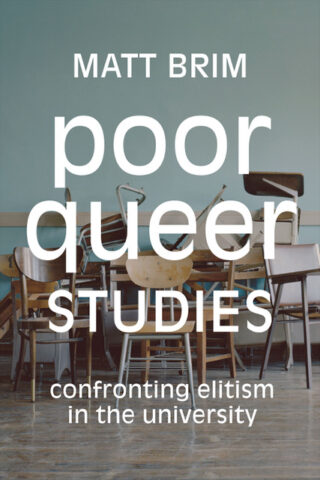
Matt Brim’s Poor Queer Studies: Confronting Elitism in the University is, as its title suggests, an evocative intervention in Queer Studies as well as Critical University Studies. With lively prose, creative methodologies, and sustained focus on a field that the book is, itself, in part inaugurating, Poor Queer Studies is a timely exploration of why and how the local matters for how and what we study and teach. Describing the book’s project as a grounded and located study, Brim brings the concrete, place-based import of academic labors to life, and through this approach, the book is enacting one of its own ambitions: namely, pulling “back the curtain on our jobs as jobs,” especially our jobs as Queer Studies professors (118).
What emerges is an original, often devastating reflection on the exclusions of higher education: its “prestige pipeline” (81) that keeps elitism entrenched, for example, and the “compete-speak” skills that some students learn and others do not (39). At the same time, the book’s incisive modeling of “pulling back the curtain” on jobs as jobs extends to students as well, resulting in some of the most joyful and compassionate accounts of undergrad classrooms I’ve ever read. Professors are workers, and so too are students, at least in the classrooms where many of us teach: let’s make common cause with our students as workers as well as thinkers, Brim suggests (108).
The book’s subtitle hails us, as readers, into the vested stakes of confrontation, reminding us of Queer Studies’s close affiliations with critical theory more broadly. “In a nutshell,” Brim writes, “elitist education is based education” (38). And, as “a general rule, in higher education, riches harm the poor” (7).
What does it mean to work and reach for equity, solidarity, and liberatory social worlds for everyone when our institutions—and, closer to home, our disciplinary affiliations—uphold the harms of “elitism” as an unquestioned heart of academic systems? How do we address the tensions between “a normative alignment between individual and institution,” arising out of upward mobility, and queer calls for equal-access, open-access, public educational systems that don’t “reproduce class and race stratification” (95, 197)?
And, for those of us in Queer Studies, what happens when “that magical ability to forget or ignore or dismiss or doubt the fact that Queer Studies is Rich Queer Studies” is turned into a matter for analysis and critique (84), as it is in Poor Queer Studies, rather than remaining an unmarked quality of all or most influential developments in the field? (As I explore below, the status of what counts and gets to count as unmarked is, itself, a beautifully vexed and situated question in this symposium, especially in the exchange between Siobhan Kelly and Matt Brim. I offer thoughts on this exchange at the end of this introduction).
Just as these queries echo critical theory’s commitments to existential self-scrutiny, Brim’s exploration of academic inequities is compelling, often full of gorgeously tangible details, and, to this reader, thoroughly persuasive. I came away from Poor Queer Studies newly transfixed by entanglements of “knowledge”-production with material conditions—a sensibility that’s not at all neutral, as the book itself makes clear, given the dynamics of our practices (how we read, teach, assess, write, interpret, promote, engage) and our relationships (with colleagues, students, canonical texts and curricular innovations, and our own selves). We are, after all, as Brim points out, “of our institutions even as we are often deeply at odds with them” (75). And “we both are and are not our institutions” (184).
Such insights, of necessity, grip each of us differently—as participants in this symposium bears witness to. Some of these differences might bring us closer together, as readers and conversation partners with Brim. I love, for example, this pointed passage in the book:
I blame, in part, our aspirational mood. Just as we learn to say the words and thoughts that class- and status-based Rich Queer Studies has made for us, so too we aspire in our own work . . . Aspiring (and frequently perspiring) thus becomes the thinkable mode and the method of professionalizing in Queer Studies within the university context. (85)
Many of us will find ourselves implicated by the compromising tensions that arise from this diagnosis. After all, as A Longoria and Gregory Mitchell each point out in this symposium, education holds significant practical import for students, opening up pathways with importantly material consequences. Queer Studies itself can be occasions for “writing ourselves out of” and therefore also “away from” our hometowns, as Mitchell writes. (I identify with this deeply, as queerness and graduate studies served as entangled resources for leaving my natal community: thank goodness for both).
What’s complicated here, and each respondent addresses this complication directly, is how conditions by which education can be a route “out” or “away” keep becoming more inequitable rather than less. If it’s no longer possible to graduate with zero student loan debt, as it was in the past, as Mitchell makes clear, then Poor Queer Studies‘s call to redress public education’s inaccessibility is as urgent as it is generationally and historically specific. And if the concentration of “status” at rich schools intensifies abuses of power at elite institutions, as Kelly notes, then Poor Queer Studies‘s epilogue, titled “Queer Ferrying,” underscores a key contribution of the book: namely, to help us each, in our own ways, to cultivate attentiveness to how resources travel and to forge practices for sharing and for redistributing.
“We teach in tiers,” Brim reminds us (90), and Eve Haque shows how deeply and widely our institutional dynamics manifest systemic differences. For those of us at non-elite teaching schools, for example, the temporal rhythms of students (taking public transportation, eating from a vending machine, arriving after a work shift) are essential parts of our classrooms.
It’s striking—and a sign of the book’s effects on readers—the degree to which this symposium includes first-person stories about institutional life. Injuries, both personal and professional, that often accompany important, necessary programmatic work—like, in the case of Haque’s response, making recognizable a Black Studies stream in a graduate program—are so essential to read, share, and respond to; it makes sense, given the ethos of Poor Queer Studies, that this symposium includes such generous storytelling by participants.
As another example, in Evren Savcı’s response, the ramifications of the overwhelming hegemony of Anglo-English speech and culture in higher education include a whole additional array of symptoms and challenges for those with trans-national, trans-linguistic histories. Confrontations might involve finding strategies for affirming much more pluralistic ways of expressing ourselves and hearing others—in the face of presumptions around so-called fluency and “accented” modes of expression.
Returning to the passage that I love, cited above, Poor Queer Studies offers a skeptical lens on what Brim calls the “aspirational mood of higher education,” a mood that “inspires reverence and mimicry” (92). This opens up a wonderful question: in addition to confrontation, how can we tap into alternate, more queer moods and inspirations?
One response, provided by the book, looks directly to pedagogies and the labor of teaching. Resonating with conversations at play in recent symposia like Nathan Snaza’s Animate Literacies1 and Ela Przybyło’s Asexual Erotics,2 Poor Queer Studies and its interlocutors in this symposium testify to the contributions that classrooms make to Queer Studies. The question is not, Brim makes clear, how to teach queer theory. “Rather, Poor Queer Studies asks, How do we teach queer theory to our students, who work for money full-time and take night class?”—a class-conscious question (41). Poor Queer Studies includes many examples of “anti-neoliberal pedagogies” (38), and the responses in particular by Longoria and Mitchell echo and expand upon their importance.
Another response for the question of how to summon and share alternate, more queer moods and inspirations is at play in Siobhan Kelly’s close reading of a passage in Poor Queer Studies. The passage in the book is a poignant retelling of a pedagogical exchange: Brim retells a joke by Judith Butler in order to upend the exclusions that the joke risks underscoring, a way to call out Rich Queer Studies from within the location of a Poor Queer Studies classroom.
In the initial version, Butler writes, “I was off to Yale to become a lesbian, which of course didn’t mean I wasn’t one before,” and Brim’s retelling hinges on the status of Yale itself. “But no one in my classes, Poor Queer Studies professor included, has ever been to Yale,” Brim points out (67), and Poor Queer Studies as a whole excels at replacing “Yale” (a proxy for Rich Queer Studies) with the “valuable queer data” and “queer-class inquiry” (57) of Poor Queer Studies places and practices. The mood turns comedic, and at times celebratory, as Butler (also a proxy for Rich Queer Studies) becomes an outsider in the new joke. What perhaps gets to count as “unmarked” here is the joyful work of a pedagogue, recasting a joke’s terms so that the classroom becomes a space for laughter and resistance.
In turn, Kelly retells the joke once more, turning it into a comedy about institutional prejudices (Yale’s, in particular) and about the risky evasion of historical and contextual details. What I find fascinating, as a reader of the exchange between Kelly and Brim, is a shifting sense of the “unmarked.” In Kelly’s reflection, for example, the teacher is marked out as a person (a persona, even) who affords students a chance to deconstruct or disarticulate “identity.” It could be then that the theatricality of pedagogy (something so shared with comedy) is offered up as an “unmarked” heart of Queer Studies, especially when it comes to classrooms.
In contrast, what I read in Brim’s response and in Poor Queer Studies more broadly is a different heart of Queer Studies—more akin to cartography, a mapping of institutional coordinates, as Brim puts it, that is savvy and deliberate in how it dislodges the “rich, right, stable” (67) places like Yale from their unquestioned elite status. Savcı’s response for this symposium includes this lovely line: “I know for a fact that something magical happens in a classroom if you are willing to show up for it.” I find myself musing about how the dissonance between Kelly and Brim’s jokes might also be at the heart of Queer Studies, and how this reminds me of the magic of classrooms (when diverging perspectives or feelings are coinciding in a shared space) and even of the magic of comedy itself. As Amy Marvin notes in a recent essay on trans philosophy and comedy, laughter can serve as a force of violence—an insight that seems importantly part of both Brim and Kelly’s comedic takes, given how they each include examples of the unfunny and its import.3 On Marvin’s account, though, humor also holds resistant, transformative, existentially affirming powers.
And so, when Brim writes (to cite another of my favorite passages), “It is not always clear—at least to me—whether Queer Studies plays the protagonist or the antagonist in such a normalizing institutional narrative” (10), I hear such an evocative note of comedy. It could be that demarcating a subfield as “Poor Queer Studies” is in part a way to call forth comedic dissonance—to forge a gap between protagonist and antagonist. I hear this, for example, in many descriptions that the book provides—like portraying Queer Studies as “a discipline with a vanguard complex” (32). I laughed aloud when I first read this line (in part, to be honest, because it makes me sigh about my other disciplinary affiliation, philosophy, and its hapless non-attachments to fashion of any kind).
What does it mean to turn to Queer Studies as an antagonist (as a source of ongoing elitist inequities), given that, for many of us, this field has formed us as thinkers, writers, and teachers?
And when we turn to our classrooms as sites for protagonist action, inspired by books like Poor Queer Studies, how are we remapping (in Brim’s terms) or performing (in Kelly’s terms) the very ingredients by which protagonism takes place?
Rather than seeking shared answers across the exchanges, my sense of this symposium is that it provides a plurality of localities, grounded places, and perspectives—and even a plurality of how to draw lines between the fashionable and unfashionable, the unmarked and marked, the funny and unfunny, the classroom and its beyond.
https://syndicate.network/symposia/literature/animate-literacies/↩
https://syndicate.network/symposia/philosophy/asexual-erotics/↩
Amy Marvin, “Laughing at Trans Women: A Theory of Transmisogyny,” in Trans Philosophy, ed. Perry Zurn, Andrea J. Pitts, Talia Mae Bettcher, and PJ DiPietro (University of Minnesota Press, 2024), 71.↩
2.25.26 |
Response
Cross-Border Travels of Poor Queer Studies
Confronting Elitism in the Public University System
In the fall of 2019, I went to New York for a glorious academic term on an Advanced Research Collaborative (ARC) fellowship at the CUNY Graduate Centre in New York City. Coming as a mid-career tenured faculty member from a large commuter campus university north of Toronto, Canada, this was a career highlight and it was also where I met other ARC fellowship recipients which included local CUNY faculty as well as a handful of international faculty. This is how I met Matt Brim, who at the time was also an ARC fellowship recipient and finishing up the manuscript for this excellent monograph, Poor Queer Studies: Confronting Elitism in the University. Not only did the ARC fellowship give us all offices proximate to each other in the Graduate centre, but it also held weekly seminars, receptions and other events which guaranteed that we would have a chance to get to know each other, where we were from institutionally, and also give us a chance to share our work. Coming from what is a public university serving a majority racialized and poor student population in the deep industrial suburbs of Toronto, I felt both my regional and non-elite status acutely in this beautiful landmark B. Altman & Co. renaissance revival building located kitty corner to the Empire State building in the heart of Manhattan.
Matt ends his book by talking about his institutional (non)-affiliation and work at the CUNY Graduate Center to propose queer ferrying as a cross class pedagogical method for producing relationships that resist class and race stratification in higher education (200). Specifically, he identifies this as a way to orient our queer-class-race work expansively beyond the neoliberal academy and field relations between center and margins; thus, also as a way to push institutional class difference as a potentially queer connective tissue, rather than a divisive fault line (202). My time at the CUNY Graduate Center was precisely this, a chance for my own queer ferrying in order to experience academic life as queer connective tissue beyond borders and the class stratification that relegates York University to the lower tiers of an ostensibly fully public, but in funding reality, only a partially public higher education system in Canada.
This book has been reviewed widely and well so four years after it came out, my engagement here is not so much a book review but rather is more a testament to the significance and applicability of Matt’s arguments about elitism in the university, even across borders and in a completely different higher education system in Canada. Matt begins by locating Queer Studies within a broader context of higher education, underlining the crucial point that the field cannot be separated from the large-scale institutional production of racialized class stratification (3). Matt chooses “poor,” as opposed to the more relational “class,” to signal that institutional disparities are a critical determiner in the conditions of knowledge production and pedagogy of the discipline of queer studies; hence positing a poor queer studies in relation to a rich queer studies to reveal the (non)elite operations between universities, disciplines, students, workers and even infrastructure. Matt uses methods of narrative case study and queer archival practice in order to illustrate how poor is both a material space and a discursive construct in higher education (25). The emphasis on materiality is critical here as all queer studies working conditions are not equal so queer ideas and pedagogies are connected to the disparate conditions of their production and therefore cannot be easily universalized; thus, Matt tells the material histories of queer studies in order to address the problem of class stratification in higher education (17).
Class stratification of the ostensibly public universities exists even in the Canadian higher education system, as years of austerity measures and neoliberalization of education has meant that in many provinces, including here in Ontario, barely a third of revenue for university operations are now coming from the provincial government. These measures have driven the top down imposition of “differentiation” (Hicks & Jonker, 2016) in the last decade between research and teaching universities in order to streamline funding and research support and in so differentiating, imposing a de facto hierarchy amongst the universities. In this provincial hierarchy of differentiation, there are 4 tiers and York University is in the 3rd tier from the top with our largely downtown neighbor the University of Toronto being in the top tier all on its own. There is also a national hierarchy of universities called the U15 which is a “group of Canadian research universities” which lobby for their own interests as a coalition of research focused universities (comparable to R1 universities in the US); needless to say, York University is not one of them.
In fact, York University has many alignments and similarities to the College of Staten Island (CSI) that Matt describes, even as York is the third largest university in Canada, established in 1959 with an evening college for part time students, and now a full time university enrolling approximately 55 thousand students. Located in one of Toronto’s “priority neighborhoods,” an underserved neighborhood with low socioeconomic and health indicators, York has one of the most racially diverse student bodies in the country and comparably to our higher ranked university neighbors, serve a greater proportion of students who are from poorer and newcomer communities and groups who have been traditionally underrepresented at university including students who arrive with lower marks, experience lower persistence and completion rates, and have higher loan default rates (Hicks & Jonker, 2016). As Matt explains, even as access to higher education has become more egalitarian, where a student attends college and what they study have become increasingly tied to the social background and gender of the students. Thus, most of our undergraduate students arrive, as they do at CSI, as commuters and already as un/paid workers who want degrees that will improve their access to better jobs and thereby, better the life chances for them and their kin.
The class stratification that overlaps with race sorting that Matt points to in his introduction, is in full effect here, where tiered higher education doesn’t just reflect class disparities, but it reproduces them (4). Most of our undergraduate students, with a majority of them already working (part-time, full-time and unpaid), want employment mobility and York university in its rush to maintain enrollment interest of our potential student applicants, has entered the competition being fought especially amongst the lower tier universities to foreground what seem to be direct job readiness programs over its historical strength and focus on the arts, humanities and social sciences. So traditional discipline based programs are being pushed to find ways to create more applied programs, programs that lead to various certifications, micro-credentials, neoliberalized experiential education programs and various pre-professional programs; these and other related strategies for increasing (or even maintaining) enrollment are strategies of the managed university that target a certain demographic of poor already working students who are at the university both to learn and to earn (105). The historical alignment of higher education with class relations and racial capitalism rather than democracy is still very visible in these contemporary neoliberal strategies of the university (71).
The main York campus is a large isolated primarily commuter campus served mainly by buses from all parts of the Greater Toronto Area and beyond. Only recently has the subway been extended to the campus but it best serves those who live downtown and the majority of our students do not. Commuting as a function of the poor queer life is reflected in the lives of our students and as Matt has observed, living at parent’s homes while commuting is an overwhelmingly low-income and working class experience (148), but this tendency is amplified for the racialized York student population by cultural norms and expectations of their various communities. What Matt notes for his CSI students is also so true for our York students, that they “must navigate a defunded public transportation system in order to navigate a defunded public higher education system” (153). Soon after I began teaching at York, I realized that students arriving late to class was often not a result of their inability to plan their commute, but rather the outcome of long and arduous commutes often across incompatible payment and scheduling public transportation systems. Therefore, I developed an option that I would not mark anyone late if they wrote in to complain about the poor service they have experienced with the transportation system and copied me on it.
The deep diversity of our students is not reflected proportionally in the tenured faculty who teach at York. Nevertheless, queer and racialized faculty have been here and are still here even as “we both are and are not of our institutions” (10). Matt cites Sara Ahmed’s important work on institutional incorporation of those of us historically excluded from institutions of higher education and the struggle when we do not inhabit the norms of the institution (57). As Matt notes, queer faculty have extra service (44) like women of color faculty especially when these embodiments overlap and our students are poor and racialized. Not only do we do the invisible service labor that keeps our institutions liveable for us and our students but we are often given the task of transforming institutional norms and producing knowledge of the marginalized which in and of itself is its own pedagogy (57).
Important here is Matt’s reminder that we must be attentive to the conditions of knowledge production, as in the case of rich and poor queer studies, if we are to not reproduce the classed raced stratifications that are already part of the history and present of higher education. Matt cites Kristin A. Renn’s observation that although institutions have come to tolerate the generation of queer theory from within, they have resisted the queering of higher education itself (10). As Matt notes, it is not enough to just insert gay and lesbian lives into an existing set of rights and protections, rather the difficult work of transformation needs to happen (123) or we will fall into the EDI (Equity, Diversity and Inclusion and all its variations) trap of token inclusion and become the alibis for hollow institutional representational theatre. In response to decades of community organizing for inclusion, the response to identity based demands for recognition has been mainly answered through incorporation into the university structure as EDI statements, reports, plans all expanded into another layer of administrative management. Matt cites Rod Ferguson’s observation that minority difference and culture are characterized by their maneuverability by dominant systems of power; for example, EDI incorporations become the diversity bait and switch, an individualized and spectacularized placeholder for an institutional commitment that goes nowhere (114). EDI statements, which are rife at almost all Canadian universities now, are examples of the muddy language practices that supplant any analysis of structural exclusions (173) and sideline their constitutive political operations (126). In this way, whiteness remains intact in the organization of queer class and race relations (182) when the question to be asked instead is how can queer, and other overlapping identity studies, throw a wrench into a university system that is only in the service of capital (109).
Throwing a wrench into a system of higher education that is structured increasingly only the service of capital is not without its costs especially for queer and racialized faculty. Even if we can acknowledge the resourcefulness of minority studies and minoritized faculty to, as Sara Ahmed says, “gum up the works” (114), doing so requires the fortitude to withstand what Robyn Weigman—as cited by Matt—calls the double bind of withstanding the insecurity of a present that offers no epistemological grounding from which to adjudicate its characteristic contradictions (97). Despite this contradictory grounding, we still persist in this double bind to expend our time, energy and open ourselves to administrative, collegial and personal reprisals because we wish to animate minority disciplines’ countercurrents, hopeful for a space of knowledge production and pedagogy that can evade institutional incorporation and reproduction of classed stratifications. When I was the graduate program director of Social and Political Thought at York University, I sought, alongside many faculty members in our program, to broaden and update our existing very white 3 program fields to include a stream on Black Studies and Theories of Race and Racism. The effort of this proposal and ensuing democratic process was for the transformation of existing program norms to finally made visible the already long standing presence of Black Studies in the courses offered, the minority faculty who taught and the students who studied in our program. Given the poor and racialized student demographic of the university, this visibilization of Black and racism studies as a stream was seen as an important change that would make it easier to resource and amplify these already present and growing minority disciplines as well as to make our program more reflective of contemporary disciplinary shifts and student interests. However, once the program had been approved, the harsh backlash directed at both the new stream as well as specifically toward my gendered racialized self as the representative architect and defender of this small attempt to transform institutional norms, exacted an intertwined personal and professional toll that I will never fully recover from. In the poor university, the race for dwindling resources and narrowing spaces for minority knowledge production and pedagogy makes even small programmatic changes competitively fraught and can exact often life changing personal and professional tolls on queer and racialized faculty. If acquiescence for minoritized tokenization into EDI roles can provide institutional class mobility for a few, it comes at the expense of maintaining a class, race hierarchy for the rest of us, ensuring that queer scholars of color even as they remain not of the institution are also probably not writing their way out of anywhere either (98). The urge to make visible our respective minoritized disciplines in the hope of some epistemological grounding from which to adjudicate and withstand the insecurity of a contradictory present is not an endeavor that can be undertaken without consideration of the material histories of our institutions. This insight is Matt’s contribution, illustrated so well through his case study of Poor Queer Studies brought to life through the narratives of the CSI students and faculty. Four years after its publication, the impact of Matt’s book can be measured by how well it continues to travel, even across borders to reveal the poor/elite fractures and the queer raced stratifications of the Canadian system of higher education. May it continue to travel well. Thank you Matt.
References
Brim, Matt. (2020). Poor Queer Studies: Confronting Elitism in the University. Durham & London: Duke University Press.
Hicks, Martin & Jonker, Linda. (2016). The Differentiation of the Ontario University System: Where Are We Now and Where Should We Go? Toronto: Higher Education Quality Council of Ontario.
3.2.26 |
Response
Teacher Education and Poor Queer Studies
I have found generative inspiration from Brim’s concept of Poor Queer Studies and its connections to my work as a teacher educator. This commentary is based in part on my presentation at a Modern Language Association (MLA) panel Brim put together for the 2020 conference. Insofar as Brim asks how we might interrupt Queer studies’ participation in the “prestige pipeline” (81) in higher education, I humbly would like to add additional conditions and contexts I believe must be made in order to interrupt that participation. I am a tenured associate professor on a teacher education faculty in a master’s granting state university in Bellingham, Washington, a college town within approximately 90 miles of two major metropolitan areas. My primary teaching responsibilities include teaching students studying to be secondary (middle and high school) teachers. I teach in applied graduate, undergraduate, and pathways programs, or for those thinking about a teaching career. I pull from an examination of my teaching practice for this commentary. I also look toward the UndocuQueer movement for further complexities to consider for queer-class thinking, especially around documentation.
In contrast with elite universities, many state universities began as normal schools in the late 19th century to educate teachers through a largely White women workforce. Teaching—typically interpreted as the profession that educates public school youth—today is a classed field. Further, to become a teacher a student must gain state certification or licensure in order to teach in public schools. Employment is often found in public schools where compensation and working conditions are typically negotiated through collective bargaining and unionization. In order to access this profession, students must complete accredited programs in post-secondary institutions which are nearly exclusively housed in universities. Thus, teachers are necessarily trained in the Academy. While some limited programs exist, one cannot train, for example, at a community college to get licensure to become a teacher. This places teacher education within a classed, higher education context. Further, teacher education is largely an applied field. Even the graduate degree our department offers is a master’s degree in teaching that focuses on applications of theory rather than knowledge production as in traditional graduate degrees. Admittedly, the highly technical training a teacher undergoes might be most at home within a vocational program—often housed in community or technical colleges.
This vision of the blue-collar teacher is potentially erroneous, particularly in urban or metropolitan areas. Teachers, by their very training, must be highly educated and skilled. The irony of this is that it creates a working-class profession that is vetted through higher education and its processes. This runs counter to a blue-collar image. While it is true that many teacher unions—and therefore by extension teachers themselves—are blue-collar oriented, perhaps this has more to do with union solidarity across career contexts rather than an inherent blue-collar nature to teaching. Admittedly, this blue/white collar divide is most apparent in urban and metropolitan contexts. In rural settings, where the average teacher pay is significantly lower than urban school districts, the blue collar sentiment is likely most strong.
In the training of teachers, Queer studies is almost invisible. At best, in multicultural education training (an erstwhile required course for teacher ed programs to be accredited that is disappearing in some programs) students learn about serving youth with Queer identities as part of the teaching and learning process. At best, students gain real-world experiences in their student teaching and other field experiences where Queer youth are present. My question to attempt to bridge Brim’s work to my professional realities: shouldn’t poor queer studies be effected in teacher education? I agree with Brim in dialogue with Krebs that knowledge production at elite institutions propagates knowledge production that epistemologically values that which comes from these institutions (200–201). What then of so-called lesser tier schools? In these schools, which are largely state and non-elite universities, we find most teacher education institutions. And just like in Queer studies, we find teacher education (and school districts) valuing knowledge production from elite institutions rather than great work being done elsewhere. I would like to push this concept further to trouble the notion of an east coast elitism at play in higher education. Elite universities also dominate decision-making processes in teacher education: especially as related to state policies and innovations. This also reflects more resources poured into metropolitan areas rather than rural areas.
Poor Queer Studies, exampled by Brim, is informed by Queer faculty pedagogies. Brim writes “Even Poor Queer Studies offers such an incentive, if for no other reason than this: a Queer Studies professor inevitably models a direction . . .” (22). I take as inspiration from Brim in writing from my own teaching practice. In unpacking my own teaching practice, I find that as a Chinese-Mexican (or as Robert Chao Romero calls our identity “Chino-Chicano), I was not prepared in the simple act of being out and embracing my transition as non-binary faculty, for the amount of students that would look to me as a Queer resource in the professoriate. I am enacting a certain pedagogy of possibility by modeling a Queer life in teacher education. In many ways, this work is complexified by Brim’s notion of the “queer career counselor” (113). That insisting on my pronouns, that changing my email name and university data systems name to reflect who I really am enacts a pedagogy of possibility is in itself a kind of embodied scholarship. Even within the Academy, I find an environment of possibility that is sometimes more progressive and accepting than the community that it serves. Inside the university, my identities may be affirmed. Yet, in healthcare settings, in the grocery store, or in government agencies, my identities are not seen or honored. The university then becomes a haven, a place where I can live a Queer life that the world outside the academy does not often provide. In my teacher education work, I am often in the field, in a middle school, and students know me by my name and pronouns. The Queer possibilities of my pedagogical world emanate beyond the Ivory Tower to a Poor Queer Studies that takes place in my applied courses in the poorest middle school in our community. That I, as an intersectional Queer of color, enact some pedagogy simply by my corporeal existence and insistence to do Queer work in my academic life is some embodied facet of Poor Queer Studies.
I would add, but likely I suspect that I am making explicit what Brim implies, that this modeling of Queer possibilities, of a type of social mobility, is in need of theorizing, but perhaps this work effects more than that. Perhaps it is passively pedagogical? There is a modeling in our insistence to attend to Queer studies and Queer academic lives. I do not mean to imply that our pedagogies must solely be validated through theory-making or knowledge production as is the norm for imperatives in the Academy. But perhaps memorialization, perhaps something beyond simple visibility, diversity, and inclusion politics that the Academy so loves to celebrate is a more sustainable way to engage with Poor Queer Studies.
My work as an interdisciplinary scholar, perhaps unusual for teacher education, I argue, should not be unusual for a teacher educator like me to hold scholarly and disciplinary interests outside of my home department (Secondary Education) or the training of teachers. Transdisciplinary work is needed to help lay ideological foundations for transforming teacher education and the material and ideological conditions for Queer studies. Perhaps the silos of the academy discourages this kind of work for it confuses tenure committees and budget lines. In spite of teacher education’s historical roots in the creation story for many state and public universities as normal schools, the work of colleges of education are often seen as lower priority than other academic programs in the Academy. This reality exists in spite of the more stable job prospects for graduates. This speaks to the poor status of teacher education.
I would like to turn toward intersectionality through an example of the UndocQueer movement and identities. UndocuQueer people hold multiple marginalizations as undocumented, Queer, and, often, non-White identities. Queer identity in UndocuQueer context is far more complex than the queered identities of rich Queer studies. Intersectionality serves us, perhaps out of convenience, though it too might simply be an heuristic device for us to unpack the complexities of Queer identities. A gaze from a Poor Queer Studies lens might help us effect this more aptly. For UndocuQueer people, there are multiple closets, barriers, and, in truth, dangers over the more monolithic Queer identities rich queer studies may be propagating. Consider for a moment how documentation affects class. In the United States, one must have documentation in order to work: legally. Without documentation, how do you make a wage? How do you fully pay income taxes? Thus, there is a very real privilege to documentation, citizenship, or permanent residence. In many states, particularly in the Pacific Northwest, undocumented youth that have graduated from a state, public high school are allowed to apply for and attend state universities and pay in-state tuition. There are even financial aid opportunities, albeit only in-state tuition supports as undocumented students cannot access most federal supports provided through the Free Application for Federal Student Aid (FAFSA).
Documentation is of particular importance for teacher education because one must be documented (show proof of work authorization) in order to hold a teaching position in a public school. Note there is not a barrier for undocumented students to enter into or for completing a teacher education program, though the later quickly becomes an implied barrier if school districts are not willing to accept multiple forms of documentation for school, field-based training: experiences necessary for gaining state required hours in clinical classroom settings.
The subsequent absence of UndocuQueer people—the absence of their visibilities and physical presences—suggests a barrier informed by nationalism, class warfare, and hegemonies—that prevent an important Queering of teacher education. Without UndocuQueer people in our classrooms (as teachers and as teacher candidates, those training to be teachers) we have a serious class-ed divide that excludes intersectional experiences of Queerness in our classrooms. The cascading effects create dissonance in the Academy that I hope is rectified. Yet, we might stop and ponder for a moment the very real barrier that documentation via a plastic card and, perhaps government documents poses an interruption to queering teacher education, and by extension queer studies. UndocuQueer identities uncover an important barrier we must attend to in Poor Queer Studies.
The UndocuQueer movement has its roots in youth activism, particularly through the organization of undocumented people through the national organization United We Dream. It is by and large a political movement that is primarily driven through social media, and led by Latinx UndocuQueer people. This political activist movement is multilingual and prolific. The movement has sought to bring voice to UndocuQueer identity. The movement highlights problems of visibility and marginalization within the larger immigrant and Queer communities. We might view the UndocuQueer movement as pedagogical to carve out space in Poor Queer Studies toward something beyond awareness. In my own experiences at a regional state university that exists in the shadows of elite state and private universities along the West coast, I have taught many UndocuQueer students. We might question if assumptions exist in rich Queer studies that Queer people do not experience borders or issues of restrictive transnationality. To be fair, elite universities may consider UndocuQueer identities in its scholarship, but what about the material conditions and access in applied studies? UndocuQueer identities offer a further push on intersectionality that builds on Brim’s deep questioning of its role in Poor Queer Studies and his own lived experience (60). Yet, intersectionality does not change the material conditions and real barriers to education that Poor UndocuQueer Studies may yet examine.
Greater coordination among these various strands running through Queer studies is important. We must continue to cross this divide between elite approaches to Queer studies and applied approaches that practitioners necessarily take up in their professional lives: especially those approaches generated in non-elite academic settings. Our futurities and imaginary are served by a larger tent, I argue. This tension between rich queer studies and Poor Queer Studies might demand better coordination between the two. What might it look like for us to collectively admit this tension? To acknowledge its presence and actively work to ameliorate the divide?
Also, greater coordination between theory-making in the Academy and its respective university administrations are important for changing the material conditions of Poor Queer Studies. This cannot simply be through addressing Queer inclusion as a siloed intervention, for example. Providing students the ability to change their pronouns and names in university data systems without supporting cultural shifts and practices—professional development if you will—for faculty and staff, is not sufficient. Students are intersectional beings. Interventions for undocumented students also serve Queer students that are undocuQueer. Further—perhaps these heuristic devices we have employed to isolate identities in order to unpack them have worsened the barriers to higher education and material realities of all Queer students
Greater coordination between theory-making in Queer studies and more practical, dare I say real-world training like the field of teacher education are important, especially for creating safe (physically and legally) conditions for intersectional Queer identities. Let us remember that higher education can be both a tool for social mobility and vocational training for students in our classrooms. This is not meant to serve arguments that higher education should have some pragmatic value as its sole criterion for evaluation. Rather, there should be something we place into Queer studies, some mechanism, that helps fulfill the promise of changing material conditions for our students in Queer studies and its affinitive spaces. Poor Queer Studies might offer us a tool toward this aim.
References
Romero, R. C. (2010). The Chinese in Mexico: 1882–1940. Tucson, AZ: The University of Arizona Press.
3.4.26 |
Response
All the Students of the World
At the end of a day-long conference on Audre Lorde’s “Uses of Anger” organized by the University of Connecticut’s WGSS Department, which involved among other things discussions regarding the institutionalization of feminist studies, a graduate student asked the members of the final panel how we may dismantle the academy. The question was framed by the acknowledgment that as a current PhD candidate this student was possibly asking for something that would foreclose their own future. The answer I gave to this question there and then sounded something like this: I feel that we need to clarify what it is that we are referring to as “the academy” when we demand its abolishment because I am afraid that we are implicitly speaking of the US academy of the now. I wondered, what part of the academy do we exactly want do away with? I would really miss a learning public, the act of reading and thinking together. Would we be getting rid of writing when many people in the world have spent their lives (and some continue to do so) writing from prison cells? In addition, universities have been homes to radical student movements and organizing throughout the world. In that sense the university has worked like a factory—a place where students physically gather, which makes for unintended consequences that are in many ways contradictory to universities’ stated reasons to exist. The Gaza solidarity encampments had not yet been pitched at the time, but student organizing across various campuses asking for ceasefire was already in place. At the time of the completion of this piece, we have witnessed the powerful, determined, imaginative, and driven organizing and protests regarding Israel’s war on Gaza and continued occupation of Palestine in their full force, where students have put their well-being and future prospects on the line demanding that their universities divest from weapons manufacturing, facing doxing, arrests and disciplinary actions across the US and all over the world. Does the education these students have received at the university really have nothing to do with their political will and organizing?
My other response, the one I did not have the chance to formulate there and then, would have rejected the assumption that all of academia is a rich, elite endeavor. Often, when faculty and students voice their desire for the dismantling of “the academy” it is because they think of it as an unabashedly elite institution that will always and only work toward the reproduction of social, political and economic inequality. In Poor Queer Studies, Matt Brim beautifully illustrates how even at poor schools, where students get their dinner from vending machines right before their evening class, a field seemingly as “elite” as queer theory has reason to exist, and work to do. In my rejection, I join Brim who is critical of “blanket theories that flatten our many class-diverse workplaces into the neoliberal academy” (91). This account of academy’s (blanket) “elitism” is reminiscent of the key argument in Bourdieu’s Distinction, but it must be noted that Bourdieu did not only argue that the education system reproduces class inequalities, but also showed how it does so. And perhaps more importantly, his argument targeted not only higher education, and neither only private education, but all education—because formal education withholds the secret key to the kingdom, the habitus, while perpetuating the illusion that a national education system will have a leveling effect of social inequalities. As a result, from a Bourdieusian perspective, what needs dismantling is not necessarily education itself, but the illusion that it will have a class-inequality-leveling effect. I find it also worth noting that sometimes academic critiques of the “eliteness” of education arise from the fact that those critics themselves are occupying elite institutions and thus might be under the impression that all education is elite. After all, PhD students in this country have to be trained in institutions categorized as “Research-1” since poor queer studies universities are not PhD-granting, and may discover the class-diversity of higher education with their first job, if they ever do.
These two responses I outlined above to the question of dismantling “the academy”—one regarding its alleged depoliticized nature and the other its elitism—are not separate, and in the remainder of this piece I will illustrate their connections through my experience with various university settings both in Turkey and the United States in order to rethink Matt Brim’s inspiring work transnationally.
My perspective on higher education has been shaped, first and foremost, by being the daughter of a revolutionary student leader in Turkey. My father was enrolled at the İstanbul Technical University for about a decade during the long 60s, where he spent majority of his time organizing as the chairman of TMTF (Türkiye Milli Talebe Federasyonu—Turkey National Student Federation) rather than going to class. This was made possible by the fact that universities were truly free at the time and students did not need to go into debt in order to attain higher education. A free education resulting in the possibility of prolonging one’s enrollment also meant that the turnover in organizing was lower and the chances to build and transmit knowledge and experience among students higher. Socialist and communist students at the time understood the future as something to be built collectively, and as something that was going to be worth looking forward to only if their fight against imperialism and fascism could be won. Clearly students of Turkey were not alone at that moment, or historically, in their counterhegemonic organizing—the Mexican Student Movement, other 68 student movements in Europe, the student organizing against the war in Vietnam, and the anti-Apartheid student movement in South Africa are just a few examples of revolutionary organizing of university students and of universities’ inability to exert total control. The TMFT and its members were connected to leftist university students from all over the world and their demands and protests were taken seriously by scholars, journalists and politicians alike.
I myself started college in Turkey at a public university, Galatasaray, where the language of instruction was French and where my tuition and fees totaled $200 a year. During my college years, students on various campuses were protesting and organizing for the right to wear the headscarf at public universities. Yet all that political action and more was happening under the shadow of the Council for Higher Education (YÖK, in Turkish), which was formed in response to the student organizing and revolts and political clashes that my parents and their generation had been involved in: As a regulatory office that oversees all activities at universities, public and private, the Council both marks universities as locations of counterhegemonic and revolutionary thought and action, and works to ensure their repression, if not their erasure, at all times.
I am providing all this background in order to give context to my astonishment at arguments that equate higher education with depoliticized elitism, and universities with simply and only serving the status quo. If this first response I owe having grown up in a country where universities are treated as potential locations for revolutionary political organizing in need to be surveilled, my second response I owe to having been a member of both poor and rich queer studies institutions in the US as an international student and scholar in addition to all the important insights and much-needed theorizing of Poor Queer Studies.
Class is complicated by immigration, as many scholars have documented and as many who have lived diasporic lives can attest to. This is because of the many manifestations American imperialism takes and their various implications. Here I will briefly touch upon two imperial currencies: the US dollar, and the global English. In addition to a life lived in an accent and at times without sophisticated vocabulary, which for a long time (if not forever) marks you as a foreigner, none of your ways of navigating everyday life, your pop culture references, your ability to joke or understand jokes, your social networks or your ability to recognize what having attended a particular high school means translates to a new context. Unlike the crude form of financial capital, social and cultural capital do not so easily travel to new places. In the US, this is compounded by various intersections of capital and cultural capital: for instance, this untranslatability can look like not having a credit score and not having a clue about what that means and why it matters, or accepting a “free” gift that shows up in your mailbox without reading the “terms and conditions” in the miniscule font, which will result in being haunted by collection agencies. This is part of one’s education in the meanings of free/dom™ in America, but all these are also testimony that one’s middle class upbringing elsewhere may not prepare them for navigating the US as a middle-class person, including the education system.
I am certainly not arguing that a rich person becomes poor in America, and I am personally troubled by the deployment of an abstract category “immigrant” in ways that erase the extremely divergent class backgrounds and standings of people who would technically fall into that classification. And even though the story for a middle-class person is very much dependent on their country’s currency vis-à-vis the petrodollar, what happens is not simply becoming poor. Yet something gets lost in the poor-rich dichotomy for transnational subjects, and that something has to do with the privilege most Americans of no matter what class background enjoy of not having to or needing to know that the values of the US dollar and petroleum were tied in 1973. How could we rethink/transnationalize poor queer studies so that class is understood and factored in with all its transnational dimensions? This would start with an acknowledgment that in the US one dollar is one dollar, yet in much of the world the daily value of the US dollar is a popular topic of conversation and the lives and well-being of so many hang on its fluctuations.
Let me get back to the question of universities. My time in various educational institutions in the US, first as a student and then as a teacher and scholar have involved both poor, middle-class and rich universities. I have spent my undergraduate years at UVA, a large public university, and my graduate education at UVA and USC, the latter a mid-size private university, as an international student. My two significant teaching experiences have taken place at the WGS/S departments of one poor queer studies university, SFSU, and one rich queer studies university, Yale, which features in Brim’s book as the rich queer studies school par excellence. I am fully aware that it gets poorer than SFSU—that campus is after all one of the two flagships of the Cal State university system, where we had the privilege to teach a 3-3 load (as opposed to the 4-4 load of most other Cal States), a union-backed decent salary (though the salary did not rise as fast as the cost of living in SF), really good health benefits and an unreal pension. At the same time, like most faculty at working-class institutions I have many stories of me and my colleagues trying to see if we could allocate $25, or if we felt very resourceful $50 per faculty to buy a couple of books for research. It goes without saying that I did all my research out of pocket and during the summers, because sabbaticals are a rare occurrence at poor queer studies schools and those sabbaticals that were actually competitive Presidential Awards had become rarer at SF State, as I was told by my colleagues. I had students living in their cars, students getting evicted, students commuting from Sacramento. When we raised funds as the WGS department it was not for fancy student summer research fellowships or for paper awards as in my current institution, but in order to have an emergency fund for students who may not be able to afford the co-pay of an unexpected medical or dental bill to prevent it from avalanching into an unmanageable debt thanks to the predatory credit system.
But in all this materialist critique, there also needs to be room for the Fulbright student from South Africa who wanted to quit the MA program they had worked so hard to attend because none of their English-education had prepared them for what they would encounter at this technically “poor queer studies school.” I knew exactly that feeling that they referred to, that feeling that you have gotten stupider, because the more sophisticated ways in which you may be used to expressing yourself when talking about readings or a novel of a film in your “mother tongue” are not available to you with the limited vocabulary you have, so you feel like you are an eight-year-old trying to discuss queer theory, but more often than that you just feel plain stupid. This is certainly not the same thing as being poor, it is not even exactly moving down in one’s class-standing. But it is certainly not being rich, and it is not being middle-class in the ways one would be as a US subject. How do we rethink the material conditions under which queer studies is done if those conditions are inevitably transnational and take into consideration the hegemony of global English? And how does the transnational material realities of knowledge production affect poor queer studies beyond the international student and the international scholar, whom perhaps because of the built-in expectation that they will return “home” we do not refer to as immigrant student and immigrant scholar?
I am reminded of an American Sociological Association Sexualities section mini-conference panel, where a few of my colleagues were lamenting the fact that they felt marginalized by mainstream Sociology. I had to tell them that my colleagues in Turkey, and most likely many other places in the world, read and teach their work—scholars and students unbeknownst to them engage with their thinking and writing, because who will be taught in Sociology of Sexualities courses and in queer studies courses if not US scholars? This information does not undo the critique of rich versus poor queer studies Matt Brim so powerfully puts forth, but works as a reminder that there are many people across the world who would die to be a “poor queer studies professor” in the US—a fairly hard feat even with a PhD if that degree is not granted by a US institution, no matter how prestigious it might be in the country it was conferred.
Let me be clear: I am in full agreement with, and thankful to Brim’s distinction between “redistribution of queer knowledge and redistribution of material resources” (62). Often, US critique of “elitism” can take the form a tired critique of Butler’s “inaccessibility”—let’s make this phrase not so subjectless, I am personally tired of it—as if access is a natural thing we are born with, as if human infants are naturals at the acquisition of some forms of textual knowledge over others, as if “the people” fall from the sky, fully formed, just like that, capable to read who knows whom but certainly not Judith Butler. As feminist and queer studies scholars and students we should be asking questions about the production of a naturalized “people” with inherent levels of literacy and “access” and to what end such naturalizations serve rather than working to perpetuate such essentialisms. Of course histories of colonialism and imperialism need to be taken into account when we seek to analyze what is recognized as language today, what is registered as literacy today, what we understand as education today, and the place global English occupies in all of this. There is a way to be critical of the material conditions of knowledge production and of who gets read transnationally by whom without essentializing humans’ access to language and knowledge, and their capacity to understand and analyze.
I would like to end on a note on students, with the hope to complement the vision of Poor Queer Studies that emphasizes queer ferrying as resource-sharing between rich and poor queer studies faculty. Having taught students at SFSU and at Yale for over ten years now, I know for a fact that something magical happens in a classroom if you are willing to show up for it. While I have not held formal teaching positions in Turkey, I have the fortune to connect with students regularly thanks to events, book talks, discussions, and class visits. Despite the shelling of public everything by the government including university education, despite the rising unemployment and lack of future prospects, despite the inflation and unaffordability of everything from food to housing to books, and despite the growing authoritarianism, students hunger for knowledge, including queer studies knowledge. They pack libraries, public talks at museums, bookstores, and various institutions when they are offered, form reading groups, and insist on learning together. Reading, learning and thinking together are neither elite or depoliticized practices, nor are they disconnected from yearning for a different world and the willingness to work for it. These three bodies of students, those in Turkey (with all their varied class positions), those at SFSU and those at Yale exist in a world that is set up to ensure their separation and isolation from each other. Yet I am of the faith that feminist and queer studies students are working to transform that world that separates them every day. What we have witnessed in the rise of the cross-campus formation under Students for Justice in Palestine is a materialist movement—in its analysis and ideology with demands for divestment. I am hopeful that a growing anti-militarist student movement will also find ways to practice that solidarity in materialist ways that involves redistribution of resources—a queer ferrying among rich and poor queer studies students not only in the US, but all over the world.
3.9.26 |
Response
Brim, Butler, and Bad Jokes
In the second chapter of Matt Brim’s Poor Queer Studies: Confronting Elitism in the University, he attends to the legitimating myths of what he calls “Rich Queer Studies.” Brim provides a searing critique of not only the elitism entrenched in Queer Studies, but of the particular way major figures (who he calls “status agents”) in the field distance themselves from their own wealth and prestige via “often slippery class identifications [that] mediate our institutional statuses in complex—and indeed, moving—ways” (65). In this chapter, Yale in particular serves as a lightning rod for discourses of Rich Queer Studies, “for a tour of the field of Queer Studies almost inevitably runs through—and often begins with—that status-laden university. Judith Butler going to Yale to be a lesbian. Eve Sedgwick going to Yale and not being a lesbian” (65).
That Butler line refers to a line in Butler’s early essay, “Imitation and Gender Insubordination,” where they say “When I spoke at the conference on homosexuality in 1989, I found myself telling my friends beforehand that I was off to Yale to be a lesbian, which of course didn’t mean I wasn’t one before, but that somehow then, as I spoke in that context, I was one in some more thorough and totalizing way, at least for the time being. So I am one, and my qualifications are even fairly unambiguous. Since I was sixteen, being a lesbian is what I’ve been. So what’s the anxiety, the discomfort?” (18). This passage appears in a section Butler titles “On the Being of Gayness as Necessary Drag,” and that aforementioned 1989 Yale conference was the environment where Butler first presented ideas that became the published work in 1991.
Brim uses Butler’s repetition of this joke to think with and against Butler, and Yale, about the elitism of Queer Studies. This joke falls flat when Brim teaches Butler to his students at the College of Staten Island (CSI): “it’s not the word ‘lesbian’ that we have the real trouble with. It’s the word ‘Yale.’ The joke is on us because the joke is not for us” (67). On Brim’s reading, “Yale becomes background so that the lesbian ‘I’ can be performatively undone between those hardworking quotation marks,” that it “ground[s] . . . the act of destabilizing identity” (66). Yale is the ivy-covered and immovable backdrop for the project of deconstructing (lesbian) identity: “Yale, it turns out, is exactly the right, rich, stable place to go off to in order to effect a particular kind of gender—but not class—insubordination” (67). He then offers his own reconceptualization of this joke of Butler’s: “For us, a funny joke might be the epigraph I invented for this chapter: ‘Judith Butler and a community college professor walk into a bar . . . ba dum bum.’ That joke occurs on our class terms, and it’s funny in part because it remakes Butler as the outsider—but not because [they’re] a lesbian” (67). (Whether or not either of these jokes is funny is another story, and thankfully not a metric by which we measure the utility of Queer Studies.)
I worry Brim’s analysis here is a simplification that runs the risk of countering the very (and very necessary) project of Poor Queer Studies (not to mention that it misses the funniest part of Butler’s anecdote, their “even fairly unambiguous” qualifications for lesbianism!). Elsewhere in the work Brim is unquestioningly accurate in his diagnosis of the elitism of Queer Studies and the harm this poses (and has already caused), and the benefits of a Queer Studies reoriented toward the least wealthy classrooms where it is taught is a necessary field corrective. However, Brim’s analysis of Butler’s joke and the theoretical maneuvers emerging from it give me pause.
Brim’s certainty his students cannot understand Butler’s joke reifies the very structure of unassimilable class difference Brim writes against. The juxtaposition of “lesbian” and “Yale” in 1989 (after the heyday of the Yale School, the deconstructionist paradigm associated with the story of Yale and Queer Studies) trades on the humor in positioning high class alongside low. Susan Sontag, in “Notes on Camp,” sees this queer form of humor—one with a complex and by no means settled relation to class—as one that “converts the serious into the frivolous.” (Camp, I find, is underthought in Butler’s work: their references to Divine in Gender Trouble and this joke appearing in a section on necessary drag are but two examples.) Yale is brought down to the level of lesbian—an identity marker strongly associated with blue collar and working-class women—by the joke. Yale as self-serious and stuffy, vulgarized by the presence of such uncouth lesbians, seems, to me at least, to be the joke. The joke is on Yale in its simplest form, a joke that does not require any college education to understand.
Butler’s joke, and Brim’s reading of it, is particularly funny if one recognizes that two years prior to the conference in question, that snobby university was furious at the idea it might be a place for lesbians and gays. After a Wall Street Journal op-ed about how gay Yale was is published, its president sends “A sternly worded, three-page letter” to alumni volunteer fundraisers (see here where class appears) to counter the story: “If I thought there were any truth to the article, I would be concerned, too.” Yale’s class status was called into question by its association with homosexuality, a fact Butler recognizes and plays with in this joke. New York Times coverage of the clash between attendees and the police at the conference where Butler first presents this work ends with a reference to that alumni letter. The joke works without this additional context where lesbianism and gayness are, prior to Butler’s “lesbian” arrival, positioned as a threat to the university’s wealth—though, perhaps not quite as well as if you do, which I may argue is where the teacher’s role comes into play. Brim’s attempt to render Butler’s joke one off-limits to the practitioners of Poor Queer Studies treats the Poor Queer Studies as at best incapable of learning about context or recognizing the camp play of high and low culture, at worst of being humorless. Butler’s joke becomes, weirdly, funnier after contextualizing Brim’s comments. Yale is the accepting and sage environment for anti-identitarian queerness to develop, so gay you don’t even have to be gay anymore (for Brim), while simultaneously and continuously distancing itself from any association with queerness of any variety (for Yale itself). Queerness is a threat to Yale’s wealth at the same time its (dis)articulation is conditioned by it. Funny, sad. We can see, of course, that class remains central (what university conferences receive New York Times coverage?), but the story is a much more complicated one than Brim lets on, one that reveals fraught relations between institutions of higher learning and queerness. Yale being so gay you can be ~~gay~~ there—or being so gay in any way—is a threat to its continued accrual of absurd sums of money.
Brim’s own joke is more of a non-joke, a setup without punchline, narrated so the setup is revealed as the joke—that Butler and a community college professor might go to a bar together. I am less convinced of the impossibility of such an encounter than Brim seems to be, possessing a sense that the rarified air of Rich Queer Studies is uniform, exclusive, and homogenous. It often is—but not always, and the gap between “often” and “always” is the site of Poor Queer Studies’ overreading. Formally, Brim’s joke does not resemble Butler’s, so the reworking is not in the timing, temporality, or syntax of Butler’s joke. They share only the presence of Butler—a presence Butler effaces in their own offering but that Brim solidifies in his. We move from a joke by Butler to a joke about Butler: a repersonalization that seems leveraged to unseat Butler’s refusal of the “I,” lesbian or not. This is borne out by Brim referring to Butler as “a problematically funny lesbian” even after attending to Butler’s refusal of such a term as early as 1991. This disciplining of Butler via identitarianism is even more fraught given Butler’s disavowal of “woman”—something that happens in Gender Trouble in 1990, in Butler’s claim to legal non-binary status in recent years, something prefigured once more in a 1995 interview with transsexual Kate More where Butler says “in some ways my identification with transsexuality is rather seamless, which I’m happy to avow, though that’s not the same as having an identity. That’s just because I have problems with identity!” Brim chastising Butler, calling them back into lesbianism, replays the invocation of “Judy” that Butler expertly dispatches in the preface to Bodies That Matter, attempts to call them back into womanhood in the aftermath of Gender Trouble. (A seamless transsexual and an even fairly unambiguous lesbian walk into a bar . . .)
Brim slides from this analysis of Butler’s joke into a reading of Henry Abelove’s 1995 essay reflecting on his teaching career at the esteemed Wesleyan, “The Queering of Lesbian/Gay History.” Brim identifies Abelove’s “real concern in this essay” as “his students’ shifting identifications over the years from lesbian and gay to queer, a shift [Abelove] perceives not only in nomenclature but in how his students respond to the lesbian and gay histories that constitute his classroom texts” (68). Brim sees such a change as only attributable to a high class status: “one of the queer-class affordances of attending Wesleyan is the option to refuse gay and lesbian subjectivity,” what Brim calls “a postmodern sensibility” that I see mirroring Butler’s own refusal of the (lesbian) “I” (69).
The “postmodern queerness” of Butler and of Abelove’s students is, after a spell, revealed as the true target of Brim’s critique. This is an approach to thinking queerness that Brim sees as conditioned by a high class position, one fundamentally at odds with the forms of queerness Brim sees his own students at CSI displaying (69). He says this postmodern queerness “does not hold sway with my students, the diverse Dolphins of CSI. They’re avowedly gay, lesbian, bisexual, transgender, gender-nonconforming, asexual, and queer” (69–70). Most immediately and visibly striking in this differentiation is that some of Brim’s students claim as an identity the very term Abelove’s students used to disidentify themselves—queer. This is obviously a historical change, where in 1995 a term could be used to refuse identity has, by 2020, become an identity—which is not to say it is not still also and simultaneously deployed in that nineties kind of way. My students, too, have tended to prefer identitarian boxes when they enter my classroom for the first time. Questioning that framework becomes the work of the class, something Butler’s work helps me do—and Brim’s will, too, in the future. Students can and do engage in a deconstructive, disarticulated kind of “queer homeschooling” with their own variously classed families, friends, and coworkers, labor that Brim sees as the domain of Poor Queer Studies.
That being said, something prevents Brim from seeing the gap between his students’ and Abelove’s articulations of queerness as conditioned by the twenty-five intervening years. That something, I believe, is Brim’s unstated but palpable belief that queerness against identity is an endeavor for only the wealthy—that critiques of an identitarian model of queerness can only ever trade on cultural and monetary capital and are not useful or germane to Poor Queer Studies. While the language that some, myself included, leverage to make a deconstructive gesture when it comes to queerness and identity is a specialized one, it is not the only language of anti-identitarian predilections. Brim describes some of his commuter students coming to CSI to be queer, a queerness they leave on Staten Island as they take their commutes to their families in other boroughs or elsewhere on the island. Is this not a disarticulation of the neat terms of identity that some (that I) may describe as deconstructive? It sees class, yes, and also geography and social worlds as factors necessitating a dynamic framework for queerness that attends to the vicissitudes of life, rather than a rote framework of stable and stabilizing identity. Brim’s discussions of his students’ reading of John Keene’s difficult Counternarratives shows their capacity to bring such dynamism to the reading of texts, as “the stories we know how to read actively proscribe our ability to read otherwise” (168). Perhaps queer identitarianism is such a proscribing story for Brim in Poor Queer Studies.
This, of course, does not mean there are not other differences strongly mediated by class in the production and dissemination of Queer Studies. While not the focus of Brim’s work, a footnote on his response to the Avital Ronell controversy at NYU shows surprise: “what is most remarkable to me now is that, despite all my hunched-over hours pursuing a sustained critique of the way elitism works in this profession, I was still shocked by the whole thing” (210). I was not surprised—and my institution (and as Brim repeatedly reminds us, “we both are and are not our institutions”) has had its fair share of professorial harassment scandals of late as well (10). A less-explored side effect of the concentration of power and prestige among the few and moneyed is a culture that silences and normalizes abuses of power in those upper echelons. Brim says, “When one’s livelihood depends not only on one’s own written words but on the words inscribed on that most cherished work-permit-by-another-name—a letter of recommendation by a high-status advisor at a top school—then we need to ask just what kind of work relationship is getting reproduced, rewarded, and coded as knowledge within Rich Queer Studies” (84). That type of dependency engenders a stark divide between those with power and those without it, stratifying not only elite institutions above less wealthy universities, but also drawing sharp lines within elite spaces. An image of “rich colleges where students don’t have to work for money or take care of children or parents” suffuses Poor Queer Studies; while that certainly applies to many of my peers and students, such a monolithic view ignores that even the wealthiest institutions function on the backs of the underpaid and overworked. Those with less power, less money, less status at those places that hoard power, wealth, and status—graduate students, adjuncts, workers of many kinds—may experience the veil of safety that comes with proximity, but that closeness is always conditional. That conditionality is felt. “Queer ferrying,” Brim’s method of sharing and redistributing resources between rich and poor, then, might be best understood as not just a mode of relation across institutions, but one internal to them as well.
Gregory Mitchell
Response
Writing Away from Normal
I am a deep admirer of Poor Queer Studies, as Matt knows. I’ve hosted him at my own institution, Williams College, to directly allow him to “confront elitism in the university” by presenting his ideas at a school with an acceptance rate in the single digits, approximately 2000 students and 4 billion dollars. When he suggested that students consider whether it was ethical for Williams to actually exist, even the poor queer kids were stunned at the thought of such a radical proposal.
When asked to write a brief response, I was most struck by the chapter, “You Can Write Yourself Out of Anywhere,” a line taken from a Q&A with Eve Sedgwick, the godmother of queer theory. As Matt points out, the quote is unfortunate, possibly apocryphal, and difficult to contextualize. I did not know Eve well, but I doubt she meant it as the neoliberal “bootstraps” dictum it seems, nor that she would have been a hardliner in advocating its truth and broader implications. Nonetheless, the notion exists, especially at elite institutions, and is something we at Williams often directly or indirectly tell our first gen and low income students to believe. They, more than any others, seem the most invested in this fabulation because we also tell them they already have written themselves out of “nowhere.”
Thinking about writing one’s way “out” of anywhere is something I can relate to. I’m similar to Matt in many ways. I am a Full Professor and Chair of WGSSS. I’m a white midwestern boy. I grew up in poverty, struggling with housing and food insecurity as well as abuse. In 1996 when I applied to colleges, most people thought “the Internet” was the AOL chat rooms that would pop up when we stuck a free CD we found in the mail into a computer. Certainly, we did not have access to university websites or online information on applying to college. My rural high school had almost no resources for college counseling. No one told me with my test scores, extracurriculars, and class rank that I could have at least gone to our flagship state school, The University of Illinois. Instead, I applied to one school: Illinois State University, a third-tier state school a couple hours “downstate” from my little hometown. I wasn’t writing myself “out” of my hometown so much as writing “away” from it.
I do not regret that decision. I received an excellent education and had many wonderful and supportive professors. As a theatre major in a department with about 350 majors, it felt almost like a liberal arts experience within an enormous 20,000 student behemoth nestled in the cornfields in a town named, of all things, “Normal, Illinois.”
And to return to Eve’s quotation, I suppose going to ISU did allow me to write myself out of “somewhere.” Public education prepared me for graduate work at the University of Chicago in Anthropology, a PhD in Performance Studies from Northwestern, a prestigious senior visiting position in Gender & Sexuality Studies at Princeton, and tenure and a full professorship at Williams. So I did write my way out, but only because going to ISU allowed me to graduate with zero student loan debt.
The blessing of a “no loans” education cannot be overstated. I am also grateful that Williams, even if its existence may be morally suspect, has put its money where its mouth is. It now has a “grants only” financial aid policy. About half the students are so wealthy they do not qualify for financial aid, but the remainder can rest easy that they will graduate with no loans. They also are not required to contribute through work-study jobs, though most poor kids still work those jobs except now they send the money home to help support their families. Despite the largess, these students have scarcity mindset. They sign up for the smallest meal plan and just fill their bags with food and squirrel it away in their rooms to make it stretch.
My “poor queer kids” also benefit from many opportunities not available to Matt’s at the College of Staten Island. These include prestigious summer internships as well as the ability to accept unfunded internships that the college pays them for instead when a worthy NGO cannot. They have money to fund them to present at international conferences.
When we see the success rate of students from elite SLACs matriculating at Ivy+ institutions or the enormously skewed hiring of PhDs from a tiny handful of institutions into the few tenure track jobs in a given year, we must look beyond what Matt analyzes as “the prestige pipeline.” It is not merely bias that allows people from fancy schools to get fancy jobs. The truth is much harder. The students who go from Williams to an Ivy for their PhD are not necessarily selected simply because of name recognition. The students from Stanford and Yale who get the “good jobs” are not necessarily selected wholly for the perceived prestige of their alma maters. There is a reason the US News and World Reports rankings correlate so closely with endowment dollars per student. Students from the elite schools graduate with amazing experiences in research, internships, access to grants, and other opportunities that often actually do make them more qualified. They had the opportunity to experience these things—things which Matt’s CSI students will never know. This is the way privilege is accrued in academia, even for the poor queer kids who learn to swim in elite circles, however uncomfortably they may feel as they flounder.
I do not begrudge my students these academic luxuries that would otherwise be so foreign to them. I know that even with such perks, when they go home they struggle with things like poverty, domestic violence, and a growing sense of alienation from their families as they become “elite” while the rest of the family does not. Indeed, the Women’s, Gender & Sexuality Studies program at Williams currently has about 25 majors (roughly the same size as the Physics Department despite having 1/8 the FTE of Physics and a budget smaller than many student clubs.) 75% of our majors are first gen college students and a majority are students of color. Almost all have a second major—Economics and Biology are especially popular—and they often tell us that the other major is so they can support their families after graduation and the WGSS major is to keep themselves “sane” until then. These are not students who have any illusions that queer theory is going to help “write themselves out of anywhere.” But they understand that STEM will.
But I must close this rumination on the idea of “writing yourself out of anywhere” by making one final point. Yes, I worked my way through school with part-time jobs and by selling my plasma twice a week. But adjusted for inflation, my room and board at Illinois State University would clock in at 12,000 dollars a year. My Pell Grant covered 8,000 of that. My sophomore year, I received a check for about a thousand dollars. I hid it in my dorm dresser for a week, asking friends if they thought it was safe to try to deposit at the bank. I was convinced it was a clerical error and that I might be expelled for stealing. Eventually, a more experienced Pell kid explained it was the remainder of my financial aid and was intended to support my demonstrated need throughout the semester for things like food and out of pocket living expenses. The very idea that the state was giving me money to go get a coffee with my peers at the food court was baffling.
As mentioned above, my Pell grant covered 75% of my tuition and living costs. Today’s tuition plus room and board at Illinois State University at Normal is 26,000 dollars a year and the maximum Pell Grant is only 6,000. Tuition is up over 200% and Pell Grant funding down 25% at a third tier state school few people know about outside the region.
If I were born today, I would not have been able to write myself out of Normal, Illinois. Having seen the bank repossess our home and having understood what it meant to be in debt, I simply would not have gone to college. I certainly wouldn’t have been gallivanting with students at conferences in Hawaii or writing books while on sabbaticals at Princeton. Even when I was applying for jobs at the end of grad school, I had no idea what the prestigious SLACs were. I had to Google places like Williams, Colby, Colgate, and Pomona prior to interviews. I had literally never heard of them even after 12 years of higher education. I had a disastrous interview at Harvard where they asked me questions about wine vintages, art swaps, and the tasting notes of brands of Scotch I had never tasted. I did not feel like I was capable of writing myself out of anywhere and that was with the support of my beloved and well-connected advisor, E. Patrick Johnson. Ironically, E. Patrick was himself once a “poor queer kid” who wrote himself out of Louisiana and became a professor at Amherst, where Eve Sedgwick had once taught one of the first queer theory classes in the US. Senior faculty told him that he should go to the student writing center and ask for a tutor (i.e., an undergraduate student) because his own work, as a first gen Black college grad in a tenure track professorship, needed more “polish.”
I can’t honestly say whether I think the college where I work should be allowed to exist. I like to see my function at the institution as funneling money and expenditures away from the usual ends (e.g., unnecessary new buildings, administrative bloat, budget increases for things like Computer Science and Statistics) and using them to create opportunities for the “poor queer kids.” I sometimes subversively and lovingly tell colleagues that I was hired as the first tenure track line in WGSS to come and run “the island of misfit toys.” I would not have it any other way. Nonetheless, what Poor Queer Studies forces me to think about (perhaps more than I am comfortable with) is the notion that perhaps “my” poor queer kids are too privileged.
This model cannot be scaled. I’m also faced with the truth that I would never have gotten into Williams in 1996. I could have landed much “better” than I did, but the gutting of the Pell Grant program has done irreparable harm. I needed the state to give me a leg up and let me get my shot at the Ivy+ institutions that I would eventually collect paychecks from after a solid public school education without debt. And today, students at Illinois State University at Normal cannot get that lift from the state, but the fact that students at a wealthy and paternalistic private institution like Williams can is going to serve a much smaller number of poor queer students overall.
Poor Queer Studies asks us to confront the elitism of queer studies, but as someone who will feel forever both elite and anything but, I’m just not sure I know what the shape of that confrontation is going to be.
2.23.26 | Matt Brim
Reply
Already Gone Greg: A Response to Gregory Mitchell
All the generous and thoughtful responses in this Syndicate symposium demonstrate the benefit to queer studies when scholars tell the material histories of their participation in the field. These entwined personal and professional narratives make visible the connections among the material conditions in which queer studies scholars work, the scholarship they produce, the academic class cultures they inhabit, and queer-class relationships they form. Crucially, they also narrate scholars’ histories of arrival in the field.
Greg’s response reminds me that it’s a deceptively simple question, “How did I get here?” In fact, his remarks demonstrate that even as queer material histories orient, they also disorient. I want to think briefly about academic queer-class disorientation.
I keep thinking about two moments in Greg’s essay that disoriented me. I’ll start with the second one. Greg writes, “If I were born today, I would not have been able to write myself out of Normal, Illinois. Having seen the bank repossess our home and having understood what it meant to be in debt, I simply would not have gone to college.” These lines are startling, as simple truth telling can sometimes be. They are preceded by the story of how in 1996 Greg did go to college. From rural poverty, he applied and was admitted to a third-tier public school where he was able to graduate debt free thanks to part-time work and, primarily, a Pell grant that covered 75% of his tuition. Though I have lately been seeking out and sometimes finding material histories by queer studies professors about their personal and professional class trajectories,1 it is nevertheless disorienting to read the line, “I simply would not have gone to college.” That line projects an absence: no queer studies Greg. Perhaps like yours, my first reaction was, “What a loss for queer studies!” And then that loss multiplied in my mind as I wondered, Who else? How big would the hole be in queer studies if its theorists were born poor today?
It is difficult to fully appreciate that the hypothetical classed void created by the clause “If I were born today” isn’t hypothetical at all but rather is an actual structural absence built into the future of the field of queer studies, like the crop you are sure not to get when you don’t plant the seed. As I thought more about it, Greg’s future absence refused to stay in the future; it reached back into the present to make today’s queer studies Greg seem, oddly, like a thing of the past. When we read Greg’s work, we are reading the product of a scholar who can no longer be made within the current conditions of knowledge production in higher education. Greg’s material history of moving from a third-tier public to an elite private offers an artifact of possibility, not possibility. No bootstraps. We don’t have to wonder about the future of queer studies. As his material history teaches us, future Greg is already gone.
What more does this structural absence in queer studies, obscured by Greg’s presence but revealed by his material history, mean? For one, it implies an urgent project. If my book offered a located study of an overlooked queer studies place, the College of Staten Island, Greg and the other authors here suggest that an expanded study is in order because we have a lot to learn about our field as a class-based knowledge formation. Collecting the material histories of queer studies people—including students and instructors at every rank and across all institutional tiers—offers one way to advance that project. Queer studies has long been accused of navel gazing, but I am not advocating for a “self study” so much as proposing to make legible the queer-class structures of our work, which is to say the structures of our thought, because as Greg’s response demonstrates, we think in queer-class structural relation. I would add that we do so whether we take care to or not. When Greg poses his “if I were born today” scenario, he is thinking in queer-class relation not only to an imagined younger self but to a generation of poor people who will not participate in college, let alone become queer studies professors anywhere. We fool ourselves if we ignore the fact that what and how we think in queer studies, as the field is structured today, depends on poor people’s absence. That is a very intimate relationship, indeed.
And yet, set alongside this disorienting relation of absence is a disorienting relation of presence, for there are “poor queer kids” everywhere we look in higher ed, including at CSI and at Williams. The split screen relation of these two poor student groups provides the second startling moment of Greg’s response, which he flags for us as a “much harder truth.” He writes that “My ‘poor queer kids’ [at Williams College] also benefit from many opportunities not available to Matt’s at the College of Staten Island. These include prestigious summer internships as well as the ability to accept unfunded internships that the college pays them for instead when a worthy NGO cannot. They have money to fund them to present at international conferences.” The much harder truth is that the “academic luxuries” that Greg identifies as accruing around students from elite colleges “actually do make them more qualified.” If Greg is right, the opportunity to expand one’s experiences is the key feature that distinguishes high-class education from low-class education. All that poor students must do to become opportunity-distinguished is slip through the narrowest points of entry in higher ed: elitist admissions. That is certainly a harder—and ugly—truth, one that makes me wonder about the relations poor students are in with each other as they seek out and sometimes find the structure that will ever after divide them from each other: the tiny door of opportunity.
What shape should our confrontations with elitism in queer studies take? This is the question Mitchell poses at the end of his response to Poor Queer Studies. For me, though, he has already started to answer this question, for his essay comes in the shape of a material history of his academic life. His material history essay is already a shaped confrontation and an important one because such confrontations are rare. I suspect, though I’m not yet sure, that they are rarer in academic class locations that structure-out the thought, “I simply would not have gone to college.”
I am currently collecting queer studies professors’ material histories as part of a research project. If you would like to volunteer to share yours, please email me at [email protected].↩