
Symposium Introduction
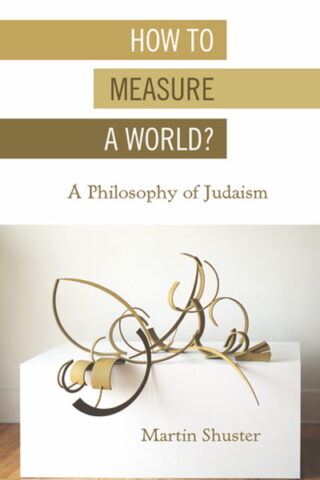
Martin Shuster’s How to Measure a World? A Philosophy of Judaism is impassioned, full of critical import, and deeply readable. Through close, carefully parsed encounters with canonical Jewish thinkers and by way of wide-ranging contemplation of the book’s central query, How to measure a world?, Shuster’s reflections underscore the reach and import of this question itself. In one passage, for example, Shuster describes a kind of spiritual exercise, in which an individual might work to transform the self, in ways that are, as he puts it, “by no means exclusively Jewish”—inviting us as readers to consider how each of us might become implicated by the book’s investigations.
While writing this introduction, I’m also immersed in Anna Kornbluh’s Immediacy, Or the Style of Too Late Capitalism, a study of contemporary life that shares Shuster’s most insistent and framing reference: namely, critical theory. What’s at stake when we feel so at home in the world that anachronism, along with capacities for reflective moral judgement, drop away? Art, along with taste and capacities for discernment, not to mention a sense of a shared world beyond selfies and the “I,” get swept up in currents of circulation and consumption. Shuster’s book, with its orientation toward pragmatism and critical theory, will speak to readers who seek answers for why the humanities (philosophy, literature, literary theory), in this present context, seems to be retreating in importance for policy-makers and students alike. As Larisa Reznik puts it, in a response for this symposium, philosophy emerges as a “queen science” in the book: a resource, in other words, for re-affirming meaning and meaning-making. Alongside philosophy, theology and religious praxis likewise emerge as fully contemporary resources, including those lines of religious insight that hail our attention to medieval texts and origins.
And so this book offers a philosophy of ethical, pragmatic, and existential practice—within and also beyond the bounds of Judaism. As a Quaker, for example, I find myself musing on almost every page of Shuster’s book about connections between established, inherited religious traditions (including the peace tradition of the Friends) and one’s own embodied, habitual practices which may or may not accord with what tends to count as “religious.” When Shuster suggests that the most authentic expression of anachronism might be silence (207), and that a kind of anachronism “carries the most supreme peace as a native possibility” (208), I read such passages as invitations to make specific religious practices newly strange and thereby available for inquiry. (Might Quaker Meeting, as an example, with its collective silence oriented in part toward peacemaking, be understood and affirmed in terms of anachronism? And what might this open up, as a way to track and trace what emerges out of contemplative listening?)
Shuster’s book, in other words, is both an important contribution to Jewish Studies and Jewish philosophy and also a beautiful summoning of attention by readers to the very interplay of philosophy (as reflective reading, thinking, and most importantly careful exchanges with others) with spiritual or existential capacities. How to Measure a World? points us to a repertoire of concepts and exegetically grounded readings that, to my mind, underscore the current urgency of raising this very question.
As How to Measure a World? suggests, if we are on the hook, ourselves, for helping to fashion our shared world, then we are also responsible for how we assess or “measure” the world, and, even more importantly for the book’s claims, for how this assessment might translate into one of two affective and practical orientations (21). As the book explores, in concrete detail, we might choose wonder at the world or critique of the world. We might find ourselves overcome with awe, as Shuster explores throughout the book, or overwhelmed with horror. If it’s wonder, then I am asking that the world be more fully appreciated; if it’s horror, then I lay claim to the moral grounds for pressing transformation.
In each of these two practical orientations toward the world, as Shuster elaborates, there is anachronism: being not at home in this world that we helped shape is a central premise and also a vested hope of this book. While these two practical orientations—wonder and outrage—are essentially existential and available in the first person, the book is very interested in the in-between. How we express wonder or communicate outrage: these are central problems for the book’s investigations precisely because of the hope that they both express, namely hope for a morally better, more just and more beautiful world. Throughout the book, Shuster reminds us that this world is a communicative one. Toward the end of the book, he makes this a point explicitly, writing “[s]haring a language is sharing a world” (190).
Especially in the sections on Levinas, the book provides an account in which religiousness is a modality, a form, and an existential approach to existence. As Andrea Dara Cooper draws out deftly and clearly in the first response for this symposium, this is an account that hails us to attend to the irreducibly somatic significance of our bodies and embodied experiences. While such experiences are singular and specific—as in the beautiful phrasing that Cooper offers in which motherhood and breastfeeding involve becoming literally thinner-skinned, they are also concrete and material, a matter of policies and relational dynamics. How do the title’s question, “How to Measure a World?” and the resources that the book lays out in response reflect or deflect from the specificity of bodies, including sexed and gendered bodies?
As Claire Katz emphasizes in the second response, turning to Levinas in particular, Judaism offers an ethics, rather than a formula or categorical imperative—which means that a philosophy of Judaism points us toward discourse and education, all the more fraught with import at a time of self-certainty and overwhelmingly binary thinking. Drawing on her own incisive writings on Levinas, as well as her work on philosophical teaching for children, Katz foregrounds the book’s significance for how we take up and affirm educational practices.
These first two exchanges point, together, to an important throughline of Shuster’s book, which has to do with the limits of reason, on the one hand, and the sheer import of acknowledgment, on the other. By turning to Stanley Cavell, in particular, Shuster dramatizes the crucial difference between knowing something, which is just about filling in a blank or addressing an absence, and acknowledging something, which is to address indifference, callousness, or exhaustion. These conversations invite Shuster, along with readers ourselves, to confront tangible, situated examples of acknowledgment.
The third response, by Larisa Reznik, returns us to the stakes of affirming philosophy, with all its specificity of method and vocabulary, as a response to the book’s guiding query. Reznik lays out what to me is a hugely instructive difference between “high-altitude” and “low-altitude” analytical approaches, and, in a reading that differs somewhat from my own, Reznik also flags a certain distancing that Shuster’s book forges between some philosophical texts and their theological tethers. Philosophy becomes an anachronistic reading of religion, on this account, and Shuster’s exchange with Reznik brings to life vivid stakes of the book’s project writ large. As Shuster explains, “[T]he religious (and academic) institutions around us for the most part operate in highly ossified and rote ways, indeed oftentimes actively aiding the very status quo that gives rise to the necessity for anachronism in the first place.”
The fourth response, by Karim Dharamsi, returns us to the terrain of religion, specifically the comparative analysis that How to Measure a World? lays out between Islamic metaphysics and Jewish philosophy. Theological implications emerge here, including a range of modalities of spiritual insight, certainty, and faith that extend the pragmatic orientation of this symposium in the direction of religious practice. In response, Shuster translates the book’s query into a first-person, practical one: “How do I understand the religious archive I have inherited? And what—if anything—ought I do with it?”
What I’m left pondering is how the interreligious dialogue, exemplified by this fourth exchange in the symposium, might return us to Reznik’s call to inflect these reflections with “sociological” or even anthropological dimensions. When practitioners of religious traditions speak different languages, for example, perhaps ones that come from different language-families as in the case of Dharamsi and Shuster, how might the key referent in this book, “a shared world,” come up against the specificities of languages themselves? Annemarie Mol reminds us, for example, that “eating is an English word,” a claim that states the obvious in order to provoke attention to what is often not obvious at all, like the hegemonic reach of Anglo-English.
Is there a point at which our practices and our respective traditions can produce a sense of awe or even terror at the very plurality of worlds that we inhabit? And does the sustained focus on language that Shuster brings to the philosophy of Judaism help to equip us for taking up such an acknowledgement?
2.11.26 |
Response
The Turn to Educational Discomfort
My newsfeed during the past few weeks has been dominated by headlines like these:1
“200 arrests this weekend at college campus protests, bringing total to 900” (The Independent)
“Pro-Palestinian protests disrupt colleges across the US” (CNN)
“How Universities are cracking down on a swell of tension” (CNN)
“Where are the adults?” (MSNBC)
“Columbia protesters say they’re at an impasse with administrators and will continue anti-war camp” (AP)
“‘Like a war zone’: Emory University grapples with fallout from police response” (The Guardian)
“Presidents grapple with how to respond to student protesters” (Inside Higher Ed)
Campuses around the country from the prestigious Ivy League schools like Columbia University to public universities in the south like the University of Texas, Austin, have been experiencing not only the campus protests but the ensuing actions taken by the university or the surrounding government, with the presence not only of university police but also local police, sometimes donning full riot gear. In addition, articles have appeared comparing the recent campus protests to the protests campuses experienced in the late 1960s and early ’70s.2 Significantly, what ties the two sets of protests together in similarity is the inability of university administrators to know how to address the protests. Plagued by the following questions, administrators seem damned if they do and damned if they don’t: Do they bring in the police? If so, when? How do they keep the campus safe? Is the protest protected free speech? Almost 60 years after the Columbia University protests in the 1960s and we can ask, what did we learn?
In 1986, I enrolled as an M.A.T. student in the Philosophy for Children program at Montclair State University, in New Jersey. Founded by Matthew Lipman, along with his colleague, Ann Margaret Sharp, Lipman would say that part of the motivation for developing such a program was having been a professor at Columbia University at the time of the protests in the 1960s. He was struck then by the inability of all parties, including administrators, to engage in thoughtful conversations about the difficult issues of the time. Sixty years later, the national headlines suggest this is still a problem. Our “thought leaders” are not leading us in thought.
* * *
Martin opens his book, How to Measure a World? A Philosophy of Judaism, with Levinas’s provocative claim that Judaism is an anachronism. Describing the claim this way, Judaism “is a non-coincidence with its time . . . an anachronism . . . the simultaneous presence of a youth that is attentive to reality and impatient to change it, and an old age that has seen it all and is returning to the origin of things” (1).3 Judaism is either too old or too young, too wise or too naïve.
A few lines down, Martin writes, “Later in the essay, Levinas harnesses the same idea to suggest that Judaism ‘has always wished to be a simultaneous engagement and disengagement,’ noting that the ‘most committed [engagé] . . . [the] one who can never be silent, the prophet, is also the most separate being . . . the person least capable of becoming an institution.'” Martin then explains that contemporary readers might be uncomfortable with this characterization for two reasons: 1) Levinas appears to claim that Judaism has an essence and 2) that Levinas appears to conflate Judaism with monotheism, which Martin points out is problematic considering scholarship that points to alternative origins for monotheism.
While Martin could very well be right about a contemporary reader’s discomfort, I take Levinas’s point to be something else, and maybe something even more relevant to the argument Martin wishes to make in his book. The essay from which the above quotes are taken, “Judaism and the Present,” is, like many of Levinas’s essays, Levinas’s lament that young people have turned away from Judaism. Some turned to Heidegger, some to the activism of May 1968, some to anything other than Judaism, which they see as passé. Indeed, within the pages of this essay, Levinas discusses whether living in the modern world would conflict with someone keeping the Sabbath, but this, Levinas says, is a problem for someone who has already chosen Judaism. It is an internal squabble, a domestic problem. Levinas’s concern is with those who have turned away from Judaism—the young people who claim to have no use for it, who see it as old and irrelevant.
This essay brings together themes that are found throughout the essays in Difficult Freedom: assimilation and anti-Semitism; rationality/reason and wisdom; youth and Judaism; Christianity and Judaism; world redemption and personal salvation. In his comments about Judaism itself, Levinas indicates that Judaism is fundamentally about ethics. The attempts to discredit it by claiming that biblical cosmology is incorrect miss the point. Continuing a theme that runs throughout this essay, Levinas contends that Judaism—and the Bible—are about wisdom, not truth, ethics not reason.
Levinas ends his essay, as he does elsewhere, by scolding young people who turn away from Judaism because they do not believe it offers them “sufficient enlightenment” to address contemporary problems. But like his ethics, Levinas reminds his readers that Judaism offers clarification, not a formula. One needs wisdom that comes from experience to address contemporary problems. Judaism will not provide a formula like a categorical imperative or a utilitarian calculus. We have, he believes, not only become too comfortable ourselves but allowed Judaism to become an accessory that does not make us uncomfortable in the ways that it should, by jarring us, and reminding us of the ethical responsibility we have in and to the world. I think for Levinas, Judaism’s uncanniness, its “not-at-homeness” allows it to be both engaged and observe from the side. It is anachronistic in the same way that the prophet is anachronistic.
Turning to Martin’s chapter on Levinas and Cavell, we can see then why Martin focuses on the significance of discourse. The words we use to describe an event shape how we think about that event, e.g., “torture” versus “enhanced interrogation.” Being in the world is being in the world as a being that interprets and judges that world. Words locate us within that world.
As Martin says at the end of the introduction to this chapter, “If all that is the case, however, my subjectivity is never the sole arbiter of things, indeed, it is not even the source of meaning rather, meaning is itself an intersubjective achievement, one that is accomplished only among others, through discourse; what words we use matters.”
In other words, if our entry into the world, our interpretation of the world, in short, our relationship with the world is fundamentally intersubjective, then our relationship with another is as Martin writes, a key point of interest. Martin turns his attention briefly to Donald Davidson’s view of language, but he does so to draw the connection to Levinas’s ethical project, in which he finds an analogous expression.
I wish however to linger a bit on the section, “Expression of Other and the Possibility of Violence.” Martin begins by underlining the relationship between the possibility of violence inherent in being a linguistic agent and the ethical import that accompanies that subjectivity. Indeed, this observation is not unlike the formulation that Levinas provides—the Other is the sole being I wish to kill, and how the other commands me not to kill her. It is because I might wish to kill the other that the other precisely commands me not to kill her.
But what I find most compelling in Martin’s discussion in this section is the recognition of the limits of reason—although he does not state it quite in this way. He introduces this part of the discussion with a reference to skepticism and then states, “In suggesting that the Other might fail to matter (or register) because of the limits of acknowledgment as opposed to knowledge, Cavell’s suggestion is that the question of our relationship to others is not to be solved through knowledge. When I have taken a particular stance toward the Other, I will not be swayed by some knowledge claim about them (‘Look he’s a Jew and not vermin!’ or ‘He is a human and not an ape’ or ‘She is not up to something’) . . . . To speak of minds, as opposed to others—other people—is already to reveal a particular orientation toward the Other (one that implies a potentially dangerous abstraction)” (186–87). And then later Martin writes, “the problem of my relationship with an Other is not a problem of knowledge. And the question of my relationship with another (of how I take the Other) could never be settled by more knowledge (Cavell) or more power (Levinas)” (188–89).
The irony of skepticism, although Martin does not say it quite like this, is that although the skeptic believes himself to be humble, to be uncertain, in fact the skeptic has committed what Martin calls denial or annihilation of the other. The skeptic is not skeptical at all. Because once the skeptic has taken this stance, no amount of knowledge can suffice. Thus, in effect, the skeptic has annihilated the other, and if we are talking from the point of view of Levinasian ethical responsibility, the skeptic has denied their ethical responsibility.
When I first approached Martin’s book, I used the 2009–10 debate over healthcare, which has striking similarities to the most recent debate over how people should respond to the pandemic, to consider this problem that Martin identifies. What is interesting at this moment in time is not the skeptic but the person who is self-certain. Although if we use Martin’s logic, the outcome of the skeptic is similar to the person who is self-certain. That said, using the headlines I referenced at the beginning of this paper, we have reached the inevitable outcome of a country that has become binary in its thinking. There is one side or the other, and you are either on our side or the wrong side. There is no room for discussion, for nuance, for holding several ideas or feelings simultaneously. And indeed when reason fails, when dialogue fails, when the obligation to and for the other is not already in place, the space for violence opens up.
As I wrote in my 2013 book, Levinas and the Crisis of Humanism, reason has its limits.4 That is for sure a difficult claim for a philosopher to write. I wrote that statement in response to a set of discussions that took place at a conference I had attended on teaching philosophy to K–12 students in September 2009, not even a year into Obama’s presidency.
I was pushing back against the framing of ethics as an obligation that we have only when our lives are not at risk. Instead, I argued that the ethical obligation remains present even when our life is at risk. We might choose to preserve our life, but that does not mean that the obligation is negated. It remains, even if we chose to protect ourselves rather than respond to the other. The fact is just that we sometimes decide to neglect, and thus fail to meet, our obligations.
Modern ethical theory has been based on a view of the self that allows us to view the other as an Other. As long as the sovereignty of the ego remains central, then neither philosophy in particular nor a humanities education in general will be sufficient to change the heart. Levinas invites us to understand ourselves differently in relationship to others—to think of ourselves as decentered. He would claim that this is what Judaic wisdom does for the Jewish tradition. But can we acquire this wisdom through reason alone? Can we be taught to care for the other? Or must we already value this disposition? And if so, how do we instill this value in those who do not yet have it? This is what Martin’s book has asked me to think more carefully about. And yet, more important than the question of acquiring such a disposition is the question: to whom do we owe this ethical responsibility? Who is the other? We, who work in the academy, who work in the humanities, who have the luxury of asking these questions, who carry the privileges of title and security—what is our role in creating a world where real answers are offered to real questions posed by those who have the most to lose?
At the time this response was written, these were the news stories dominating the headlines.↩
For a discussion of the comparison, see Hua Hsu, “The Uneasy Comparison between Campus Protests, Then and Now,” New Yorker, April 27, 2024.↩
All parenthetical page numbers refer to Martin Shuster, How to Measure a World? A Philosophy of Judaism (Chicago: University of Chicago Press, 2024).↩
Claire Elise Katz, Levinas and the Crisis of Humanism (Bloomington: Indiana University Press, 2013), 5–6.↩
2.16.26 |
Response
Altitude Training and Altitude Sickness
How to Measure a World at a Lower Altitude?
What is the question for which How to Measure a World? is an answer? Its interrogative title invokes a DIY tutorial involving a tool belt and YouTube. Yet, the titular question mark suggests that the author is in the same position as the reader—seeking rather than offering a “how-to” guide. One of the book’s virtues is that it offers conceptual resources for a range of philosophically significant questions. While the text gestures toward a “collaboration of the faculties,” philosophy still emerges as the “queen science.” Why might this matter and why begin here? Because on one level, in keeping with the project’s sources, especially Levinas and Adorno, the book reconstructs theology, religion, and “being-Jewish” as an ethical supplement to the brand of western secular rationality taken as axiomatic in much analytic philosophy. But insofar as a supplement both adds to and displaces the philosophical center, I wonder if, in places, the text is laboring against itself to rescue the philosophical tradition from the very effects of supplementation it invites? I organize my comments around three, overlapping clusters, as an invitation for Martin Shuster to help me piece together the links missing in my own thought process: 1) the semantic range and the politics of the term “anachronism”; 2) the status of theology and religion in the book; and 3) the significance of disciplinary boundaries between philosophy and its various others (sociology, ethics, theology, etc.)
Throughout the book, Shuster uses the phrase “high altitude” or else “eagle’s eye view” to indicate his approach. He invites us to inhabit a perspective that is sufficiently general (so as to render visible as shared) a set of preoccupations with the world (and the kinds of things that appear or fail to appear in it) exhibited by a range of thinkers, not all self-evidently in conversation with one another or with “Judaism,” in any obvious sense. Considering the amount of work that has been done on the affinities and differences between Judaism and “negative theology” that reconstructs genealogical relays from Exodus 20:4 to Jewish Neoplatonism to Maimonides and others before landing on Adorno, Levinas, Derrida, and a few more twentieth-century philosophers with some “Jewish” credentials (whatever that may mean), Shuster’s choice to stage a conversation between Maimonides, Adorno, and Levinas makes sense. But he also weaves a tapestry where thinkers familiar to the Jewish philosophy canon are plaited with Anglo-American philosophy of language and punctuated by German Idealism, thereby situating Adorno and Levinas in an Aristotelian-Maimonidean-Kantian-and-post-Kantian-Wittgensteinian-Cavellian constellation. Framed this way, one can see two distinct and related goals of the project. The first yield of the “high altitude” view is to soften, if not altogether dissolve, the “philosophical” distinctions like that of “analytic” and “continental” into mostly “sociological” noise (18, n45). After all, if at a sufficiently high altitude, Aristotle, Maimonides, Hegel, Marx, Adorno, Levinas, Davidson, and Cavell can be seen as engaged in one conversation across space and time, then the distinctions we often use to organize fields of inquiry (distinctions like “analytic” and “continental” or “Hebraic” and “Hellenistic” or even “critical theory” and “phenomenology”) become matters of institutional arrangements and gatekeeping but say nothing about the actual questions posed by these thinkers.
Second, at a high enough altitude, this project offers a plausible justification of the post-Holocaust philosophical move to “universalize” a particular figuration of Judaism; plausible because it tries to work against essentialist and chauvinist implications of Jewish exemplarity, focusing on what is exemplary, rather than proprietarily Jewish, about this modality of being.1 Third, at a sufficiently high altitude, epistemological, phenomenological, and ethical concerns appear so inextricably linked that a “bad” phenomenology—a careless, inattentive account of experience of the world and things appearing or not appearing in it—perpetuates human suffering, as do conceptual totalities abstracted from their ongoing mediation by history and embodiment.
But acknowledging that history and embodiment matter is not the same as allowing the historical and the particular to supplement the formal analysis—in the sense of both adding to and unsettling the form’s applicability to content. In an effort to describe and explain Levinas’s cryptic and ostensibly supersessionist claim that Judaism is an “anachronism,” Shuster’s anachronism becomes strikingly elastic. He defines anachronism as “distance from the present world” (115). This distanciation isn’t just alienation from the world but concomitant attunement to something beyond it (204). In Maimonides, it is “wonder and awe before the world, in all its glory, that demands that we understand that whatever present account we have is fundamentally incomplete” (65). In Levinas and Adorno, it is human suffering that screams the present world ought not be, which, by extension announces that something else ought to be instead. In analytic philosophy, anachronism holds open the door for the sociality of both reason and language, which Shuster deftly develops through a reading of Stanley Cavell and others. At a sufficiently high altitude, Maimonides’s negative theology, Levinas’s alterity ethics, Adorno’s negative dialectics, and Cavell’s “word projection” all exhibit what Shuster calls “anachronism” but what I might just call negativity—in all its awesomeness and awfulness—alienation, apophasis, incompleteness, excess, the trace, heteronomy, not-allness, openness, etc.
But unless one’s task is just to show some measure of correspondence or translatability between distinct discourses, to appreciate what about this formal similarity is valuable, a low altitude supplement is needed to differentiate, particularize, and reconnect with the mess that we abstract from, when we formalize and generalize. Shuster gestures toward such “low altitude” moments throughout the book. For instance, while Maimonides and Adorno may have some allegiances to what is sometimes called “negative theology,” Shuster is right to note that the stakes of negativity for Maimonides are epistemological and, more importantly, as Shuster argues, phenomenological, while the stakes for Adorno are uncompromisingly ethical. Unsurprisingly, this is an aspect of the project I want to hear more about and something I’d like to press on some. After all, not all negativities are the same, nor are the procedures for negation. The insistence that no merely human language user with merely human representational resources may speak of the divine in the affirmative, lest one commit idolatry and confuse the creator with the creature; the insistence that in a signification system subject to time, all signs, not just those for the divine, will necessarily fail to capture their referents entirely; and the ethical imperative to deliberately stage and restage the failure of concepts to fully capture objects (what Adorno calls “the preponderance of the object”) in a world so unjust that any other mode of representation effaces the hope and possibility of things being otherwise; formally speaking, all three are getting at a certain negativity. But what might this formalization leave out?
For one, I worry that if we don’t attend to the historical specificity of the idiom “anachronism,” we risk effacing the chronopolitical dimension of anachronism. After all, for all the ways Levinas’s claim, as Shuster shows, can be distanced from the developmental, supersessionist discourse on “anachronism” and read as a philosophical point about what the Jewish tradition has gotten right about what it means to be human, Levinas’s intervention takes place against a background history of anti-Judaism and a supersessionist presentation of Judaism as a kind of developmental lag—an anachronism. The history of western philosophy reiterates this trope of Jewish alienation, externality, sublimity, heteronomy, etc. So, if the philosophical tradition of Latin Christendom has made “Judaism” the representative of the negative moment—en route to Christian/philosophical universalism, redemption, etc.—the move to affirm “anachronism” as a universally persuasive phenomenology, rather than a “particular” Jewish developmental “deficiency,” and to valorize “the Jew” as its exemplary guardian, rather than the lagging perpetrator, of this negativity—is as much a oppositional, resistive discourse as a phenomenological exploration. Crudely put, for us to experience Levinas’s claim as in need of explanation and appreciation in the first place, we need first to inhabit a universe where the norm against which this intervention is undertaken as one where either the majority of humanity, or the majority of philosophical claims about it, presumes a reality of mastery, sovereignty, closure, or exhaustive knowability of the world. It is then the task of the philosopher to induce a break with that construction of reality. For Levinas, it seems, “being Jewish” is a critical modality of being human that is ethically necessary for all the acquisitive, sovereignty-seeking, and domination-driven modalities of being that make up much of modern (unethical) life. When we move to the other thinkers in Shuster’s archive, then, is anachronism the same sort of modality? More importantly, does the contrasting modality (synchronism? if such a thing even exists) exhibit the same sorts of problems and invite the same sorts of critiques as we find in Levinas? In other words, what (and whose) is the synchronistic take on the world, that the “anachronistic” modality responds to, complements, supplements, opposes, displaces, etc.?
Maimonides, like others, only grants Moses access to the whole of ultimate reality, while the rest of us operate with a kind of “epistemological deficiency” (69). The intellectually elite rely on spiritual exercises to approach asymptotically that epistemological completion. The unphilosophical “multitude” needn’t bother and should just rely on the tradition for a glimpse of that totality. In a gloss on Heidegger, Shuster writes that even the “most unphilosophical or uncurious minds” will wade in the waters of anachronism “when our involvement with the world breaks down or when things go awry, then we are led to reflect on the various structures and references that hold a world together” (65, 65n88). That this attitude arises from the very practical human-world relation is clear. But how do we talk about what follows from this insight? Is anachronism a natural attitude? If so, on account of what features of the world do the unreflective and the “multitude” find it so difficult to inhabit in a sustained way? Is anachronistic attunement a goal? Is it to be pursued or managed? Is it to be pursued by the curious seeker but managed with the authority of tradition, when it arises in the “multitude”? Is this anachronistic attitude how we grasp our situation of “epistemological deficiency,” how we are cut down to size in our arrogant delusion of epistemological mastery? Is it really a deficiency, if it is a feature of being human? Is our dominant modality that of synchronistic epistemological proficiency, until suffering or things going wrong makes anachronistic phenomenologists of us all? In other words, it seems here that a philosophical sketch of negativity needs historically and sociologically specific supports for conceptual intelligibility.
My question about the background assumptions against which something like anachronism registers also arises for Shuster’s discussion of philosophy of language but in the context of a different set of sociological considerations—those of disciplinarity. Shuster’s book gives analytic philosophy a very generous gift of insight from critical theory and continental philosophy to illuminate the potential ethical import of its belated discovery that reasoning and language use apparently take place in time, under particular historical and material conditions, and in commerce with a multiplicity of others. I worry, though, that Shuster’s generosity risks depoliticizing the significant conflict between positions for which these two camps serve as shorthand. Given how hard they have to work to persuade their audience of something that appears so basic and obvious (time, history, materiality, the existence of others matters foundationally), I have to assume that the analytic philosophers treated in this book address an audience that requires rigorous convincing that non-sovereignty is a genuine philosophical discovery worth talking about. In the meantime, so-called continental philosophy—for all its occlusions and blind spots—has been talking about time, history, materiality, embodiment, intersubjectivity, and structures of domination for much longer. To bring together these two traditions as if they are in conversation “across space and time”—as if the label is a merely sociological accident—risks concealing the power dynamics and intellectual hierarchies at stake. Given that this is a book committed to the suffering and embodied particulars of our shared world, one might expect a more adversarial stance toward a tradition that has, at best, neglected these concerns, and at worst, provided intellectual cover for the institutional logics that perpetuate suffering. At the same time, I recognize that Shuster’s own approach to writing and argumentation here might be modelling a mode of engagement on the other side of these power dynamics—a mode that seeks to persuade rather than antagonize, to build bridges rather than walls. What, then, can be said about this tension and the text’s relationship to the disciplinary politics of academic philosophy?
I began by asking what question Shuster’s book answers. But this question has a companion: to whom is this answer offered? This brings me to my final cluster of questions, about disciplinarity, and about the role of theology and religion in the book. I confess that I am not sure how to understand what Shuster calls “religion as it is traditionally conceived” (204). My sense is that this functions largely as a foil for the “religion” recovered by the phenomenology of anachronism. But is this merely a rhetorical contrast or does it describe actual communities, scholars, or ways of life? And if it does describe actual religious traditions, which ones, and how do they relate to the institutional logics and power dynamics that the book critiques elsewhere?
I am especially curious about what the book’s approach might mean for theology—a discipline that has, historically, claimed more than a passing interest in discussions of God, transcendence, and negation. Shuster is clear that the book’s approach is phenomenological, and that its claims about God and transcendence are phenomenological claims. But if we decide, in advance, what belongs to philosophy and what belongs to religion, might the hoped-for criticality be compromised? Alternatively put, if the distinction between “analytic” and “continental” philosophy can be suspended on “sociological” grounds, why can’t the distinction between theology and philosophy be approached likewise?
On this topic, see Oona Eisenstadt, “Levinas and Adorno: Universalizing the Jew after Auschwitz,” The Journal of Jewish Thought and Philosophy 14, nos. 1–2 (2006): 131–51; Sarah Hammerschlag, The Figural Jew: Politics and Identity in Postwar French Thought (Chicago: University of Chicago Press, 2010).↩
Andrea Dara Cooper
Response
On Being Not-at-Home in the World
How to Measure a World? ends with a beginning: the epigraph to Levinas’s Otherwise Than Being or Beyond Essence. In French (language matters here, as Martin reminds us it always does), Levinas dedicates this work to “those who were closest among the six million assassinated by the National Socialists” and the “millions of all confessions and all nations” who are victims “of the same hatred of the other man, the same anti-Semitism.”1 The Hebrew following this dedication may appear to non-Hebrew speaking readers to be a direct translation of the French, but instead remembers loved ones who perished in the Nazi genocide, listing by name those in the author’s family who were killed in mass executions in Lithuania.2 The dedication notably departs from the language of the rest of the text. Here, the proper names of the lost are represented in an intentionally delimited linguistic mode. The move from representation to naming, in memorializing, takes place in a language shift. How does this relate to the linguistic discourse of the ethical call, and to an ethics that is primarily communicative?
The epigraph illustrates the place of language and translation in Levinas’s work, and of the particularity of testimony that nevertheless feels an obligation to speak to the universal.3 In my reading of Levinas, I have long been preoccupied by the need to both universalize and specify that are evident in these two epigraphs which resist mirroring one another. The dual meaning would probably elude many of his readers. And in Levinas’s more general references, such as the French epigraph, antisemitism becomes anti-humanism. The victim of antisemitism is any victimization at the hands of the other; any/every antisemitism is any/every persecution. This becomes a central question for Levinas and for his readers: is the slide from the specificity of being Jewish to the generality of being human possible? How much of our own materiality can ever be conveyed through translation, or through language, for that matter? Levinas elsewhere emphasizes the need for translation to open a text toward the sphere of the universal, and yet the Hebrew epigraph that frames his work resists translating into French the proper names of those who are remembered. While the text is directed to any victim who suffers at the hands of the other, every instance of suffering is unique, as victimization is precisely the refusal to recognize the other’s uniqueness. The epigraph thus speaks to the universalization of suffering that nevertheless remains utterly particular and untranslatable.4
Both Levinas’s philosophical approach and biographical framework are oriented around multiple points of dislocation. He was himself displaced geographically and otherwise; his work also proceeds from a position of linguistic displacement, struggling to find a home in French, always elusive since it was not his first language.5 This dislocation along space/time frequencies resonates with the temporal disjunction in his concept of diachrony—that is, time experienced through the relation to the other. He contrasts a relation of synchrony, in which the self remains the same, to diachrony, in which the other, of another time, interrupts the inward comportment of the self. For Levinas, philosophical language tends to reduce the saying (le dire) to the said (le dit). The saying involves ethical exposure to the other along diachronic registers, while the said is synchronic and involves an ontological statement with an identifiable meaning. The saying is interruption, infinity, infection, proximity, and contact, while the said is systematization, totality, and self-containment. In other words, in the terminology powerfully highlighted by Martin, the saying is anachronistic: it is of another (of an other’s) time and space.
How to Measure a World? (that question mark in the title—so capacious) returns and rotates around anachronism, and the title is meant to indicate both space/time measurements. For Martin, Levinas’s statement that Judaism is anachronism is both a phenomenological and ethical position; it diagnoses a problem with our current situation. One of the many achievements of the book is the masterful way that it weaves together post-Shoah Jewish thought with a wide-reaching temporal scope grounded in philological analysis. Levinas’s epigraph suggests, in Martin’s words, that “such antisemitism is also a modality of being human” (208). One can imagine another concept orienting the book; rather than the temporal modality of anachronism, the emphasis could be on the spatial dimension of “not-at-homeness” (something like uncanniness, a connection rendered clearly in the German unheimlich).6 As Martin puts it, “It is a moral imperative not to feel at home in such a world” (15). The book could also have built its scaffolding upon Adorno’s statement in Minima Moralia that “today . . . it is part of morality not to be home” (156). As Martin writes, drawing from Adorno and Maimonides, “Whether we approach the world in awe or in outrage, there can ultimately be no feeling at home in it or with it” (157).7 The book encourages readers to form generative connections between modalities of space and time.
For the key figures in the book, anachronism is “distance from the present world” (114) and “the possibility of a gap between self and world” (206). In both cases, spatial terms are emphasized. Martin notes that this book about time unfolds through an analysis of space (9); could it be the other way around? What does anachronism do for this meditation on measurement that un-at-homeness, or Unheimlichkeit, does not (besides being less clunky a term)? Or, put another way, what does Levinas do for this philosophy of Judaism that Adorno cannot? It is true that Levinas self-consciously reflects on what a philosophy of Judaism might look like, whereas Adorno’s critical apparatus is more divergent. But this leads me to my next question: what does Judaism do for this phenomenology of suffering that humanism cannot? The book’s elegant Introduction suggests, if not a conflation of the two, then at least a necessary and implicit connection: “What might it mean to take this [phenomenology of anachronism] as a central feature of Judaism, of being human?” (15). Even if we understand monotheism robustly as a phenomenological category (207), is monotheism unique in this way, or could other cosmologies offer alternatives?
Furthermore, if Judaism is intricately connected to human experience, what do we mean by experience? For each of the book’s main figures, biographical circumstances are philosophically formative: Maimonides’s forced conversion (37) and the drowning of his brother David (74); Levinas’s time as a prisoner of war held by the Nazis; and Adorno’s experience of the Nazi genocide (13). Levinas’s fundamental approach that undergirds the argument of the book draws from his lived experience of persecution. Martin alludes to his own positionality as a way of illustrating this experiential modality: “The very fact that one is in a world combined with the potentially infinite scope of what that amounts to (am I merely a professor? A husband? A father? A citizen? A human? An earthling? A consciousness?) suggests that all of existence is potentially implicated in and fodder for such an inquiry” (65).
Maimonides, Adorno, and Levinas—indeed, the phenomenological method—all suggest that lived experience involves a “practical, embodied relationship with the world” (19). Embodiment is at the heart of Otherwise than Being, in which Levinas asserts that multiple allusions to the body should not only be interpreted figuratively.8 For Adorno, too, “we are always, through and through, embodied creatures, whose mental life depends irreducibly on our physical life, and vice versa . . . Our conceptual capacities are—in the form of an ethical sensitivity—always already bound up with our bodily comportments” (98–99). For both Adorno and Levinas, the experience of bodily suffering enables ethical sensitivity: “What is most real is matter” (105). Ethics depends primarily on the somatic capacity of the human.
For Levinas in Otherwise than Being, this embodied ethical relationship is exemplified in maternity.9 Martin’s Introduction mentions the forced separation by US customs and border patrol of a mother and 9-month-old infant daughter, alluding to this particular ethical model. He is making a philosophical point and demonstrating why it matters (and why it is material). As a mother whose own body was until very recently the only food source for her formula-allergic infant (my body could tell me when she was hungry, especially when I was away from her), my reading experience of this reference was to immediately be evicted from the text as my cognitive capacities were interrupted by dark, intrusive thoughts. In a Levinasian sense, when I say that my skin has become thinner, I don’t only mean figuratively. My experience of the world has become even more embodied, affective, somatic. Mentioning this, of course, is a risky choice, labelling and sequestering my thought as far too particular and embodied—but, then, that’s the point.
Martin mentions that one way to read Levinas’s remarks about Judaism as anachronism is along the lines of “Judah Leib Gordon’s Haskalah [Jewish Enlightenment] ideal of being a Jew ‘in your home’ and ‘a man outside of it'” (2). But it matters that only a man could make this choice in the Haskalah context. Halachically (in the realm of Jewish law), this is still a complicated question, especially in the context of Levinas’s thought, which links femininity with domesticity and habitation. Referring to Maimonides’s awed comportment toward the world, Martin writes, “Every individual is importantly already in a world and in this way already occupies—practically and theoretically, bodily and conceptually—the sort of (worldly) space that allows, indeed likely (at least at certain moments) requires, her to undertake what Maimonides suggests” (65). While I deeply appreciate Martin’s use of the female pronoun as the Maimonidean subject here, I am also aware of the irony of this usage, since for Maimonides, that subject is most certainly male.10 For the book’s major (male) figures, what are the contours and limits of this embodied relationship with the world? And what can that experience look like for each of us?
Emmanuel Levinas, Otherwise Than Being or Beyond Essence, trans. Alphonso Lingis (Dordrecht: Kluwer Academic Publishers, 1991), v.↩
“To the memory of my father and teacher, Rab Yehiel son of Abraham the Levite [ha-Levi], my mother and guide, Dvorah daughter of Rab Moshe, my brothers, Dov son of Rab Yehiel ha-Levi and Aminidav son of Yehiel ha-Levi, my father-in-law Rab Shmuel son of Rab Gershom ha-Levi and my mother-in-law Malka daughter of Rab Chaim. May their souls be preserved in the bond of life” (Salomon Malka, Emmanuel Levinas: His Life and Legacy, trans. Michael Kigel and Sonja M. Embree [Pittsburgh, PA: Duquesne University Press, 2006], 81).↩
In his author’s foreword to his collection of essays In the Time of the Nations, Levinas invokes the scope of translation and testimony: “Attention is to be given to all testimony, avoiding the ambiguities of translation” (Levinas, “Author’s Foreword,” In the Time of the Nations, trans. Michael B. Smith [London: The Athlone Press, 1994], 1). Notably, in Otherwise than Being, he chooses Hebrew as a monument for his murdered relatives. Dorota Glowacka observes that the choosing of Hebrew and not Yiddish may be a linguistic marker of the “displacement and dispersal” of Yiddish speakers and “the impossibility of giving testimony to that disappearance in Yiddish” (“The Trace of the Untranslatable: Emmanuel Levinas and the Ethics of Translation,” PhaenEx 7, no. 1 [Spring/Summer 2012], 10). On Levinas’s choice of language in the epigraph and the relation to translation in Shoah testimony, see also Dorota Glowacka, Disappearing Traces: Holocaust Testimonials, Ethics, and Aesthetics (Seattle: University of Washington Press, 2012).↩
At the end of the collection Difficult Freedom, in an essay entitled “Signature,” Levinas ends a summary of his “intellectual biography” with the following statement about his work: “It is dominated by the presentiment and the memory of the Nazi horror” (Emmanuel Levinas, Difficult Freedom: Essays on Judaism, trans. Seán Hand [Baltimore: Johns Hopkins University Press, 1990], 291).↩
See Samuel Moyn, Origins of the Other: Emmanuel Levinas between Revelation and Ethics (Ithaca: Cornell University Press, 2005).↩
Martin does invoke this term in his discussion of Heidegger in chapter 2.↩
On this point, see also chapter 4, “Adorno’s Minima Moralia and Ethics,” in J. M. Bernstein, Adorno: Disenchantment and Ethics (Cambridge: Cambridge University Press, 2001), 130–71.↩
Levinas writes, “It is not by chance that the terms sensation, vulnerability, sensibility, and maternity can be used in our exposition. . . . This is not the result of some sort of penchant for ‘edifying discourse’ but rather of an attempt to describe subjectivity” (Emmanuel Levinas, Otherwise Than Being, 78).↩
See Levinas, Otherwise Than Being, 75–81.↩
See my analysis in Andrea Dara Cooper, “Maimonides on the Contemplative Life and Death,” in Gendering Modern Jewish Thought (Bloomington: Indiana University Press, 2021), 43–77.↩
2.9.26 | Martin Shuster
Reply
Response to Andrea Dara Cooper
Above all, let me open these remarks by stressing how grateful I am to Ada Jaarsma and to all the respondents—Andrea Dara Cooper, Larisa Reznik, and Karim Dharamsi—for their incredibly generous and keen engagements with my work. In the world of specialized academic publishing—and the even more specialized world of Jewish philosophy—this is a real boon. As is likely obvious, this was a peculiar book and deeply personal, so it means a great deal to have the opportunity to respond to the comments of such talented scholars.
Andrea Dara Cooper raises questions about the status and scope of Judaism and experience in How to Measure a World? and especially in the way in which these connect to human embodiment, including, of course gender (but also race, ability, and other inflections of our embodiment). Andrea’s own response in fact shows the importance of such questions when it invokes a literal sense of her skin becoming thinner in the wake of becoming a mother. She frames this response as a “risky choice” which I think speaks far less to the choice itself than to the contemporary (academic) context in which it is made. I want to highlight again how deeply appreciative I am of this bit of biographical detail on her behalf. We need more such detail in scholarship, not less, for these details, as much as texts, form sites of testimony in the shifting record that is Jewish philosophy. I want to return to this suggestion shortly but before I do I want to situate a few more thoughts in response to Andrea’s careful response.
She asks whether, “even if we understand monotheism robustly as a phenomenological category, is monotheism unique in this way, or could other cosmologies offer alternatives?” Equally, we may ask what Judaism does here that monotheism does not? Or, as Andrea does, what does Judaism do here that a humanism may not? These are not idle questions: they seem to me to cut to the heart of a project, albeit in a distinct way: just as Andrea alludes to her reader experience in the face of my example of a mother abused by US customs and border patrol agents, so I would suggest these questions about the kinds of choices I’ve made in my presentation of my claims in How to Measure a World?, ought to allude to—we may nowadays say resonate with—certain readers. As I suggested in the book, the desire was to unveil a possible tradition of Jewish thought that has been overlooked, deprioritized, and has been left—theoretically and practically—unapproached. My sense is that this tradition can offer novel possibilities for Jewish thinking (and thereby, I would hope, for Jewish living).
I thereby don’t know in advance who these readers are or with whom it will resonate, but I do know that the story I tell about anachronism in light of Jewish philosophy offers us possibilities for both (1) rethinking even more the canon of Jewish thought (so locating resonances with and traces of such anachronism in Jewish textual—and other—traditions far beyond those that I considered), and (2) as a possible feature of that potentiality equally allows for, if not suggests, a fundamental reorientation of how we might see Judaism as connected to other traditions. My sense is that the archives of all religious traditions have immense breadth and depth and that, if mined and pushed deeply enough, they each have the potential to become isomorphic with one another (this is how I would inflect the claim by Levinas that “there is not a single thing in a great spirituality that would be absent from another great spirituality”).
I want to cite here a remark of Cavell’s from The Claim of Reason where he sketches a picture of how a judge may operate with respect to the law:
My point in How to Measure a World? (and this is one way to register the presence of Maimonides there) is that the tradition of anachronism I sketch there is at the heart of even the most philosophically comprehensive and towering and potentially well-trod or well-established notions of Judaism. This is also another way of making explicit the procedures of the book: once we acknowledge the canon around anachronism that I suggest and try to develop, then it becomes possible to look backwards and forwards in ways we may have not done and to notice things in both we may have not noticed before. (And this is another way to say that—as Andrea astutely notes—space and time are already always intertwined here). So, this is all to say that in a deep sense this book offers a kind of confession not entirely divorced from the sort that Andrea herself makes in her response: this is a particular view of Judaism that has emerged for me through a certain kind of engagement with Jewish textual traditions, (Jewish) philosophy, and Jewish communal life. Each of these is in the background as the aspirations and moves of How to Measure a World? unfold. And what emerges is thereby a kind of biographically inflected construction of a scholarly development (Judaism as anachronism).
To present this point, though, is to acknowledge the concluding trajectory of Andrea’s questions (indeed suggested again by Cavell’s own invocation of a male judge) around the role of gender in the figures of How to Measure a World? I don’t think I say anything controversial when I note that my own impulses in my book likely run counter to the impulses that animate many of the figures that I marshal to outline the tradition of anachronism I sketch. In this way, Andrea’s line of questioning is not to be ignored, and my book—at best, if at all—makes a kind of propaedeutic intervention, opening up the recovery of texts and possibilities that the masculine—if not frequently outright misogynistic and patriarchal—exclusions performed by these figures (and all of us who equally study them only in certain oftentimes gendered ways) cover over or make unavailable. In this way, I would cite Andrea’s own Gendering Modern Jewish Thought as a central intervention, and in doing so echo her sentiment in that book that we can continually “push at the limits of the canon” (an aspiration that I certainly share even as I inflect it in a different but not—as I see it—incompatible way).