
Symposium Introduction
I rolled my eyes twice during the process of becoming a godparent. The first was when I was filling out a question on the godparent eligibility form: “If married, is your marriage recognized by the Roman Catholic Church?” I had to answer no. Luckily, this didn’t preclude me from becoming a godfather. I knew there were no canonical reasons why I couldn’t be a godparent. But the particular parish where the baptism was being performed maintained, at least on its website, that only married Catholics in heterosexual marriages were eligible for the role. So even on the morning of the baptism, I was prepared for the possibility of a last-minute refusal.
The second time I rolled my eyes was when I lined up on the altar with the other baptism candidates and their parents and godparents. Of the dozen or so families appearing for baptism, ours was the only one with just one godparent. A’s other godfather, my husband, was a few feet in front of us recording the moment on camera. I rolled my eyes because, to anyone with half a clue, Andy and I were together. But even if none of the parishioners knew, A would grow up knowing we were married, just as her big sister does. They would be raised knowing us to be their godfathers. Who, then, was this charade for? The faithful? To prevent them from being scandalized by seeing gay people included in the life of the Church? To prevent throwing them into confusion about official Church teaching on homosexuality? Is anyone at this point unclear about the policies?
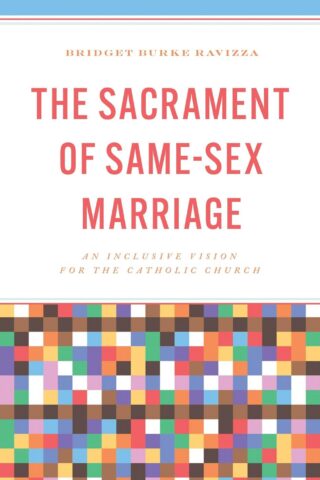
This experience is familiar to many married gay Catholics: we participate in the life of the Church, but we are expected to know our place, so to speak, to know that ours is not a sacramental marriage because our love is, according to the powers that be, something less or other than real marital love. In The Sacrament of Same-Sex Marriage: An Inclusive Vision for the Catholic Church, theologian Bridget Burke Ravizza interviews twenty-two same-sex married couples whose very existence in the Church witnesses against some of its own teachings. One woman named Margaret said that her partner Val “truly is the presence of God in my life” (17). Kevin, another married Catholic, describes his marriage as sacramental: “I find God in my marriage more than anywhere else in the world” (13). A third couple describes how, after trying “desperately” to give up their feelings for each other one Lent, they ultimately discerned God calling them to marriage. “This is a sliver of how God must love someone so much, like me,” said one of the women of her matrimonial relationship (9).
Burke Ravizza’s book follows up on an earlier project she coauthored with Julie Massey called Project Holiness: Marriage as a Workshop for Everyday Saints. For that book, Burke Ravizza and Massey interviewed hundreds of married Catholics in the attempt to “think theologically about marriage from below,” that is, in the pews (xiii). Burke Ravizza says that some of the couples they interviewed asked if they planned on talking with gay couples; at the time, the answer was no. That question, however, “pricked at [their] consciences,” and eventually Burke Ravizza decided to write the book.
Although this book is organized to highlight the experiences of the interview subjects, Burke Ravizza’s capabilities as a theologian shine through. Rather than begin with theology and then drive it home by telling a story about a couple whose relationship epitomizes or challenges that theology, she grounds her work in the testimonies of married gay couples. At crucial moments in these stories, Burke Ravizza jumps into the conversation to build out a theological insight or to contextualize the development of a specific church teaching; but the focus remains on what the gay couples believe about themselves, their marriage, and their relationship with God. In other words, Burke Ravizza models here a compassionate yet intellectual way to do the theology of gay marriage: by letting queer people take the lead.
While the Church has, especially during Francis’s papacy, made strides in welcoming LGBTQ people, the teaching remains the same: homosexual sex acts are objectively disordered and closed to life, and therefore relationships that include these acts cannot be considered in any way analogous to marriage. The testimonies gathered here, coupled with Burke Ravizza’s gentle and insightful theological commentary, possess the power to prick the consciences of all Catholics.
I am grateful that four brilliant and kind theologians have accepted the invitation to respond to Burke Ravizza’s book. First up is Cristina Traina, Avery Cardinal Dulles, SJ Professor of Catholic Theology at Fordham University. Traina provides a brief historical sketch showing how the Church arrived at its contemporary theology of marriage, a theology she believes is “incoherent.” From its “inauspicious start in the New Testament,” through Augustine’s On the Good of Marriage, which suggests love and charity “more as the byproducts than the causes of matrimony,” and finally to the encyclicals of the last century, the development of the so-called Catholic view of marriage, argues Traina, does not have the theological rigor to sustain the weight of its own contradictions.
Also responding to Burke Ravizza is Lisa Fullam, Professor Emerita of Moral Theology at Santa Clara Jesuit School of Theology. Fullam notes from go that Burke Ravizza’s book isn’t about the moral goodness of same-sex marriage, but its sacramentality, which Church leadership is reluctant to recognize. Not that she’s surprised. “It took long enough [for the Church] to recognize the sacramentality of heterosexual marriage.” (Marriage wasn’t officially declared a sacrament until the Fourth Lateran Council of 1215.) Fullam chalks this up to the sacraments’ “shaky scriptural foundation”; early Christian views on eschatology and the belief that “the biological family would be eclipsed by the Christian community itself”; and the sacrament’s “dangerous association with sex.” As Fullam notes, the only lingering problem for the magisterium is the third. (Catholics don’t believe Jesus is coming back next Tuesday, nor are they critical of the biological family, like Jesus was.) Historically, the Church has quelled its anxieties about sexual pleasure by focusing on the procreative aspect of sex acts. And yet, as Fullam points out, Vatican II proclaimed that “Marriage to be sure is not instituted solely for procreation.” Surprising, then, that when the Church leadership dismisses the possibility of sacramental marriage, their go-to argument focuses exclusively on procreation. Ultimately, as both Fullam and Burke Ravizza know, the Church is not able to address the sacramentality of same-sex marriage unless and until it is willing to reconsider “the morality of same-sex sex.”
Our third contribution comes from Ish Ruiz, Assistant Professor of Latinx and Queer Decolonial Theology at Pacific School of Religion. Ruiz contextualizes Burke Ravizza’s book as a kind of “synodality in action” undertaken in a “spirit of transformative listening” and aimed at prophetically inviting the Church to “develop its conception of marital sacramentality.” Ruiz believes Burke Ravizza’s book “flirts with queer theology” by prioritizing queer epistemologies. These ways of knowing disrupt the heteronormativity that has long anchored Church teaching on marriage. Ruiz appreciates this disruption but invites Burke Ravizza to go a little further—he wants “to push her method toward a queer sacramental relationality beyond monogamous heteronormativity.” Can a Catholic sacramental imagination make room for nonmonogamous sexual encounters? What about sexual encounters involving more than two people? While Ruiz acknowledges these questions are beyond this particular book’s scope, he nevertheless wants to push his “queer agenda” on Burke Ravizza’s work in the hopes of further undermining the Church’s heterosexist norms. (“Can LGBTQ+ inclusion in the Catholic Church be fully attained if we perpetuate heteronormative norms for same-sex relationships?”) In her response to Ruiz, Burke Ravizza says that she has heard from at least some same-sex couples that they believe “nonmonogamy is not discarding fidelity as important for marriage, but reinterpreting it.”
Our final respondent is Mary M. Doyle Roche, Professor of Religious Studies at the College of the Holy Cross. Roche is the coauthor of Modern Catholic Family Teaching: Commentaries and Interpretations, which sets magisterial texts on the family in dialogue with commentary on those texts. Her essay discusses two such documents, both issued during Francis’s papacy: Dignitatis Infinita and Fiducia Supplicans. Like many Church documents on marriage, these “undercut” the dignity they claim LGBT persons possess by repeating “tropes about ‘gender ideology,’ reproductive justice, and the lives of LGBTQIA+, particularly trans, persons.” One solution might be to follow Burke Ravizza’s lead: her argument is not so much for the sacramentality of same-sex marriage as it is for the Church to “recognize and honor the de facto sacramentality of these relationships.” As long as Church leadership is unwilling to recognize what same-sex Catholic couples believe about their own marriages, then the narrow vision of marriage they espouse will not reflect the full vision of marriage that has long been embraced by many Catholics, including those in heterosexual marriages. God is already “showing up” in queer families, Roche says. Any Church teaching that does not begin by acknowledging this reality will always miss the mark.
One same-sex couple featured in the book tells Burke Ravizza that “their sense of Catholicism is not bound up with the church’s hierarchy” (137). Instead, like many married gay Catholics, Anne and Bernadette “keep being the church, living out their Catholicism with others, and trying to hold out hope that church teachings and structures may change for the better” (137). Burke Ravizza’s book, just like our church, contains many such testimonies. We pray God grants our fellow Catholics the ears to hear.

8.12.26 |
Response
If It Walks like a Duck
Recognizing the Sacramentality of Same-Sex Marriage
Many arguments have been made that recognize the morality of same-sex marriage. But that’s not the question for Bridget Burke Ravizza: she invites us not to recognize that same-sex marriage is (or can be) a moral good, but that it is a sacrament. This book draws from and continues the work she began in Project Holiness: Marriage as a Workshop for Everyday Saints, where, in collaboration with Julie Massey, she surveyed and interviewed opposite-sex couples to explore the “lived sacramentality” of marriage: how spouses are “sacraments to one another; . . . sacraments to others; and sacraments in daily married and family life.”1 That book was a phenomenology of marriage—how is that sacrament experienced and lived in the lives of those promised its grace? Her argument here about same-sex couples is essentially: “if it walks like a duck and quacks like a duck,” then the Church should recognize its anatine status. In a rich and moving engagement with same-sex couples connected to the Church, she concludes that “the church should expand its definition of sacramental marriage to include same-sex couples.”2
The reluctance of Catholic leadership to recognize same-sex marriage as a sacrament is not surprising. It took long enough to recognize the sacramentality of heterosexual marriage. Christian tradition has never condemned marriage outright, seeing it as a natural good instituted by God. But from the early centuries onward, Catholic tradition has held marriage in an uneasy tension with celibacy. It was only in the twelfth century that marriage was considered sacramental in the specific sense accorded to the other six sacraments.3 Part of this is due to its shaky scriptural foundation: sacraments are defined as being instituted by Christ, but it is the water-into-wine miracle at Cana that is adduced as scriptural evidence for the sacramentality of marriage. Saying that marriage is a sacrament because Jesus performed a miracle at a wedding is like saying swimming is a sacrament because Jesus healed a man by the pool of Siloam.
But other factors contributed to the slow recognition of marriage as a sacrament by the Church. First, many in the early Church looked for Jesus’s imminent return—don’t bother yourself with this world, but prepare for its end. Stay married if you’re married, don’t marry if you’re not, and don’t order long magazine subscriptions. The exception noted by Paul is for those who would be distracted from focusing on the eschaton by sexual desire, “for it is better to marry than to be aflame with passion.”4
Also, there was a sense in the early Church that the biological family would be eclipsed by the Christian community itself. This also has a root in scripture: when Jesus’s family came to bring him home after hearing that “He has gone out of his mind,” Jesus turned to his followers and said: “‘Who are my mother and my brothers?’ And looking at those who sat around him, he said, ‘Here are my mother and my brothers!’”5 The Christian community provided chosen family for widows, other vulnerable people, and for those who left everything behind in service of the gospel.
A significant reason for slow recognition of marriage’s sacramental nature is due to its uncomfortable association with the dangerous pleasure of sex. Writings from the early centuries of Church tradition are full of warnings about and condemnations of sex. The lapsed Manichee Augustine is most well-known for this; he saw sexual desire and the unruliness of sex organs themselves as paradigmatic of the disordered state of post-lapsarian humanity. For Augustine, sex can only be sinless in marriage, and even then only if one intended procreation or sought to ease one’s spouse’s concupiscence without surrendering inordinately to pleasure oneself.
Of these three main factors contributing to Christian ambivalence about marriage, only the third remains. The hope for Jesus’s imminent return has been dashed for centuries. While we continue to look for Jesus’s second coming, it strains experience for us to expect it will happen any time soon. And the apparent opposition of Christian community and biological family has been largely overcome. The Vatican II document Lumen Gentium spoke of the family as “so to speak, the domestic church,” in which spouses “help each other to attain to holiness in their married life and in the rearing and education of their children.”6
The Catholic tradition’s discomfort with sex,7 even in marriage, was allayed by focusing on its procreative potential. Until the twentieth century, marriage was taught to be principally a context for procreation, with other goods subsidiary to that principal end. Marital sex is sanctified by the possibility of procreation. Lumen Gentium again: “From the wedlock of Christians there comes the family, in which new citizens of human society are born, who by the grace of the Holy Spirit received in baptism are made children of God, thus perpetuating the people of God through the centuries.”8
However, another Vatican II document upset the apple cart of the primacy of procreation as an end of marriage. “Marriage and conjugal love are by their nature ordained toward the begetting and educating of children,”9 we read in Gaudium et Spes. However, the same paragraph states:
Marriage to be sure is not instituted solely for procreation; rather, its very nature as an unbreakable compact between persons, and the welfare of the children, both demand that the mutual love of the spouses be embodied in a rightly ordered manner, that it grow and ripen. Therefore, marriage persists as a whole manner and communion of life, and maintains its value and indissolubility, even when despite the often intense desire of the couple, offspring are lacking.10
This communion of life can be seen as an equal end with procreation in current magisterial teaching, with one important caveat. While non-procreative unions are still truly marriage, loveless-but-procreative unions are never affirmed. The raising of love to an equal end of marriage with procreation, while affirming non-procreative unions, in fact relativizes the important good of procreation. And while antecedent and permanent impotence is canon-legal grounds for annulling a marriage, infertility is not. As Burke Ravizza notes, “There is room already in the tradition for couples to be sacramentally married while unable to naturally conceive children.”11 It is also the case, she says, that many same-sex couples do parent children, and further provide the broader ecclesial and social context in which children and others are cared for, cherished, and blessed into being and becoming their best selves.
But if procreation is no longer the primary end of marriage for Catholics, someone should have told the Vatican. The Congregation (now Dicastery) for the Doctrine of the Faith addressed the question of civil recognition of same-sex unions in 2003 in a document signed by Joseph Cardinal Ratzinger (later Pope Benedict XVI). The objections he raised default to procreation (or to the asserted complementarity of the male and female, surely a petitio principii in a document on same-sex relationships: it amounts to saying “same-sex relationships are bad because they’re not opposite-sex”).12 Even civil same-sex unions were an affront to the Church according to this document, largely because they would not be procreative.
In sum, marriage was a latecomer to the sacraments. In the early Church, several reasons contributed to ambivalence about marriage, but one that still stands is ambivalence about sex, which was dealt with by pointing to the procreative potential of sex. For centuries, procreation was held to be the principal end of marriage, a stance fundamentally changed, if not upended, by the Vatican II raising of spousal love to an equal end with procreation, saying also that failure to procreate does not vitiate the sacrament. And when the Vatican’s doctrinal office addressed same-sex civil unions, the best arguments they could come up with were about procreation.
But Burke Ravizza asks us to think about sacramentality, and the sacramentality of a marriage cannot be reduced to a biological process like procreation any more than the sacramentality of Eucharist can be reduced to the details of digestion. A sacrament is an efficacious promise of grace, and the sacrament of matrimony is an offer of transformation and courage to strengthen and sustain partners as they live their vocations as agents of the Reign of God. If non-procreative heterosexual marriage can be sacramental, why can’t non-procreative same-sex marriage be sacramental?
“But wait,” some might say, “marriage involves sex, and same-sex sex is condemned by magisterial teaching.” And of course that’s precisely what Luis F. Cardinal Ladria, SI, said in 2021 when his Congregation for the Doctrine of the Faith was asked about blessing same-sex unions:
it is not licit to impart a blessing on relationships, or partnerships, even stable, that involve sexual activity outside of marriage (i.e., outside the indissoluble union of a man and a woman open in itself to the transmission of life), as is the case of the unions between persons of the same sex.13
So we circle around to the question of the morality of same-sex marriage, which, for Church leaders, hinges on the morality of same-sex sex (and the absurd statement that sex in same-sex relationships is extramarital because the Church doesn’t admit those relationships to its sacramental life—in other words, “we don’t allow them to marry, so it’s extramarital sex”).
Ultimately, to settle the issue of the sacramentality of same-sex marriage, the question of the morality of same-sex sex has to be addressed, as Burke Ravizza notes. One way to ask that question is to employ the traditional tools of the moral tradition—and that work has been done. At the very least, it is fair to say that magisterial teaching on sexual ethics could bear an update with attention to contemporary experience and scientific knowledge, with renewed focus on the gospel priorities of justice, mercy, and love of neighbor, and perhaps a more analytical and historically informed view of the discernments of those in earlier eras in the tradition.
Another way to investigate the sacramentality of same-sex marriage is to ask whether the graces received and lived by couples in same-sex relationships resemble the graces received and lived by opposite-sex couples. Burke Ravizza’s findings offer a resounding “yes.” The magisterium’s stark and harsh “no” to same-sex relationships seems not to have prevented the Holy Spirit from sparking, enlivening, strengthening, and sustaining those relationships in ways that are strikingly parallel to the Spirit’s action in opposite-sex relationships. And if it walks like a duck and quacks like a duck . . .
Of course, the big difference for same-sex couples in the Church is exactly this magisterial disapproval. Burke Ravizza documents the ways in which same-sex couples have been rejected and harmed by the institutional Church, along with stories of Catholics who have supported and encouraged them in their faith and their relationships. But even if partnered lesbian and gay people (along with bisexual people in same-sex relationships) are accepted on a “don’t ask, don’t tell” basis in their parishes and as employees of Church-related institutions, often it is marriage that is the deal-breaker. It is the public affirmation of love and responsibility14 that leads to their dismissal, not the relationship itself.
For me as a moral theologian, that’s the key outrage. What is being opposed by Church leaders when they punish gay people for marrying is this: the daring and grace-empowered willingness of two people to stand up in public and promise before God, trusting in God’s help, that they will strive to love and care for each other, knowing that such love and care will reach beyond themselves to their families, their communities, and the world. What Church leaders oppose when they punish gay people for marrying is a lot like what Gaudium et Spes said about marriage:
This love is an eminently human one since it is directed from one person to another through an affection of the will; it involves the good of the whole person, and therefore can enrich the expressions of body and mind with a unique dignity, ennobling these expressions as special ingredients and signs of the friendship distinctive of marriage. This love God has judged worthy of special gifts, healing, perfecting and exalting gifts of grace and of charity. Such love, merging the human with the divine, leads the spouses to a free and mutual gift of themselves, a gift providing itself by gentle affection and by deed, such love pervades the whole of their lives: indeed by its busy generosity it grows better and grows greater.15
Why would Catholic leaders want to stand in the way of grace? Why would they want to stand in the way of that distinct friendship, blessed by God, that so suffuses the lives of all who are touched by it?
Burke Ravizza ends with a plea for the Church to recognize the sacramentality of same-sex marriage, and to become sanctuary, a safe space, set apart, “‘cocreated by relationships of mutual vulnerability and risk.’”16 I would say yes to sanctuary, but there must be more. The Church should be a place of positive celebration of marriage for LGBTQ+ persons. The celebration is for the evident grace that gay marriages can shine forth, for the witness they bear to the faithfulness of God to all God’s children, and for the startling human capacity to love beyond ourselves, even to the ends of the earth.
And I suspect—I trust—that through the long centuries before Church leaders finally recognized the sacramentality of heterosexual marriage, that marriage was already a possible medium of the grace of the Holy Spirit to the people of God. Marriage already was the kind of place where a Guest might turn water into wine in sheer exuberance, just to keep the celebration going. And I suspect—I trust—that same-sex marriage likewise is already a medium of the grace of the Holy Spirit to the people of God, even if blinkered and cranky Church leaders can’t see it yet. The Spirit is always already ahead of us, calling us into love, blessing us into joy, and changing the water of our everyday lives into the very best wine.
Bridget Burke Ravizza and Julie Donovan Massey, Project Holiness: Marriage as a Workshop for Everyday Saints (Collegeville, MN: Liturgical Press, 2015), 1.↩
Bridget Burke Ravizza and Julie Donovan Massey, Project Holiness: Marriage as a Workshop for Everyday Saints (Collegeville, MN: Liturgical Press, 2015), 184.↩
There are earlier uses of the term related to marriage, but in other senses. For example, Augustine wrote of fides (fidelity), proles (offspring), and sacramentum (enduring commitment) as the goods associated with marriage, but he does not mean sacrament in the “one of seven” sense, but in keeping with its Latin meaning, “oath.”↩
1 Corinthians 7:9.↩
Mark 3:21, 33–34.↩
Vatican Council II, Dogmatic Constitution on the Church Lumen Gentium, November 21, 1964, para. 11.↩
This is not the place to explore that assertion, but here are a couple of examples of that discomfort: all sexual sins are considered mortal sins (if undertaken with adequate knowledge and intention), and all ordained ministers in the Church must be celibate. At the very least, sex and sex-adjacent topics including masturbation, birth control, abortion, sex outside of marriage, and same-sex sex acts seem to garner a disproportionate share of moral theological attention. The sexual anxiety of Augustine and other early Church authorities about sex also created a ripple effect through the centuries as Christians aimed to understand and respect the opinions of those who have gone before.↩
Vatican Council II, Lumen Gentium, para. 11.↩
Vatican Council II, Pastoral Constitution on the Church in the Modern World Gaudium et Spes, December 7, 1965, para. 50.↩
Vatican Council II, Gaudium et Spes, para. 50.↩
Burke Ravizza, The Sacrament of Same-Sex Marriage, 76.↩
Congregation for the Doctrine of the Faith, “Considerations Regarding Proposals to Give Legal Recognition to Unions between Homosexual Persons,” June 3, 2003.↩
Congregation for the Doctrine of the Faith, “Responsum of the Congregation for the Doctrine of the Faith to a dubium regarding the blessing of the unions of persons of the same sex,” February 22, 2021. Pope Francis’s furtive approval for priests to bless homosexual people, even if they approach the priest in pairs, was explicitly not a reversal of this decision, and upheld “the perennial Catholic doctrine of marriage; it is only in this context that sexual relations find their natural, proper, and fully human meaning.” (Dicastery for the Doctrine of the Faith, Declaration Fiducia Supplicans, On the Pastoral Meaning of Blessings, December 18, 2023.)↩
Yes, the parallel is intentional. Karol Wojtyla, Love and Responsibility, rev. ed. (San Francisco: Ignatius Press, 1993; first published in Polish, 1960, and in English, 1981).↩
Vatican Council II, Gaudium et Spes, para. 49.↩
Burke Ravizza, The Sacrament of Same-Sex Marriage, 189, quoting Erin Brigham, Church as Field Hospital: Toward an Ecclesiology of Sanctuary (Collegeville, MN: Liturgical Press, 2022), 6–7.↩
-

8.12.26 |
Reply
A Reply to Lisa Fullam
Thank you for this thoughtful and heartfelt reflection. You offer a helpful, historical perspective on the Catholic church’s slow acceptance of marriage as an official sacrament and critically discuss the reasons that Catholic leaders today are reluctant to include same-sex couples in its definition of sacramental marriage. I appreciate how you highlight the circular and “absurd” argument made in magisterial teaching related to the morality of same-sex sex: “sex in same-sex relationships is extramarital because the church doesn’t admit those relationships to its sacramental life—in other words, ‘we don’t allow them to marry, so it’s extramarital sex.’” This reminds me of the story in The Sacrament of Same-Sex Marriage told by Liam, who’d been called by his parish priest and told he could no longer serve as a eucharistic minister because he was “living in a relationship without the benefit of marriage.” To which Liam responded, “I have an idea. Marry us” (132). The priest, in turn, said he could not—there was no way out. And Liam and his husband Marty, as a result, are shut out.
You note that “the big difference for same-sex couples in the Church” is magisterial disapproval of their marriages, the refusal to see them as good and as sacramental (and the harms that flow from that refusal, such as firings, inability to serve in church ministries, and lack of full inclusion in Catholic spaces). This, of course, is illustrated well by Liam and Marty’s experience—they are married but their relationship is not recognized by the magisterium as sacramental. You write: “What is being opposed by Church leaders when they punish gay people for marrying is this: the daring and grace-empowered willingness of two people to stand up in public and promise before God, trusting in God’s help, that they will strive to love and care for each other, knowing that such love and care will reach beyond themselves to their families, their communities, and the world.” And for you as a moral theologian, this is “the key outrage.” I concur.
You suggest in your conclusion that sanctuary is not enough: “The Church should be a place of positive celebration of marriage for LGBTQ+ persons.” Absolutely, yes. I see celebration of same-sex married couples—“for the evident grace that gay marriages can shine forth” and for their witness—as an expression of sanctuary, a safe space of welcome and inclusion. I think about the testimony included in the book from Megan and Mary, who carefully worded their commitment-liturgy invitation, asking friends and family to come “celebrate and bless [their] love and life together.” Mary said, “[T]hose two words [celebrate and bless] were very important to us. We wanted the community to come and say, This is good, and you are good, and this is something to be proud of. This is something to have joy around. This is something to rejoice in. Also that blessing part for the spiritual dimension, for the sort of religious dimension in a faith context. We wanted this to happen in a church and we wanted it to be churchy” (100). The book includes extended reflection on the power and grace of Mary and Megan’s ritual. Here I simply offer their example as one that clearly underlines your argument that the church should “be a place of positive celebration of marriage for LGBTQ+ persons.” What couples like Mary and Megan long for, which continues (officially) to be denied to them in the Catholic tradition, is a communal affirmation of the goodness of the married relationship, a blessing of the covenantal relationship as something to be proud of and “have joy around.” I am with you, Lisa, when you wonder with frustration why Catholic leaders perpetuate teaching that denies this celebration and blessing to LGBTQ+ couples.
When I read and sat with your response, an interview Oprah Winfrey had with author Toni Morrison years ago kept popping into my head. In it, Morrison says: “When a kid walks in the room—your child or anybody else’s child—does your face light up? That’s what they’re looking for. When my children used to walk in the room, when they were little, I looked at them to see if they had buckled their trousers, or if their hair was combed, or if their socks were up, and so you think that your affection and your deep love is on display because you’re caring for them. It’s not. When they see you, they see the critical face. What’s wrong now? But then, if you let your—as I tried, from then on—to let your face speak what’s in your heart. Because when they walked in the room, I was glad to see them. It’s just as small as that, you see.”
Oprah responds: “That’s what I think is so profound, because that is how you learn what your value is. Not by what the person is saying to you, but what you feel.”
This hits me at my core as true. What we most long for, as children and adults, is to walk into a room and see someone’s face light up. A lit-up face tells us that our presence is celebrated. It’s how we know we belong, how we learn our value. We feel it in our deepest self and our bodies. I believe God made us for such belonging. Fr. Greg Boyle often writes about this: about a God who adores us, who gazes upon us with unconditional love. Our job, in turn, is to learn how to see each other in this way and act accordingly, thereby creating a community of radical inclusion and belonging. Imitating the God we see in the gospels requires ever-working to discard our “critical face” (received as What’s wrong now? How am I not measuring up?) and let our face be lit up when others walk in the house, or church, or whatever space we’re in. That’s love-inspired, celebratory, and community-building, and that’s what we’re made for. “It’s just as small as that.” Why do we make it so complicated?
Your impassioned reflection created the space for me to tap into both my head and my heart in responding to you. Thank you.

8.17.26 |
Response
August 17, 2026, 1:00 am



Cristina Traina
Response
Sacrament without Ceremony
In The Sacrament of Same-Sex Marriage, Bridget Burke Ravizza lightly interprets heartwarming, heartrending interviews of twenty-two married gay and lesbian couples with “a meaningful connection to the Catholic tradition” (xv) on their experiences of grace, mutual love, generosity toward the community, vocation to both marriage and their ministries and professions, and (of course) struggles with their families and the Catholic church. On the basis of these conversations, which follow a similar volume that she and Julie Massey wrote on heterosexual Catholic married couples (50), she argues:
For Burke Ravizza, the proof is in the pudding: the abundant fruits of the Spirit in her interviewees’ lives. The partners are sacraments to each other and the world (1, chapter 2). She argues that the wisdom of their experiences—challenging the Vatican’s interpretations of scripture and Catholic tradition and expressed as the sensus fidei, or internal knowledge of God’s truth—should give rise to a transformation in the sensus fidelium, or the whole church’s wisdom (185). The recent Catholic Synod on Synodality (2021–24) only strengthens her argument that the rest of the Church must listen to and recognize their charisms.
Burke Ravizza’s book is rich in so many ways: her masterful use of ethnography to capture ethics and theology at ground level; the beauty and profundity that her questions inspired in her subjects’ responses; their pained accounting of the terrible costs many paid when outed and dismissed from their ministries in Catholic institutions; her critical yet appreciative weaving of church teaching and contemporary theology across the warp of their stories; and many others. In what follows I’ll pick up only one thread: I’ll amplify Burke Ravizza’s claim that these couples have a genuinely Catholic understanding of sacramental marriage. In other words, they thoroughly understand, appreciate, and embrace not just progressive Catholic sacramental theology but also Vatican sacramental theology, and they are simply speaking it back to the church. It is the Vatican’s view of sex and gender, not theirs, and possibly even the Vatican’s view of children, not theirs, that is at odds with this shared theology of marriage. Something has to give.
Curbing Temptation and Organizing Reproduction
The incoherence of contemporary Catholic theology of marriage is rooted in Christianity’s origins. Matrimony begins as a means to calm passion and organize heterosexual reproduction, and it ends as a publicly celebrated, grace-filled, ecclesiastically approved sacrament, rooted in love, that partners “mutually confer upon each other” in the presence of a priest rather than through him—and for which heterosexuality is not an obvious logical condition.1
Christian marriage gets off to an inauspicious start in the New Testament, as St. Paul recommends celibacy, grudgingly conceding marriage only to those who are “aflame with passion” (1 Corinthians 7:9). In his view, married people’s inevitable anxiety about “the affairs of the world” and pleasing their spouses distracts them from devotion to God (1 Corinthians 7:32–35); he believed that same-sex relations, consequences of idolatry, were even worse (Romans 1:26–27). Because more positive theological assessments of marriage initially built on civic concerns about procreation, clear lines of paternal descent, and inheritance, they were by definition heterosexual. In On the Good of Marriage, St. Augustine of Hippo (354–430) strengthens marriage’s theological significance by arguing that marriage, though still inferior to celibacy, is nevertheless good “on account of” its goods: “offspring, faith, sacrament.”2 Heterosexual marriage remains de rigueur because only the intention to procreate can excuse the normally intemperate pleasure of marital intercourse. “Love” and “charity” appear in the document more as the byproducts than the causes of matrimony, which nevertheless was not officially declared a sacrament until the thirteenth century. Even so, in the post-Tridentine Douay Catechism, marriage is a sacrament
Again, practical, civic aims reign, and the grace to “love, honour, and comfort one another” is more the sacrament’s consequence than its cause.4
From Love as Outcome to Love as Foundation
By 1930, though, the idea of marriage as a partnership rooted in romantic love—the prerequisite of the idea that heterosexuality might not be essential to matrimony—took hold in Rome. Pius XI’s Casti Connubii declared that “husband and wife are not forbidden to consider” marital intercourse’s secondary aims of “mutual aid, the cultivating of mutual love, and the quieting of concupiscence” as long as they do not thwart the primary procreative purpose of sex.5 In 1968, Pope Paul VI pronounced that “the unitive significance and the procreative significance . . . are both inherent to the marriage act.” Affective love and procreation were now on equal footing.6
In Pope Francis’s 2015 encyclical Amoris Laetitia the transition to modern, romantic views of marriage is complete. Lovers’ existing love “finds expression in marriage,” a “risk and a bold gamble” that, when celebrated publicly in the sacrament, “indicates and protects the ‘yes’ which those persons speak freely and unreservedly to each other.”7 Marriage is a “friendship marked by passion”: “God loves the enjoyment felt by human beings,” which is a “gift from God.” Indeed, because “pleasure can find different expressions at different times of life,” couples should “expand [their] consciousness” and pursue “the broadening and perfection” of desire.8
To his appreciation for the joy and pleasure of married sex, Francis adds the grace of marriage, which “strengthen[s] and elevate[s]” a couple’s original love in a “constant process of growth”9 elaborated in his extended exegesis of St. Paul’s hymn to love in 1 Corinthians 13:4–7.10 In fact, after the love that unites us to God, conjugal love is the “greatest form of friendship.” It is a union possessing all the traits of a good friendship: concern for the good of the other, reciprocity, intimacy, warmth, stability, and the resemblance born of a shared life.11
“In a spirit of solidarity with others,” this graced intimate love also spills over to parents, children, other relatives, and “the good of society as a whole.”12 Justice work renews marital love, and marital love feeds justice work. If Burke Ravizza’s interviewees had been looking for a description of the sacramental grace they have experienced in their marriages, they could not have done much better than the Uruguayan poet Mario Benedetti, whom Pope Francis quotes:
Finally, Francis laments that in church teaching these elements of marriage are so often “overshadowed by an almost exclusive insistence on the duty of procreation.”14 Granted, citing Gaudium et Spes, the Catechism insists “by its very nature the institution of marriage and married love is ordered to the procreation and education of the offspring and it is in them that it finds its crowning glory.”15 Yet, Francis recalls, Gaudium et Spes also says that “marriage was not instituted solely for the procreation of children.”16 (Sterility, once an impediment to heterosexual Catholic marriage, no longer is.) Because procreation and even adoption are only two of many ways to fulfill the marital calling to fruitfulness,17 as Burke Ravizza also notes (75–76), even a childless heterosexual “marriage still retains its character of being a whole manner and communion of life, and preserves its value and indissolubility.”18 Thus, Francis centers romance, passion, love, and fruitfulness—including justice work—in heterosexual sacramental marriage in exactly the same terms in which Burke Ravizza’s gay and lesbian subjects describe their marriages.
If procreation is not essential to sacramental marriage, the last shred of a gendered argument against same-sex marriage is that, if children are to develop healthy identities, they must grow up in a household with a heterosexual married couple who can model fully realized womanhood and manhood and their collaboration.19 The mistakes here are imagining that children are sequestered in the household, away from other adult models, and that cooperation between women and collaboration between men are less important lessons to learn. If raising children truly takes a village, it makes more sense to acknowledge the wider, interdependent, diverse community of adults that weaves a complex network of support around them. This—and not one or two parents stubbornly attempting self-sufficiency—is the model children ideally see.
To be sure, the vast majority of sacramentally married Catholic couples not only desire to have and raise children but do so, and they probably always will, as part of their vocation of “charity, of hospitality, and of sacrifice.”20 Yet Francis devotes a whole chapter to families’ need for more support in raising children—exactly what most of the gay and lesbian couples in Burke Ravizza’s book spend much of their energy providing to nieces, nephews, students, and even their own children. So Amoris Laetitia’s rejection of same-sex marriage as selfish, unfruitful, individualistic, and unnatural, in no “way similar or even remotely analogous to God’s plan for marriage and family,” and even contradicting this plan, rings hollow.21 Does Pope Francis truly believe that their own children are the only things standing between married couples and moral vice? Do he and his colleagues see children as means to their parents’ moral formation rather than as ends in themselves?
In the end Amoris Laetitia’s vision of marriage does not cohere with the understanding of gender that was essential to earlier theologies of marriage in which marital sex was an outlet for (troublesome, not divinely given) desire, and procreation was the good by which that intemperate pleasure was grudgingly excused. To be sure, Pope John Paul II tried to paper over this gaping crack; his failure must be a project for another day. For now, The Sacrament of Same-Sex Marriage makes this choice unavoidable: Catholics must either return to a fully Augustinian, Tridentine understanding of marriage, gender, and procreation, or we must let go of heterosexuality as a condition of official sacramental marriage altogether. Burke Ravizza and her subjects show us which option makes the best use of love.
John Paul II, The Catechism of the Catholic Church, 2nd ed. (Washington, DC: United States Catholic Conference, 2011), para. 1623, https://www.vatican.va/archive/ENG0015/_INDEX.HTM.↩
Augustine of Hippo, On the Good of Marriage, trans. C. L. Cornish, Nicene and Post-Nicene Fathers, First Series, vol. 3, ed. Philip Schaff (Buffalo, NY: Christian Literature Publishing Co., 1887), revised and edited for New Advent by Kevin Knight, para. 32, http://www.newadvent.org/fathers/1309.htm.↩
Henry Tuberville, The 1649 Douay Catechism (New York: Exelsior, 1833), Question 760, https://archive.org/details/The1649DouayCatechismTubervilleHenryD.D.4515/page/n75/mode/2up.↩
Tuberville, Douay Catechism, Questions 763 and 766.↩
Pope Pius XI, Casti Connubii, The Holy See, December 31, 1930, para. 59, https://www.vatican.va/content/pius-xi/en/encyclicals/documents/hf_p-xi_enc_19301231_casti-connubii.html.↩
Pope Paul VI, Humanae Vitae, The Holy See, July 25, 1968, para. 12, https://www.vatican.va/content/paul-vi/en/encyclicals/documents/hf_p-vi_enc_25071968_humanae-vitae.html.↩
Pope Francis, Amoris Laetitia, The Holy See, October 1, 2015, paras. 131–32, https://www.vatican.va/content/dam/francesco/pdf/apost_exhortations/documents/papa-francesco_esortazione-ap_20160319_amoris-laetitia_en.pdf.↩
Francis, Amoris Laetitia, paras. 125, 149, 152.↩
Francis, Amoris Laetitia, para. 124.↩
Francis, Amoris Laetitia, paras. 90–118.↩
Francis, Amoris Laetitia, para. 123.↩
Francis, Amoris Laetitia, paras. 188–93, 181, 131.↩
Mario Benedetti, “Te Quiero,” in Poemas de otros (Buenos Aires: Seix Barral, 1993), 316, quoted in Francis, Amoris Laetitia, para. 181.↩
Francis, Amoris Laetitia, para. 36.↩
Pope Paul VI, Gaudium et Spes, para. 48, cited in John Paul II, The Catechism of the Catholic Church, para. 1652.↩
Pope Paul VI, Gaudium et Spes, para. 50, cited in Francis, Amoris Laetitia, para. 178.↩
Francis, Amoris Laetitia, para. 181.↩
Pope Paul VI, Gaudium et Spes, para. 50, cited in Francis, Amoris Laetitia, para. 178.↩
The Congregation for Catholic Education, “Male and Female He Created Them”: Towards a Path of Dialogue on the Question of Gender Theory in Education (2019), paras. 27, 38.↩
John Paul II, The Catechism of the Catholic Church, para. 1654.↩
Francis, Amoris Laetitia, paras. 251, 292.↩
8.10.26 | Bridget Burke Ravizza
Reply
A Reply to Cristina Traina
Thank you very much for your generous assessment of The Sacrament of Same-Sex Marriage and for offering this excellent historical overview of sacramental theology in order to show that the couples featured are genuinely “speaking back to the church” its own theology of marriage (with their reflections on marriage and family and with their lives). The essay is so helpful in providing historical context that I suggest that anyone reading the book make a copy and staple it inside the front or back cover—either works!
Guiding us through the journey of the development of Catholic teaching on marriage—from love as an outcome (with practical, civil concerns as primary) to love as foundation—allows us to see how far we’ve come and, indeed, brings to the fore the choice the Catholic church now faces about whether to recognize same-sex marriage as sacramental. Indeed: “Something has to give.”
I’d like to lift up your valuable reflections about children toward the end of your response, since time and again I hear people in Catholic circles arguing against same-sex marriage either because the relationships are not procreative or because same-sex parenting is thought detrimental to children. You rightly remind us that we can claim both that sacramental marriage can and does exist without procreation (as magisterial teaching affirms) and that bearing and raising children remains an important part of the marriage vocation for most married couples. Catholic teaching is clear that parents are morally obligated to nurture and educate children, to care for them and help them to thrive. This is a matter of justice. Your points about communal support in this endeavor are enlightening and important.
You note that “[i]f procreation is not essential to sacramental marriage, the last shred of a gendered argument against same-sex marriage” (offered by the magisterium) is that the development of children’s healthy identities requires being raised in a household with a heterosexual married couple, cooperatively modeling “fully realized womanhood and manhood” (whatever that is!). You rightfully point out the “mistakes” in that argument, concluding: “If raising children truly takes a village, it makes more sense to acknowledge the wider, interdependent, diverse community of adults that weaves a complex network of support around them. This—and not one or two parents stubbornly attempting self-sufficiency—is the model children ideally see.” Mixed-gender parenting in community and same-sex parenting in community can successfully provide children what they need to develop into healthy and virtuous adults. From this perspective, outsized emphasis on heterosexual complementarity is an exclusionary distraction, not to mention a hurtful one.
You may recall from the book the testimony of Marty—co-parent of two children—who told me how hurt he was by Catholic opposition to the adoption of children by same-sex couples and the suggestion that it does violence to children. He told me: “I’ve often said that if I’ve ever done anything holy in my life it was raising these two kids and giving them a home. And because we didn’t image male and female that somehow we were doing damage to them, when the reality was that leaving them in the foster care system with no parents is where trauma and damage is done. So the idea that what was most holy to us could actually be called sinful and damaging, there was a sense of: You don’t understand the reality of our lives, of our lived experience, where grace is” (130–31). It would serve Catholic leaders well to open themselves up to this grace-within-families and to let these concrete realities inform their teachings, rather than prioritizing some outdated gender ideal.
As reminded by Pope Francis in Amoris Laetitia: all Catholics—gay and straight—should use their gifts and resources to support children and families, especially vulnerable ones. Communities, together, create conditions in which children thrive.
You helpfully show that—in contemporary Catholic sacramental theology—even the emphasis on romantic married love points us to community. You make it clear that this is no flimsy, feel-good romantic love. It’s not about two people staring starry-eyed at each other. Rather, this is demanding, Christian love—one tied to virtuous friendship and solidarity and justice (Benedetti’s “And on the street, side by side / We are much more than just two”). This is robust conjugal love that spills over. The world needs more of this kind of love. Church leaders should support it in every way possible, guided by its own theology.