
Symposium Introduction

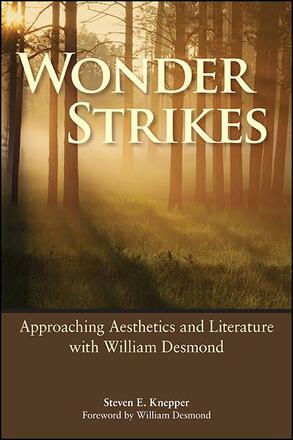
Reading through Wonder Strikes: Approaching Aesthetics and Literature with William Desmond I was caught by the silently operative and fittingly unmentioned (at least to my knowledge) virtue of humility. Humility lies beneath the text, forming and informing an openness to the excess offered by both the philosopher and poet. A genuine openness that neither stifles nor constrains the communication taking place between them, but instead facilitates growth through genuine encounter. Humility lies within the text as it facilitates the freedom of play. Guided by the lights of Desmond, Knepper plays between system and metaphor, philosophy and narrative. Humility lies beyond the text as the reader, myself most of all, is invited to accompany Knepper with Desmond into realizing the primacy of the passio essendi (the patience of being) over the conatus essendi (our endeavoring to be). We are invited to become attuned to the primacy of our porosity and vulnerability as the source and resource through which we endeavor to become. It is an invitation that, if accepted with sincerity, moves us into wonder and moves playfully between astonishment, perplexity, and curiosity.

Knepper’s monograph is divided into two sections: (1) “Incarnate Wonder,” and its application through (2) “Reading in the Between.” The first section, “Incarnate Wonder,” is an explication of William Desmond’s philosophy of aesthetics and a precise, cogent introduction to Desmond’s metaxological philosophy. The section begins where Desmond’s philosophy begins. It begins with wonder that is stirred by sensibly encountering the excess, “too muchness,” of being. This engagement with wonder and the overdeterminacy of being is the fertile ground upon which Knepper articulates the call of beauty, the work of the artist, and discernment of the holy.

By providing metaxological readings of Dickens, Melville, and Shakespeare among others, the second section, “Reading in the Between,” articulates literary moments of epiphanic encounters and also develops notions of tragedy and comedy. Here, Knepper brings Desmond’s philosophical aesthetics to life as he uses a diversity of narratives and poetry to concretize metaxological metaphysics. This is especially the case in the examples that Knepper refers to as epiphanic encounters. These encounters are literary moments of character self-transformation and wonder spurred by the character entering into and having disclosed the mystery of another’s overdeterminacy. Such encounters may be between person and thing, person and place, or simply between persons. They are an invitation to the reader to sympathetically undergo their own epiphanic encounter and awaken themselves to the mystery of being that makes up the substance of their lives. Regarding his notion of tragedy and comedy, Knepper moves deftly between Desmond’s notion of passio essendi and conatus essendi as the key principles forming tragic and comedic characters. Far from a cookie cutter formula, the dynamism between passio essendi and conatus essendi discloses the overdeterminacy of literary figures and thereby, facilitates insightful readings while never self-declaring that this is “the” reading.

Where Wonder Strikes begins, so does our symposium. It begins with four key themes in William Desmond’s philosophy: receptivity, abundance, affirmation, and wonder. Caroline Arnold, with “nuanced accuracy to Wonder Strikes,” guides us through these themes. However, beyond being a mere guide, Arnold creatively explores latent possibilities through critical engagement and the welcoming of additional voices, such as Josef Pieper. Moreover, Arnold perceives some ambiguity in differentiating Desmond from Nietzsche’s positive notion of affirmation and asks to hear more from Knepper concerning this relationship.

After Arnold’s response, the tone of the symposium shifts from direct philosophical concerns to literary. This shift takes place over the next three responses: Helena Tomko, Matthew Wickman, and Caitlin Smith Gilson. Among other virtues, Helena Tomko’s response, “A Wonderful Invitation,” fruitfully provides a metaxological reading of a passage from Dickens’s Great Expectations. She connects this reading with Knepper’s metaxological reading of Dickens’s A Christmas Carol and the redemptive laughter found therein.

Matthew Wickman’s response “A Postsecularity of Wonder, Beyond All ‘Post-‘s,'” notes that Knepper joins those humanities scholars who wish to move beyond a hermeneutic of suspicion, especially Rita Felski and Lori Branch, and toward an evocative hermeneutic. Wickman connects this movement to a broader movement of postsecularity but notes that Knepper reads less like a postsecular critic and more like a member of the theological turn who indirectly discloses the secular assumptions at work within postsecularity. This insight brings Wickman to ask how “does Knepper see his work in terms of recent critical history?”

Caitlin Smith Gilson’s response, “Tragedy, Catharsis, and the Birth of the Absolute Singular,” provides a poetic yet philosophical piece that attends to the tensions and paradox inherent to the tragic. It is philosophical in its content yet poetic in its form, and thereby shows how the poetic is philosophic and the philosophical is poetic. Thus, Smith Gilson provides us with an example and development of the philosophical thinking advocated by Knepper and Desmond.

Finally, the symposium wraps up with a theologically attuned response from Ryan Duns, SJ. Duns notes the sacramental character of epiphanic encounters in the realization that neither can be seized through our conatus essendi or willingness to be. Rather, they must be suffered or undergone. The passio essendi has primacy. Duns connects this vision to the kindred vision of the German sociologist Hartmut Rosa and his notion of resonance. This connection to sociology tees up Duns’s final set of questions that he poses to Knepper concerning the mode of epiphanic encounters in a virtual world. A world in which the instrument has become the environment. In Duns’s own words, “Can there be real epiphanies in virtual space? Can a sojourner in the digital desert encounter the Burning Bush and be called? Can the call to prophesy arise amidst megapixels?”

Caroline Arnold

Response

Receptivity, Abundance, Affirmation, and Wonder

This rich and thought-provoking study of William Desmond’s aesthetics provides an accessible introduction to Desmond’s philosophy. I found Knepper’s presentation of Desmond’s thought to be exceptionally lucid, avoiding excessive jargon without losing the richness and texture of Desmond’s thought and language—and, more importantly, without failing to be itself a thoroughly philosophical work (rather than merely a book about philosophy). Knepper also helpfully draws out many of Desmond’s unnamed or rarely named conversation partners and intellectual influences. By contextualizing Desmond in this way, Knepper both situates Desmond’s thought in what Knepper calls a “philosophical countercurrent that has steadily persisted throughout the past century,” and accentuates Desmond’s singular voice in this “countercurrent” in philosophy that is “moved more by astonished wonder than by skeptical doubt” (7). Above all, Wonder Strikes struck me as a thoughtful and engaged expression of gratitude and admiration for Desmond the philosopher and for the gift of his thought to the philosophical community, and it has deepened my own appreciation for Desmond’s work.

Moving from these summary observations and into the text itself, I’d like to explore in particular the four key themes Knepper identifies in Desmond’s philosophy: receptivity, abundance, affirmation, and wonder. By approaching Desmond’s philosophy through these four key themes, Knepper shows both how Desmond understands the nature of philosophical thought to be a practice of mindfulness of being, and the way in which this understanding of philosophy informs Desmond’s approach to the relationship between philosophy, art, and religion.

1. Receptivity

Receptivity (or porosity, a favorite Desmondian term): we are never simple, autonomous, atomic selves—no being is such. Knepper points first to our embodied receptivity, offering the simple experience of breathing for our philosophical reflection, and recalling Desmond’s observation that there is no dualistic “inside” or “outside” to the body. “Our very body is a between,” Knepper writes. “We live out an ongoing exchange,” receiving our environment into our own bodies, and giving to our environment from our own bodies (14). Moving more interiorly, Knepper notes the way in which music enters us not just through the openness of our bodies, but also into our more inward porosity: the notes of familiar melody stir us to search for the name of a song in our memory, or cause us to recall another memory, perhaps quite without our explicit consent. “We are receptive in our intimate depths,” Knepper writes, “we are porous in our memories, thoughts, and desires as well as our sense organs” (14). An understanding of this constitutive receptivity is central for understanding Desmond’s philosophical practice: understanding ourselves as essentially porous fundamentally changes our approach to thought. If we exist always in this state of interchange, deeply entrenched already within the happening of being, then philosophical thought cannot—and perhaps ought not—simply strive to go beyond, but must enact a cultivated mindfulness in the midst of being. Philosophy, then, may be a mode of intermediation in the between, a form of communicating with and responding to being.

Knepper also helpfully points to the ethical charge related to our porosity, reminding us of Desmond’s metaphor of “clogged porosity” (and noting the potential limits of this metaphor). We are continually tempted to and often trapped in self-enclosure: our porosity is “clogged,” and we lose, to some extent, our capacity to attend to reality as it shows itself and as it is, preferring our own interpretations and delusions to reality, or preferring the surety of our conatus essendi over against the more primal—and less controllable—passio essendi. Desmond, like Iris Murdoch, sees the overcoming of this tendency toward self-enclosure and the rehabilitation of our more fundamental receptivity as central to the moral life. In conversation with Ryan Duns’s work on Desmond’s philosophy as a spiritual practice, Knepper incorporates into this discussion of our constitutive receptivity and clogged porosity Desmond’s ideas of “agapeic mind” and “posthumous mind” as spiritual exercises, ways of training oneself in attentive receptivity and vigilance. By way of explanation, he offers not only description but also images from literature, first Desmond’s own examples from the life of Fyodor Dostoyevsky and from the story of the prodigal son, and then his own reflection on posthumous mind exemplified in Marilynne Robinson’s Gilead.

2. Abundance

Abundance: “Desmond is a philosopher of abundance, of ‘overdetermined’ excess, of the ‘too-muchness’ of being” (23). Knepper draws out the many ways in which Desmond understands the “abundance” of being: the multiplicity of beings, the inexhaustibility even of the singular, finite being, the overdetermined nature of our own self-transcending and desire, the multifaceted modes of intermediation between beings.

In his discussion of this key theme of abundance, Knepper also notes an important criticism that has been made against Desmond’s thought, namely, that Desmond’s continued referencing of “the other” or “otherness” can or does easily tend toward abstraction of the other, rather than attention to “the rich singularity of things” (30).1 This critique, however—as Knepper tells us—does not seem to pass unnoticed by Desmond. Desmond’s frequent recurrence to poetic description within his philosophical works helps us to return to the concrete, singular other. Knepper’s observation here sheds light on this key feature of Desmond’s philosophical writings. Desmond is not merely an academic philosopher or writing about philosophy. His work intends not to draw us away from the happening of being and into the purely noetic realm of thought and system, but to help us return to being with a renewed attention and deepened mindfulness. Desmond’s recurrence to poetic language is thus not simply a stylistic feature of his work, but also carries philosophical import.

3. Affirmation

Affirmation: Affirmation in Desmond’s thought is, Knepper tells us, the other side of our porosity. As constitutively porous beings, we receive from the outside, but we also live by a desire that moves from inside to outside. Following Plato, Desmond sees this constitutive desire as double: desire is not merely lack, but a mingling of lack and plenty, penia and poros. Because of this doubleness, eros carries an “agapeic potential” (33). Indeed, for Desmond, “agape is the highest possibility of eros,” and it does not “simply leave eros behind” (33). If it is the case that eros is motivated most fundamentally by an over-fullness and by the need not to consume but to affirm the goodness of the other, then true eros always contains within it the seed of agapeic love, a love that affirms the goodness of the other as other and even goes so far as to offer oneself in sacrificial service for the other. Knepper shows here how Desmond incorporates both Platonic insights and biblical wisdom in his relating of eros and agape. The full flowering of erotic desire into agapeic service is, for Desmond, already present in the Platonic tradition, even if not named as such, as it is in the Christian tradition. God’s affirmation of the goodness of creation in the Judeo-Christian creation narrative is at the same time an “agapeic release” of that creation to be for itself (34). In other words, God’s affirmation of the goodness of His creation is not sterile. It is an efficacious blessing, a freeing of creation to be not for God’s satisfaction but for its own good. Here Desmond shows a deep kinship with Josef Pieper, who connects this affirming love with the act of creation itself (Faith, Hope, Love 169–72). God truly endows his creation with its own goodness, with its own being, and he releases this creation to be for itself in his affirmation.

Knepper also brings into this discussion the nature of self-affirmation, addressing the possibility that “Desmond’s emphasis on agape may seem naive about self-interest,” given Desmond’s praise of agape for its self-forgetfulness and its disinterested affirmation of the other (34). This possibility in Desmond’s thought, it seems, would reveal a certain rupture or discontinuity between eros and agape. Knepper recalls Desmond’s own words: “True enough: even ‘It is good’ we human beings utter seems to be entangled in some open or secret ‘It is good for me, for us'” (34). However, self-affirmation is never merely self-affirmation, if Desmond is right that we are fundamentally porous beings. Self-affirmation is always, at bottom, an affirmation of being itself. I experience the gift of being most intimately in my own being; thus, it seems, the most radical affirmation of being I can make is my own self-affirmation, and this self-affirmation is, at its root, an affirmation of the goodness of being as such. In this way, my “self” affirmation of my own being is most true when it is also open to the possibility of the good of other-being and of being in community.

In this discussion of affirmation, I would have been interested to see some treatment of what Desmond calls Nietzsche’s “counterfeit amen.” Knepper does make reference to Nietzsche’s suspicion of alleged disinterested affirmation of the other. But it seems to me that there is more at stake when we move beyond Nietzsche’s well-trod account of ressentiment. I have in mind questions like the following: Does the sacred yes-saying of Zarathustra’s child amount to Desmond’s understanding of affirmation, and is it the same as Desmond’s relation between self-affirmation and the affirmation of the goodness of given being? What might differentiate Desmond and Nietzsche on this score? Does the responsibility of gratitude lessen, or even negate, the gift of “being for itself” that God bestows in his creation? In what way is gratitude tied to affirmation?

4. Wonder

Wonder: “William Desmond’s philosophy begins in wonder. It wonders at the aesthetic richness of the world, at our own mysterious depths, at the strangeness of there being anything at all” (1). Desmond considers a particular form of wonder to be most primordial: astonished wonder, “astonishment at the too-muchness of being” (35). Wonder is, as Socrates tells Theaetetus, the pathos of the philosopher (Theaetetus 155D). Wonder is something that happens to me, something that strikes me from beyond my anticipation. Moreover, this being struck by wonder is possible only because I am constitutively open to wonder.

The primal experience of astonished wonder opens to two related but derivative forms of wonder: perplexity and curiosity. Unlike wonder as such, which “entails an implicit, spontaneous affirmation” and thus is “agapeic” and “gives rise to gratitude and reverence,” perplexity “rattles and disturbs,” arousing in me a desire to “search for solid ground, for a secure grip on things” (36). Perplexity then narrows into curiosity, as it becomes interested in finding solutions to increasingly determinate, specific problems. Knepper helpfully summarizes: “Astonishment discloses being as richly over determinate. Perplexity discloses it as ambiguously indeterminate. Curiosity, on the other hand, is concerned with determinate knowledge, with how things work, with identifying and solving problems” (40).

What distinguishes Desmond’s philosophy is his insistence on the priority of astonished wonder over these two other modes of wonder throughout the adventure of philosophical thinking. Philosophy begins in wonder, yes, but it also ends in wonder and is companioned throughout by renewed wonder (xi). A philosophical practice that is not companioned by wonder is subject to a kind of tyrannical perplexity or curiosity that approaches the overdetermination or “too muchness” of being with fear and a desire to control.

Another feature of Desmond’s thought that Knepper points out is Desmond’s sense that wonder strikes first not in a moment of contemplating the existence of things generally, but in astonishment at the particular. It is the astonished wonder at the singular that first awakens our astonishment at the being there of anything at all. The experience of astonished wonder at the singular is also not a moving away from the singular even as it moves “beyond” the singular and to the transcendent: “To experience the transcendent via this beautiful painting or song is hardly to stop attending to it. To be struck by the strangeness of this child existing is hardly to brush the child aside” (109).

This centrality of wonder and openness to the plenitude of being also keeps Desmond’s philosophy open to its “significant others” or “companioning” approaches to being: art and religion. The prevalence of wonder is a reminder that being is always too much for thought, and that it is precisely this too muchness to which thought must be faithful. Philosophical thought will, as Desmond says, inevitably fail:

To be absolutely true to the plenitude of this happening is all but impossible for us, and indeed failure of some sort is inevitable. But this impossible truthfulness is asked of us, even if inevitable failure brings us back to the truth of our finitude. This failure may itself be a success of sorts, in renewing metaphysical astonishment before the enigma of being that was, and is, and always will be too much for us, in excess of our groping efforts.2

Paradoxically, it is in the failure of thought to capture being that thought is perhaps most true to being, but only when it confesses its own inadequacy before the plenitude of being. This self-recognition enables philosophy to accept art and religion as companions, rather than ways of mindfulness that are to be, in the end, overcome by philosophy (à la Hegel).

In Desmond’s philosophy, it seems to be precisely a sense of wonder that keeps philosophy itself open to the divine. Knepper claims (and I concur), “If one were to approach Desmond’s thought through a single poem, Hopkins’s ‘God’s Grandeur’ would be a fitting choice” (113). We see in this poem, as in Desmond’s thought, an attentiveness to the way in which man can both commodify nature and alienate himself from it. More importantly, though, we see in both a deeply sacramental vision of nature. The beauty and excess of nature is “hyperbolic”—it “throws us toward the creator but also returns us to the creation with a heightened awareness and a vocation of care” (114). This unmistakably Catholic vision of creation as sacrament undergirds Desmond’s entire philosophy.

As a student of Desmond’s and a great admirer of his thought, I am deeply grateful to Knepper for his work in Wonder Strikes, both for the way in which this book provides a much needed introduction to Desmond’s philosophy and for the way in which it has renewed my own appreciation for Desmond’s thought.


  1. Knepper specifically mentions Stephen Houlgate in “William Desmond on Philosophy and Its Others.”

  2. William Desmond, Being and the Between (Albany: SUNY Press, 1995), xiii.

  • Steven Knepper

    Steven Knepper

    Reply

    Response to Caroline Arnold

    My thanks to Caroline Arnold for this generous and thoughtful response to Wonder Strikes. She surveys the four facets of Desmond’s thought that guide my study: receptivity, abundance, affirmation, and wonder. She does so with nuanced accuracy to Wonder Strikes, but her own words shed new light on Desmond and his key ideas. She notes some ways that these themes could be approached from other angles, with other interlocutors. Certainly, there is much to be gained by examining the “unmistakably Catholic vision of creation as sacrament [that] undergirds Desmond’s entire philosophy,” and Josef Pieper would be a particularly good interlocutor on the topic of affirming love.

    Arnold wanted to see Wonder Strikes develop the distinction between Desmond’s affirmation and Nietzsche’s. This is a fair query, and I welcome the chance to say some more here about Desmond’s complex critique of Nietzsche. This is no easy thing since Nietzsche is, of course, the mask switcher. Nietzsche is a wide-ranging thinker who is at times subtle, at times hyperbolic (perhaps at times even subtly hyperbolic). Desmond is a patient, careful reader of Nietzsche who tries to do justice to these complexities. That said, we can use the four key ideas of receptivity, abundance, affirmation, and wonder to sum up Desmond’s critique of Nietzsche: Nietzsche, given his emphasis on the will, is not receptive enough to others and the world. In particular, he does not wonder at their inherent worth. This makes his affirmation at best ambiguous, perhaps even dubious.

    Let me try to briefly develop this. First, though, while Desmond has some sharp criticisms of Nietzsche, he also draws on him in more appreciative ways. In the chapter on tragedy in Wonder Strikes, I quote Christopher Ben Simpson’s assessment that Desmond is influenced by Nietzsche’s “recognition of becoming and the equivocal; the yea-saying, affirmative, Dionysian celebration of the finite and the earth; the critique of rational reductionisms, the nihilism of our merely human valuations; the poetic mode of philosophy (like Plato).”1 After this quotation, I write that Desmond sees “an unresolved tension between the ‘yea-saying’ Nietzsche and the Nietzsche who claims that all value is a human projection on a meaningless nature” (164). I go on to discuss how Nietzsche tends to conflate service to others with servility and how Desmond defends an “agapeic service” that is not groveling weakness but the fullest self-transcendence, a self-transcendence that carries one beyond willful “sovereignty.” I also talk about how Desmond uses Macbeth to criticize Nietzsche’s rhetoric of becoming “cruel,” and of being the arbiter of one’s own values. Here is a particularly trenchant passage from Desmond:

    In Macbeth we are honored with Shakespeare’s superiority to Nietzsche in seeing that what is “beyond good and evil,” gained by sacrilegious crime, is not, can never be, the “innocence of becoming.” It is, and must be, the evil usurpation of what is becoming for a man. It all begins in the betrayal of hospitality, and the delivery over to war as more primordial than the peace of being.2

    In the aftermath of their murderous power grab, in which they kill king and friend and child, Macbeth and Lady Macbeth learn that there is a repose-in-being more fundamental than willful assertion and that the latter can betray it. They murder unsuspecting others, and this murders their own sleep, turning their world into a waking nightmare.

    This touches on the “tension between the ‘yea-saying’ Nietzsche and the Nietzsche who claims that all value is a human projection on a meaningless nature.” Desmond is drawn to the yea-saying Nietzsche, the one who wants to say yes to life despite struggle and pain, but he thinks that Nietzsche’s amen is a “counterfeit” if it isn’t sourced in some recognition of being’s inherent worth.3 On the one hand, Desmond argues, Nietzsche never fully shakes the Schopenhauerian metaphysics of The Birth of Tragedy. Desmond points to some statements late in Nietzsche that evidence this, as when Nietzsche says, “This world: a monster of energy.”4 Nietzsche wants to say yes to the energy of this monster, whereas Schopenhauer wants to renounce it. But to say yes, Desmond holds, there must be some measure of hospitable goodness in it. (Desmond offers a similar critique of Schopenhauer. If Will is everything, including all that we are, then how is it even possible to ascetically still our willing? And what is the beauty that we discern in nature when our individual will recedes? Given the solace it offers, it seems to be more than adornment on a torture device. In short, Schopenhauer’s own account seems to call for a more complex metaphysics, one that does not reduce everything to Will. At the very least it seems to leave some serious unresolved questions.)5

    But late Nietzsche also frequently says that the world is worthless, that value is always and only our value, the value we project onto the chaotic flux. This is the Nietzsche of self-fashioning that has been so influential on postmodern thought. But here, too, there is the question of how this Nietzsche of value projection squares with the yea-saying Nietzsche:

    Nietzsche, properly interpreted, and this means sometimes interpreted against himself, is on the right track in asking about the ultimate amen; but he is betrayed by the whole horizon of his thinking. What is this horizon? I note four major aspects: First, it is defined by the view of valueless being, worse, by being as pain, even horror, at bottom. Second, by a view of the protective, recuperative power of creative will to power as affirming, despite worthlessness and horror. I call this whistling in the dark. Third, by a totalizing claim with respect to will to power (all being is will to power, and in either of the above two senses). But this totalized claim cannot sustain in full the sought affirmation. . . . Fourth, by the fact that our affirming will to power collapses in view of the totalized will to power: if all being is valueless, we too are valueless finally, in the valueless whole, and all our brave, heroic valuing is swallowed by the valueless whole. Inference: for the Nietzschean affirmation to make any sense at all, there must be some inherent hospitality of being to good.6

    With this passage in mind, we can see that Desmond’s strongest critiques of Nietzsche may not mention Nietzsche at all. They are where he insists on the fundamental nature of this hospitality, how it is the “between” in which we always emerge. Arnold points to this, flagging a central idea of Desmond’s that deserves much more attention: If we are porous creatures, if we are not sealed-off monads, then the basic self-insistence or self-interest that have been so central to modern thought fail to see that we never simply affirm ourselves alone. We affirm our rapport with certain aspects of being, with the community and conditions and others that sustain us. This more receptive affirmation of self-and-other is basic for Desmond, and only later might it contract to selfishness (or dilate to agapeic service). To my mind, this is one of Desmond’s most intriguing ideas. If Desmond is correct about our fundamental porosity, then there could never be a “value-projecting” human set over against a “valueless” world. Our sense of value always emerges from our fundamental relation to the qualitatively rich world. To truly say “yea,” Nietzsche would need to recognize something like this. He would need to rethink receptivity, and this would lead to a fuller affirmation and a fuller wonder.7 There is much more that could be said here, but hopefully this at least suggests the critiques that Desmond develops at great length in his writings and that I should have developed more fully in Wonder Strikes.


    1. Christopher Ben Simpson, “Introduction,” in The William Desmond Reader, ed. Christopher Ben Simpson (Albany: SUNY Press, 2012), xiv.

    2. Desmond, The Intimate Universal: The Hidden Porosity Among Religion, Art, Philosophy, and Politics (New York: Columbia University Press, 2016), 384. On Macbeth, see also Desmond, Is There a Sabbath for Thought? Between Religion and Philosophy (New York: Fordham University Press, 2005), 57–61, and Desmond, “Sticky Evil: Macbeth and the Karma of the Equivocal,” in God, Literature and Process Thought, ed. Darren J. N. Middleton (Aldershot: Ashgate, 2002), 133–55. Renée Köhler-Ryan has an insightful chapter on Macbeth in her Companions in the Between: Augustine, Desmond, and Their Communities of Love (Eugene: Pickwick, 2019), 82–97.

    3. While Desmond discusses Nietzsche throughout his body of work, see especially Desmond, “Ethics and the Evil of Being,” in What Happened in and to Moral Philosophy in the Twentieth Century? Philosophical Essays in Honor of Alasdair MacIntyre, ed. Fran O’Rourke (Notre Dame: University of Notre Dame Press, 2013), 423–59.

    4. Friedrich Nietzsche, The Will to Power, trans. Walter Kaufmann and R. J. Hollingdale (New York: Vintage, 1968), 550. See also Desmond, God and the Between (Malden: Blackwell, 2008), 27.

    5. On Schopenhauer, see Desmond, Art, Origins, Otherness: Between Philosophy and Art (Albany: SUNY Press, 2003), 131–63.

    6. Desmond, God and the Between, 27–28.

    7. Again, Nietzsche is a complex and varied thinker. Are there moments when he seems more receptive to this, when he seems to wonder at the world in this way? The contemporary philosopher Byung-Chul Han offers a more contemplative Nietzsche, pointing to at least a few passages that do seem to suggest such receptivity. See Han, What Is Power?, trans. Daniel Steuer (Cambridge: Polity, 2019), 80–97.

Helena Tomko

Response

A Wonderful Invitation

This was a case of metaphysics, at least as difficult for Joe to deal with as for me.
—Charles Dickens, Great Expectations, vol. 1, chapter 91

After his first day at Miss Haversham’s dreadful house, Pip returns home, disturbed, to the blacksmith’s forge where he lives with his abusive sister and her meek husband, Joe Gargery. At this pivotal plot moment in Charles Dickens’s Great Expectations, Pip recalls the traumatic singularity of this day that “made great changes in me,” the first link in a “long chain” that would bind his life.2 His childlike astonishment at the world has been warped by an old woman’s perverse desire to see a child at play and the young Estella’s proud cruelty toward his “common” habits. Frightened by these happenings, Pip lies about them to his sister, regaling long tales of a lavish game with swords, flags, and dogs. When Joe Gargery hears these stories, his “helpless amazement” prompts Pip to honesty:

“You remember all that about Miss Havisham’s?”

“Remember?” said Joe. “I believe you! Wonderful!”

“It’s a terrible thing, Joe; it ain’t true.”

“What are you telling of, Pip?” cried Joe, falling back in the greatest amazement. “You don’t mean to say it’s—”3

What follows is Joe’s gentle effort to counsel Pip, although this requires them both to recountenance all the day’s wonder, astonishment, and perplexity. Joe vanquishes his credulity by stepping into the breach between muddled fictions and hard truths, between Pip’s desperation and his own love for Pip. He mediates in this “case of metaphysics” by playing the companioning role of philosopher, confessor, and father, reassuring Pip that he sees him as wonderfully “oncommon.” If Pip is at all common, the way toward “oncommon” living will be something like what William Desmond would term the passio essendi (patience of being), as it has been for any “unpromoted Prince”: “‘Ah!’ added Joe. With a shake of the head that was full of meaning, ‘and begun at A too, and worked his way to Z.'”4 Joe’s expressions of unlearned wisdom are comic, as he then concedes that he has never made it to the end of the alphabet.5 Yet his words are an important corrective to the Bildungsroman‘s tragic momentum and the deforming of Pip’s conatus essendi (his endeavor to be)—the dangerous “distension” of his great expectations (Knepper 18, 22). Skilled in striking the anvil, Dickens’s Joe is distinctively open to wonder’s strikes. He is vulnerable to its counterfeits, too, but he has a generosity of spirit—an agapeic mind (19)—that accompanies Pip to the novel’s final pages. “‘Ah!’ added Joe.”

I am inspired to begin my reflections on Steven F. Knepper’s Wonder Strikes: Approaching Aesthetics and Literature with William Desmond with Dickens because Dickens furnishes the last of Knepper’s many compelling demonstrations of the metaxological approach to literature for which he advocates. My thoughts on Jim Gargery glean from how Knepper sets Desmond’s philosophy to work in his interpretation of Ebenezer Scrooge’s transformation in A Christmas Carol from quintessential miser into a man who “laughs a redemptive laugh that affirms the goodness of being” (198). Dickens has not been a postmodern favorite, as Desmond notes in his foreword to Wonder Strikes. This has been at the expense, not just of his fiction’s good cheer, but also his “lucid vision of our dark condition”—and what lies between (xiv–xv). Knepper’s application of Desmond’s thought to writers from Dickens to Toni Morrison, Herman Melville, and so many more, foregrounds all the in-betweenness of the modern novel, which has made its historic conquest of our imaginations in metaxological terrain: between intimate first-person expression and remote third-person observation; between the comic and the tragic; between the low and the high; between imitation and creation, between the common and the uncommon.

Wonder Strikes is written as a warm invitation to do as its subtitle proposes—to approach aesthetics and literature (poetry and fiction) in the company of William Desmond. Knepper models the kind of “companioning” at the philosophical heart of Desmond’s project (xi, passim). The book’s first part is a welcome entry point to Desmond’s aesthetic theory, equipped with crisp definitions of his writing’s essential lexis. In chapter 1, Knepper discusses Desmond’s “aesthetics of happening,” detailing how receptivity and porosity, abundance, affirmation, and different modes of wonder are constitutive of our encounters with the “too-muchness” of the world in which art plays its intermediating part, together with religion and philosophy (13).

Knepper generously explains how Desmond’s philosophy is porous to his own poetic gift, just as his poems are to his philosophy. In chapter 2’s account of “the call of beauty,” he quotes an especially poetic passage from Desmond’s interpretation of J. M. W. Turner’s The Burning of the Houses of Lords and Commons. Turner, according to Desmond, “‘is catching the conflagration as it flamed and his painting hand catches fire'” (56). This phrasing inevitably recalls the poetry of Gerard Manley Hopkins—the kingfishers catching fire and dragonflies drawing flame that denote the “singular particularity” of all things, doing the same thing that all creatures do as they “selve” that which they are (113).6 Knepper’s gift is to catch densely poetic, intertextual passages like this one and show how Desmond lets art, philosophy, and religion draw flame from one another. In this context, Knepper proposes a metaxological account of the posture and practice of literary creativity. Here is a vision of the writer as mediator, moving blithely between “external and internal otherness,” between “imitation and creation,” between this world and otherworlds, between poetry and prayer, between apophasis and cataphasis. No wonder Knepper is confident in arguing that many of Desmond’s philosophical concepts offer “affordances for literary criticism” (135).

This confidence leads to Knepper’s attractive proposal for how we can read within and between the many intellectual legacies that we inherit. If we have been raised on a hermeneutic of suspicion—a way of thinking assigned to rather than chosen by now many generations of young scholars—can we still aspire to a hermeneutic of affirmation that does not abandon all our acquired critical acumen (160–62)? Knepper thinks this possible. In the book’s second part, “Reading in the Between,” he considers governing critical theories with the mind of a thinker convinced of the goodness of being and what Desmond terms its “overdeterminacy” (1). The way of reading Knepper is grounding will be “marked by patient openness and a certain critical humility” (139). This disposition presumes that interpreting a text cannot exhaust it, unlike the shrinkage to which we subject texts whenever we consent to the hermeneutic limits set by a particular theory or ideology.

A metaxological approach to reading does not necessarily supplant other approaches but rather leaves them what Hopkins calls “root-room”—room to grow if they have life.7 Such reading will move judiciously between discourses, not blindly affirming errors but compassionately affirming honest disclosures. It offers what Knepper terms “affordances that are to be found in a generous study of earlier thinkers.” These can free our literary readings from the intellectual “‘straightjacket'” into which so many scholars have squeezed their thinking in an academy that long ago stepped out “‘beyond metaphysics'” (194). When wonder strikes, metaphysics resonates anew, not overwhelming but enlivening our encounters with literary art.8

Knepper’s hope for what he calls “criticism in the metaxu“—”balancing critique with affirmation”—has much in common with the post-critical turn in literary theory (7, 132). In an important chapter on “Epiphanic Encounters,” he compares Desmond’s understanding of reading as intermediation with Rita Felski’s concept of “co-making” (133–34).9 He applauds the commonsense return to character for which Felski, Amanda Anderson, and Toril Moi have recently argued. New historicism’s preference for discontinuities over continuities and the reductionism of psychoanalytic approaches are noted as examples of methodologies that have been inevitably formulaic, like “a cookie cutter that carves the same shape into every text” (135). Knepper’s alternative is not one more literary theory to rival the others but rather an extension of Desmond’s metaxology toward an understanding of literary texts as epiphanic encounters and epiphanic encounters as constitutive of literary texts from Genesis to Joyce.

This restoration to literature of its epiphanic potential is an inviting proposal for formal scholarship and also for teaching in the college classroom. What are we up to when we invite students into the literary worlds we assign to them? What if the study of literature were to become, before all else, an exercise in agapeic attention, not uncritical in its affirmations, but always entailing “an attentive openness and patience prior to such critique” (139). This is a kindred approach to what Michael Tomko, following Samuel Taylor Coleridge and J. R. R. Tolkien, has called the “poetic faith” we need in our literary explorations.10 A metaxological approach to literature is an invitation for students and professors alike to wonder together at the goodness of being and to countenance their own capacity to be radically transformed by encounters with beauty, with art, with one another, not to mention the “‘companioning’ power of the divine” (161).

As in any good classroom, laughter occupies a culminating place in this metaxological vision of literary art. Knepper explains how this focus on the comic is not at the expense of the tragic but rather emerges from Desmond’s recalibration of the Aristotelian privilege given to the noble and the tragic with respect to the low and the comic. These arguments about “redemptive laughter” are particularly well suited to analysis of the novel, which has always teetered uncomfortably between genres, “between tragic lack and comic excess” (175). I am drawn once again to Dickens’s Great Expectations and to the fraught relationship between Joe Gargery and Pip. When little Pip learns to read and write, his entry into literacy brings with it a realization of Joe’s illiteracy. He scrawls a note on his charcoal slate, promising to teach Joe to read just as Joe will teach him to be a blacksmith: “JO WOT LARX.”11 He is imagining a purposeful, playful life of comic companioning—and reading. But the happenings at Miss Haversham’s will introduce a desperate impatience into Pip’s sense of who he is and should become. This new imbalance between passio and conatus has a tragic tilt, which Joe perceives when he visits Pip in London after an anonymous benefactor has sent him forth to pursue his indeterminate “great expectations.” Joe has a note written to announce his visit in which “He wishes [the scribe] most particular to write what larks.” The now foppish Pip receives this message “with considerable disturbance, some mortification, and a keen sense of incongruity” (199). Joe is, indeed, comically incongruous in his city garb when he arrives at Pip’s lavishly furnished quarters, his eyes “rolling round and round the room, and round and round the flowered pattern of my dressing-gown.”12 The scene is painfully epiphanic for Pip, in the moment and in the retelling. His tragic course has a Faustian feel, all the more eerie because any diabolical deal was made in childhood. As he beholds Joe beholding him, however, Pip sees himself anew—adorned, foolish, and callous. Joe may be comically beside himself in his perplexity at Pip, but his generously agapeic mind registers the wonder of Pip’s being even as he refuses to affirm him in that dressing gown. Narrator Pip is, of course, recounting all this with the clarity of what Desmond terms “posthumous mind”—a mind newly awakened and attentive to all that was nearly lost (20). This hard-won perspective on his forestalled tragic course is drenched with tears. But it is also resonant with the kind of affirming laughter that, as Knepper writes, “offers another way of undoing the hardened conatus and returning to the passio” (175).

Pip’s tears get turned to laughter—licensing all the comic episodes scattered throughout his narrative—thanks to Joe’s patient agapeic gaze that lets the novel finally tilt from tragic collapse toward comic affirmation. Pip falls ill after his great expectations are confounded. Febrile, he hallucinates that he is a brick in a wall or a steel beam in an engine. It is as if he can only imagine himself, dehumanized, as a cog in the machine of history. Like Jacob and the angel, he wrestles with fantastical people he thinks are trying to murder him—only to discover “that they meant to do me good” and that “all these people sooner or later . . . settle down into the likeness of Joe.” Pip has been misreading the world as a place of mere acquisition and ambition (or, as Knepper might flag it, “serviceable disposability”), learning to suspect and fear it (4). When he recovers, however, he discovers that Joe is indeed at his bedside, gazing with a “face that looked so hopefully and tenderly upon me.”13 Joe has been reading the world better all along. Present to Pip on the threshold of his derangement, Joe knows how to companion his anguished descent toward tragic failure and his restoration to wonder. Just as Scrooge finally “laughs a redemptive laugh that affirms the goodness of being”—transforming himself and his story—Joe Gargery offers a winning emblem of what it is like to be disposed to wonder’s strikes.

As Knepper notes in his discussion of Desmond’s concept of idiot wisdom, a disposition like Joe’s “recognizes the worth of the singular in a way that will seem excessive, even foolish to ‘universal’ reason” (70). Is it absurd to choose Joe as exemplary of how to read fiction and, more boldly, how to read one another and the world? When I read about Joe, I find him wonderful. He is, of course, too good to be true, certainly more like a holy fool than a sophisticated scholar. Yet the logic of Wonder Strikes, culminating in “redemptive laughter,” prompted me to pick Joe, disposed as he is to larks and wonders, as the right companion for the task of reviewing this wonderful book. Knepper has movingly brought into focus all the ameliorative hope in Desmond’s philosophy and shown how it offers a glimpse of restoration and remedy for what ails our thinking and our teaching whenever “they are not sourced in astonished wonder” (95).


  1. Charles Dickens, Great Expectations, ed. Margaret Cardwell (Oxford: Oxford World Classics, 2008), 64.

  2. Dickens, Great Expectations, 66.

  3. Dickens, Great Expectations, 63.

  4. Dickens, Great Expectations, 65.

  5. See William Desmond’s poem “Learning Unlearning,” in Godsends: From Default Atheism to the Surprise of Revelation (Notre Dame: University of Notre Dame Press, 2021), 131.

  6. See Gerard Manley Hopkins, “As Kingfishers Catch Fire.”

  7. See Gerard Manley Hopkins, “My Own Heart Let Me Have More Pity On.”

  8. See Desmond, Godsends, 134: “It is worthy of recall that the meta of metaphysics can have a double sense—it can mean ‘in the midst’ but also ‘over and above,’ ‘beyond.’ Think of our human being as thus double: inside and outside, immanent and transcendent, immanently self-surpassing yet surpassed by what is not determined entirely immanently. The metaxu as immanence is a given porosity of being, already in relation to what is beyond itself. It partakes of this double sense of the meta. What is most important is the happening of the passage between.”

  9. See Rita Felski, Hooked: Art and Attachment (Chicago: University of Chicago Press, 2020).

  10. Michael Tomko, Beyond the Willing Suspension of Disbelief: Poetic Faith from Coleridge to Tolkien (London: Bloomsbury, 2016).

  11. Dickens, Great Expectations, 41.

  12. Dickens, Great Expectations, 201.

  13. Dickens, Great Expectations, 422–23.

  • Steven Knepper

    Steven Knepper

    Reply

    Response to Helena Tomko

    I am humbled by Helena Tomko’s kind words about Wonder Strikes. Her remarks about laughter and humor are especially gratifying given her own excellent work on these. My thanks to her for them.

    I am also delighted by the metaxological reading of Dickens’s Great Expectations that bookends her reflection. There are so many keen insights and suggestive points here. Receptivity to others and the world is important to both existential fulfillment and ethical care for others. Pip moves from an open child to a self- and image-conscious young man. He puts up a façade and is absorbed by his own “great expectations.” As Tomko shows, though, this is not simply a matter of selfishness. It is also the result of the wound he receives at Miss Havisham’s. To be open is also to be vulnerable. And vulnerable Pip leaves her house lacerated by the ridicule of his station and prospects. Miss Havisham, herself hurt in the past, tries to harden the children Estella and Pip. This does not lead to their protection but to their disfigurement. Openness means vulnerability, but to be hardened is to cut oneself off from wonder and love. There is a real risk involved. If receptivity talk can seem a bit precious or saccharine at first glance, Tomko helps us see why that is not so.

    Joe Gargery is quite a different influence on Pip. I smiled at Tomko’s apt description of the blacksmith: “Skilled in striking the anvil, Dickens’s Joe is distinctively open to wonder’s strikes.” Steadfast and kind, Joe helps Pip to see himself anew and escape his “tragic” trajectory. Dickens is a great novelist of distinctive, singular characters in complex webs of relationships.1 Desmond’s metaphysics likewise honors both the intimate singularity of each person but also how each person is always a between in the between of the world. Each person exists in manifold constitutive relationships. Indeed, our singularity emerges through these relationships. Each of us is always porous to influence. Virtue ethics from Plato and Aristotle onward notes how ethical character is not only a matter of individual self-discipline and practices but also of formative relationships, of community. Desmond’s metaxology offers a particularly sophisticated framework for thinking about the latter. This is well evidenced in Tomko’s metaxological reading of the adult influences on Pip.

    Those influences make me think of a favorite passage in Rachel Carson’s The Sense of Wonder: “If a child is to keep alive his inborn sense of wonder. . . , he needs the companionship of at least one adult who can share it, rediscovering with him the joy, excitement and mystery of the world we live in.”2 Many parents, grandparents, aunts, uncles, and teachers can readily testify to how children reawaken an adult’s sense of wonder. Carson underscores how the adult, in turn, can either nurture—or discourage—the child’s openness to wonder. Of course, adult wonder guides can take many forms. In The Sense of Wonder, Carson is the highly knowledgeable and perceptive scientist aunt, guiding her young nephew through the rich ecosystems of the Maine seashore and forest. As Tomko points out, Joe is a very different sort of wonder guide. He is naïve, even gullible at times, but also something of a “holy fool.”3 The holy fool’s naivete is not simply taken advantage of by others—it can cut through their machinations, posturing, rationalization, cynicism, and callousness of others, through what passes for pragmatic common sense or the social status quo. It can reveal these as inadequate, as threadbare. The holy fool can turn the world on its head. The holy fool can grant epiphanies, such as the epiphany that Joe grants Pip in London.

    Turning to humanities pedagogy, I appreciate Tomko’s description of the metaxological approach to reading proposed in Wonder Strikes, in which we read receptively and patiently, in which we allow the work to move and challenge us. We do not leave behind critique, but it is not the default. It emerges in dialogue with the text. As Tomko points out, other literary scholars have called for similar approaches and have much to offer. I take some bearings from Michael Martin’s The Incarnation of the Poetic Word (Angelico, 2017), which first drew on Desmond to describe an “agapeic criticism.” Rita Felski is a major interlocutor in Wonder Strikes. (I discuss her work when responding to Matthew Wickman). There have also been important figures working at the intersection of religion and literature. I could have discussed Alan Jacobs’s influential A Theology of Reading: The Hermeneutics of Love (Boulder: Westview, 2001) or Michael Tomko’s insightful discussion of “poetic faith” in Beyond the Willing Suspension of Disbelief: Poetic Faith from Coleridge to Tolkien (London: Bloomsbury, 2016). The latter would have been especially fitting given Desmond’s (under remarked upon) dialogue with Coleridge. I also could have discussed William Franke’s account of humanistic inquiry in The Revelation of Imagination: From Homer and the Bible through Virgil and Augustine to Dante (Evanston: Northwestern University Press, 2015).

    Receptivity is fundamental in a metaxological approach to reading, but it can be a nuanced receptivity. (I am tempted to say “critical receptivity.”) Just as in life we can cultivate receptivity to others without being a guileless pushover, or without tolerating an abusive relationship, so we can read receptively without being credulous. (Michael Tomko makes a similar point in the third chapter of Beyond the Willing Suspension of Disbelief, where he discusses “the willing resumption of disbelief.”) This calls for continual adjustment and situational judgment. It is what I try to model in the classroom.

    But Tomko’s discussion of Joe’s epiphanic naivete makes me realize that, while I’m no holy fool, some of my most successful moments in the classroom have come when I abandoned poised balance and risked a more radical vulnerability, when I acknowledged that a work not only puzzles me intellectually but also deeply unsettles me—or deeply moves me. These are not moments I plan out or stage. They happen organically and infrequently. Sometimes they don’t lead to a deeper discussion (just to me seeming eccentric), but at times the qualitative feeling in the classroom changes and the discussion deepens. Maybe risking such vulnerability from time to time is one way we can be wonder guides in the humanities classroom.


    1. Dwight Lindley also brings Dickens and Desmond into rich conversation in his contribution to the forthcoming collection The Intimate Strangeness of Poetry: William Desmond and Literature, which I am editing for Cascade.

    2. Rachel Carson, The Sense of Wonder (New York: Harper & Row, 1965), 45. I offer a metaxological response to this quotation in Knepper, “Cultivating Wonder,” in Astonishment and Science: Engagements with William Desmond, ed. Paul Tyson (Eugene: Cascade, 2023), 54–60.

    3. Desmond discusses the “holy fool” in Philosophy and Its Others: Ways of Being and Mind (Albany: SUNY Press, 1990), 272–75.

Matthew Wickman

Response

A Postsecularity of Wonder, Beyond All “Post-‘s”

What I most appreciate about Steven E. Knepper’s thoughtful and expansive monograph Wonder Strikes is, at face value, obvious: I love its engaging presentation of the work of William Desmond. As Desmond was, until recently, mostly unknown to me, Knepper’s book has helped open a new world of interpretive possibility. But what most intrigues me about Knepper’s book is something a little different, and the clue here is found in a section of the book that feels more familiar, situating Desmond’s novelty in context. This is where Knepper discusses the work of Rita Felski, whose arguments for postcritique have marked an important moment of reckoning for literary studies. Knepper doesn’t seem consumed by postcritique per se: his brief appeal to Felski is, if anything, more taken with the uses of literature (the title of Felski’s precursor to The Limits of Critique), though postcritique hovers in the background.1 Reading, Knepper elaborates through Felski, is an “imaginative supplement” we bring to a text, “a process of ‘co-making'” that arises from, as Desmond would call it, a text’s overdeterminacy, its openness to multiple aspects of potential significance. “Because [Desmond’s] metaxological approach recognizes the work as overdetermined, it affirms the possible insights of any number of critical approaches and their attendant concepts—biographical, formalist, feminist, historical, and so forth.” In this respect, Desmond’s concepts of perpetual betweenness (“metaxology”) and porosity are, like Felski’s model of postcritique, “less an approach than a framework,” a way of opening ourselves to ways texts may move us and act on us.2

Brief though it is, this section of Wonder Strikes helps explain what I find especially provocative about Knepper’s book. Let me provide some context. Over the past decade, especially, several scholars I admire, particularly scholars of religious faith, have expressed their hunger for a vision like Felski’s—and, in Knepper’s treatment, Desmond’s—in literary studies. That vision, as they see it, is more overdetermined than ideological, more evocative than suspicious: in the common currency, it’s a vision they deem postcritical, and some of these friends have sought to adopt Felski’s vision for postsecular criticism. Lori Branch, for example, wonders whether, through postcritique,

we might begin to glimpse a scholarly culture in which spiritual, religious experiences of hope, belief, love, and longing weren’t routinely dismissed or secularized; whether the reparative types of reading Felski approves might recognize their kin in the poetry of praise or the prose of repentance; . . . [and] whether we can acknowledge the ways that religious sensibilities have much to tell us about how to approach a text “as a phenomenon to be engaged” rather than merely an “inert object to be scrutinized.”3

Branch is a master of the stirring manifesto. But Felski’s reply to this line of inquiry, while appreciative, is also, tellingly, squeamish. It accedes a formal similarity to the “religious sensibilities” Branch invokes (“both [postcritique and postsecularity] include encounters with the numinous, the transfigurative, the inexplicable”) while keeping the two approaches at arm’s length (“My emphasis, as [Branch] points out, is squarely on aesthetic, rather than religious, enchantment”).4 Felski perceives the potential for meaningful dialogue between postcritique and postsecularity; she even spent a day as an invited guest at the 2019 NEH seminar on postsecularity that Branch organized with Mark Knight (the editor of Literature and Theology, an excellent venue for literature and religion). But ultimately, if openness-qua-expressions-of-faith are what Branch has in mind, however overdetermined—however truly open—such expressions may be, Felski isn’t going there.

And neither, in a way, does Knepper. And that is what I find so provocative about Wonder Strikes. Because affectively, his book seems to share more with Branch than with Felski, more with those who are open to religion than with those for whom religion triggers an allergic, familiarly suspicious, reaction. But unlike Branch and some of her contemporaries, Knepper expresses little if any inclination to reveal how iconic thinkers and schools of thought (e.g., Derrida, whom Branch evokes, or Lyotard, as I have5) are “always already” postsecular. Indeed, Knepper seems largely unconcerned about making a space for religious thinking among the normative, secular registers of modern thought. I do not believe this is because Knepper is unsympathetic to thinking that takes religious faith seriously. He simply proceeds as though such thinking, as one expression of porosity, already finds its own norms and oracles, with Desmond being his pertinent case in point. For this reason, there is little that strikes me as “post-iche” (postsecular, postcritical, postmodern . . .) about Wonder Strikes, little that betrays a self-conscious sense of belatedness in a crowded, distracted, and potentially indifferent marketplace of ideas. Instead, and reflecting the openness it describes, Wonder Strikes is expository rather than polemical. What, it asks, is this wonderfully overdetermined object, this philosophy of Desmond’s? What might it bring to literary studies? And how does it expound on work by thinkers of a similar cast of mind—people like Byung-Chul Han, Richard Kearney, Catherine Pickstock, Gabriel Marcel, Jacques Maritain, Jean-Louis Chrétien, and others?

To this extent, Wonder Strikes seems to belong more to a decades-long theological turn—more to a world whose cultural imaginary proceeds from such origins as Jewish philosophical ethics and Vatican II, and that thus moves easily across literary criticism and systematic theology—than to a more recent, and understandably defensive, postsecular turn whose laureate is Charles Taylor. A Secular Age, though a remarkably influential achievement, concedes a point in its very title: we live in a secular world, yes . . . but that secularity is not what you think it is! By contrast, Desmond’s world, and by extension Knepper’s, has fewer preliminary obstacles. It is strikingly, gloriously overdetermined, and so the best we can do is open ourselves to it in wonder and then find ways to respond.

Knepper enacts such a response by unfolding four tenets central to Desmond’s philosophy. First, he discusses Desmond’s aesthetic of wonder, a sensual and thus embodied excess that “pour[s] over and through us. At times, it breaks through our numbness, striking us.”6 Desmond’s concept bears similarities to others that draw from a tradition of theological aesthetics, from Hans Urs von Balthasar’s extensive meditations on transcendence to Richard Kearney’s “carnal hermeneutics.”7 As Knepper shows, and this is his second point, Desmond’s “incarnate” aesthetics impel us to reconsider beauty as a vehicle of wonder, as what “testifies to forms that are not closed but open. [Beauty] testifies to open wholes that communicate beyond themselves.”8 Third, for Desmond, art that produces and provokes us to reflect on beauty thus becomes a means of instruction; it situates us in a lush “between” (in Knepper’s treatment, between imitation and craft, inspiration and skill, and traditions and individual talents) that frames experience. Art, drawing on both (and situating itself between) religion and philosophy, becomes a privileged medium for incarnating the differential aspects of wonder as astonishment and/or as perplexity. Fourth, these features of experience—wonder, openness, and beauty—place us evocatively in the realm of the sacred, which impresses on us “the excess and mystery of being.”9 Knepper takes special care to contrast these sacred facets of our existence with the “serviceable disposability”—the reductive, impoverishing instrumentality—that characterizes so much of modern life. And once he lays these foundations of Desmond’s thought, he proceeds in the second half of his book to present a series of illustrative encounters with works of literature: ancient, Biblical, and Melvillean epics; James Joyce’s experiments with narrative; Shakespearean tragedy; and Dickensian flights of festivity and memory.

Throughout, Knepper’s book indirectly reveals the deep secularity of so much postsecular discourse. It is not that postsecular discourse is irreligious (as the religion/irreligion binary is one most postsecular criticism deconstructs) but rather that it is deeply bound up in its own time and circumstances. Hence, it wasn’t 9/11 alone to which postsecular critics began responding but also the critical injunction to “Always historicize!”10 In the form of new historicism, this axiom demanded that critics negotiate the mechanics of poststructuralism within a “cultural poetics” that accounted for a text’s material (including its historical) conditions of possibility. Here, postsecular criticism found itself on two sides of a line. On one side, it contested the dialectical-material bases of the historicist turn by insisting on religious and spiritual facets of our natures that are irreducible to crude materialism.11 But on the other, it made this case by adopting historicist premises, namely that history (e.g., 9/11) revealed that the secularization thesis was fundamentally unsound.12 In effect, then, postsecular criticism emerged in the early 2000s as an autodeconstructive enterprise—it argued compellingly against the historicist logic of its own articulation. Whatever the structural weakness of this approach, it was also a source of strength inasmuch as postsecular critics could present otherwise unfamiliar thinking in a familiar form: why religion matters now.13 (“Always sacralize”?)

In Knepper’s treatment, Desmond’s thought seemingly involves little of this drama. It is far more evocative than dogmatic, too taken with overdetermination, perhaps, to insist that one particular aspect of its philosophical approach “matters now!” But this prompts, for me, several questions around a critical intervention like Knepper’s—questions with which I will conclude:

Why Desmond now? And is “Why Desmond now?” even a proper way to approach his work? If not, what suggests that this work can draw and maintain attention?

Would Knepper consider himself a postsecular critic? If so, where does he situate his work relative to the critical mass of postsecular thought? And if not, does he hew instead to the earlier theological turn? In short, does Knepper see his work in terms of recent critical history?

What is the relationship between the “incarnate aesthetics” Knepper expounds in Wonder Strikes and the historical-materialist aesthetic that provided the grist for cultural studies?

Lastly, Wonder Strikes is, perhaps, the best exhibit of why scholars interested in literature and religion—scholars given to a postsecular bent of mind—might find real value in Desmond’s work. And ultimately, it is the integrity of our critical engagements of Desmond that will determine the latter’s viability for literary studies. So how do we describe the meaning of this engagement? In the spirit of Desmond’s work, is it possible to find ourselves “metaxologically” between the residual historicism of present-day postsecularity and a postsecularity that operates on entirely different grounds? Might any of these questions prompt, in the spirit of Knepper’s book, wonder (whether astonishment or perplexity) at the state of our current critical climate? Is there anything sacred about our era of “crisis”?


  1. I am referring to Felski’s Uses of Literature (Malden, MA: Wiley-Blackwell, 2008).

  2. Knepper, Wonder Strikes: Approaching Aesthetics and Literature with William Desmond (Albany: State University of New York Press, 2022), 133–35.

  3. Branch, “Postcritical and Postsecular: The Horizon of Belief,” Religion and Literature 48.2 (2016): 160–67 (164).

  4. Felski, “Entanglement and Animosity: Religion and Literary Studies,” Religion and Literature 48.2 (2016): 189–95 (190).

  5. See Branch, “Beauty and Belief: Postsecular Approaches to Literature and the Humanities,” Literature and Belief 36:1–2 (2016): 1–20 (11–13) and Wickman, “The New Immaterialism? On Spirituality in Modern Thought,” Poetics Today 41.3 (2020): 327–46 (336–41).

  6. Knepper, Wonder Strikes, 13.

  7. See, most notably, Balthasar, The Glory of the Lord: A Theological Aesthetics, vol. 1: Seeing the Form, ed. John Kenneth Riches (San Francisco: Ignatius Press, 2009) and Kearney, Carnal Hermeneutics (New York: Fordham University Press, 2015).

  8. Wonder Strikes, 47.

  9. Wonder Strikes, 95.

  10. This is the opening salvo of Fredric Jameson’s The Political Unconscious: Narrative as a Socially Symbolic Act (Ithaca: Cornell University Press, 1981).

  11. For perhaps the bluntest critique of a coarse materialism, see Christina Bieber Lake, Beyond the Story: American Literary Fiction and the Limits of Materialism (Notre Dame: University of Notre Dame Press, 2019).

  12. The signature text here is Jürgen Habermas’s essay “Notes on a Post-Secular Society,” Sign and Sight, 18 June 2008, www.signandsight.com/features/1714.html.

  13. See, exemplarily, Lori Branch and Mark Knight, “Why the Postsecular Matters: Literary Studies and the Rise of the Novel,” Christianity and Literature 67.3 (2018): 493–510.

  • Steven Knepper

    Steven Knepper

    Reply

    Response to Matthew Wickman

    My thanks to Matthew Wickman for this thoughtful, searching reflection on Wonder Strikes. To my mind, Wickman is one of the most insightful contemporary thinkers about literature and spirituality.1 I am humbled by his generous appraisal of Wonder Strikes, and I appreciate his sensitive questions about where it belongs in recent decades’ arguments about secularity and the humanities.

    I might start with a few words about my general approach. Wonder Strikes is my attempt to think through some of the perennial questions in aesthetics and literary studies—questions that have also perennially plagued me—such as the nature of beauty and artistic inspiration. I did not worry much about the critical zeitgeist or about trying to get the attention of the literary studies mainstream. The book was written out of a keen sense that the academic humanities are in crisis, and I think a crisis is a particularly good time to get back to fundamentals. I cite many thinkers, and I do enter into contemporary debates, but I most often draw on thinkers in my attempt to offer the most compelling metaxological account I can of the topic under consideration.

    My hope, of course, is that others will nod along to at least some of this account, that they might experience some recognition, some resonance between it and their own insights and intuitions, better yet a deepening of those insights and intuitions, and that this might inspire them to read more deeply in Desmond’s oeuvre. But I also hope that even the inevitable disagreements will be more about the topics under discussion than about where I situate myself in the latest debates. This is Desmond’s own approach, which I tried my best to follow by thinking with his remarkable body of work. Desmond’s dissertation, subsequently published as Desire, Dialectic, and Otherness (Yale University Press, 1987), laid the groundwork for his metaxological approach, which he continues to build upon decades later. Rather than the usual dissertation of narrow exegesis or contextualization, it is an audacious work of speculative metaphysics. He didn’t even want to include footnotes. (I, for better or worse, love footnotes.) I knew that my approach in Wonder Strikes would result in an odd book, and I am grateful that SUNY took a chance on it.

    That said, Wonder Strikes does engage recent scholarly discussions regarding secularity, especially in Chapter Four, and I appreciate the opportunity to say some more about those here. (I also touch on humanities pedagogy in my response to Helena Tomko.) One of the things I most appreciate about Rita Felski’s work is its departure point: Our scholarly conversations have grown too narrow. We need to pay more attention to why people (especially students) are drawn to literature in the first place, to literature’s power to affect us, to how it speaks to readers across time and space. Without dismissing the obvious ways in which literary works reflect, and reflect upon, their historical moment, Felski criticizes how we have too often locked them away in the prison cell of a “period.” Felski also criticizes the ways we too often approach literary texts as the unflinching, objective critic who “operates” on the text, brushing aside all the ways in which texts affect us. I agree with Felski that we disfigure literature when we approach it in these ways.2 In Wonder Strikes, I try to show that Desmond, with his emphasis on receptivity and intermediation, provides a supple framework for a post-critical approach to literature. While I have my differences with Felski and others in the post-critique camp, I am generally appreciative and see Wonder Strikes as participating in their conversation.

    “Post-secular” is a somewhat difficult term because it has been used so widely and in such varied ways. Wickman helpfully narrows the focus, though, in pointing to Charles Taylor’s A Secular Age (Belknap, 2007), the publication of which was undoubtedly a watershed moment in discussions of the post-secular. Taylor’s massive work is a massive achievement by any measure, and I continue to learn much from it. I became dissatisfied, however, with the way it juxtaposes a premodern past of “porous selves” against a modernity of “buffered selves.” (Desmond himself raises questions about this.) I am drawn more to Desmond’s account—which agrees with Taylor that our porosity is often clogged in modernity, that our cultural ethos is in certain ways attenuated, and that a “default atheism” reigns among many cultural elites—but which also holds that humans are constitutively porous, that even “clogged up” moderns continue to be moved by music, to be wonder-struck by natural beauty, to experience the numinous. Taylor would not disagree with this. His definition of secularism is one of multiplying possibilities rather than of the replacement of belief with unbelief. Yet his language of immanent frames and buffered selves is ultimately too historicist to my mind, and I found his concluding discussion of “itineraries” of belief frustratingly thin.3

    Hence, I do have worries about how the “post” is to be understood in post-secular. In Desmond’s terms, the primal ethos of being is just as rich and mysterious as it has always been. Our reconfigured cultural ethos might numb us to this, but the too-muchness is still there. It is perennially there. We just don’t always recognize it, especially in the academy. Wickman draws our attention to a great set of essays in a 2016 issue of Religion and Literature on the relationship between the post-critique and post-secular. In that forum, I especially appreciate Lori Branch’s notion of the post-secular as a scholarly approach that tries to “answer better to the full range of inner, spiritual experience, especially the experiences of questioning and of believing, of coming to trust or hope.”4

    This kind of post-secularism, it seems to me, attends to practice. Practice often reveals that what is supposedly lost to, or at least very difficult for, moderns remains available.5 “Re-enchantment,” to use another imperfect term, is often less about ideas than it is about cultivating receptivity to the too-muchness of being. It is about learning to see and read in certain ways.6 (This emphasis is part of what excites me about Wickman’s own work on spirituality and literature.) It is a matter of contemplation and prayer.

    This is not to shortchange ideas, arguments, and genealogies. For one thing, we need them to help people affirm their experiences of enchantment and wonder, to help them see that the reductive common “sense” of a time that treats the world as inert and meaningless, that treats living beings as cell sacks, is highly questionable. With Desmond, I argue that we need a metaphysics that can account for and preserve the richness of the world, including our aesthetic experience. It has long been fashionable to claim that metaphysics always leads to reduction and imposition. But, as Desmond points out, metaphysics in the broad sense of some understanding of being and its worth is simply unavoidable.7 Metaphysical assumptions are implicit in the thought of even the most proudly post-metaphysical thinker. Heidegger and his followers are right to warn about reduction and imposition—Desmond heeds these concerns—but the answer is not some impossible going “beyond” of metaphysics. We instead need to do better metaphysics. Desmond puts it this way, “All of our efforts to be true, all our stabs at the intelligibility of beings and processes, are subtended by different senses of being, though mostly we are unmindful of these as such. . . . Those who claim to be postmetaphysical are as much in the debt of these senses, indeed embody them diversely, as the metaphysicians they claim to overcome. Seen thus, there is no overcoming of metaphysics—overcoming metaphysics is itself metaphysics.”8

    Returning to aesthetics and literary studies, Desmond, who offers contemplative practices but also many arguments, claims that art alone cannot “re-enchant” modernity in part because its disclosive power is so easily brushed aside, dismissed as “merely” aesthetic, as at best individually therapeutic. We need metaphysics, Desmond says against its many critics, not to fence in being, but to affirm its richness as credible, including the richness manifested in art. Metaphysics can preserve instead of disfigure, especially an open metaphysics of excess and intermediation like Desmond’s. Perhaps art criticism dries up into, say, a desiccated historicism, precisely because it jettisons metaphysical concern. This insistence on metaphysics is probably the main point of contention between Desmond (and me) and many in both the post-critique and post-secular camps.9 While Wonder Strikes may skirt around certain fights and tries to be irenic (Wickman is astute in discerning mid-twentieth-century models of the old theological turn), it brazenly insists on metaphysics. It also argues for the existence of God and against widespread reductionism. If it is cagey in places, it is bold on fundamentals.

    One closing thought about the Religion and Literature exchange between the post-critique of Felski and the post-secularity of Branch. I was heartened by it, and I suspect Desmond would be as well. Their exchange seems deeply metaxological to me. There are disagreements, some sharp. Yet both Felski and Branch recognize that there is something rich and mysterious at play. Desmond argues that we need a healthy dialogue between philosophy, religion, and art, those ancient siblings born of wonder. One should not cordon off the insights—or the challenges—of the others. I see that honest, productive dialogue in their exchange.


    1. I could cite any of his excellent scholarly publications, but I will cite just one work that is very important to me: Matthew Wickman, Life to the Whole Being: The Spiritual Memoir of a Literature Professor (Maxwell Institute, 2022).

    2. See Rita Felski, Uses of Literature (Malden: Wiley-Blackwell, 2008) and Felski, The Limits of Critique (Chicago: University of Chicago Press, 2015). On historicism and “buffered critics,” I also learned much from Thomas Pfau, Minding the Modern: Human Agency, Intellectual Traditions, and Responsible Knowledge (Notre Dame: University of Notre Dame Press, 2015).

    3. There is also plenty of “enchantment” beyond organized religion in modernity, even in the esoteric interests of thinkers we tend to think of as secular. See Jason Ananda Josephson Storm, The Myth of Disenchantment: Magic, Modernity, and the Birth of the Human Sciences (Chicago: University of Chicago Press, 2017).

    4. Lori Branch, “Postcritical and Postsecular: The Horizon of Belief,” Religion and Literature 48.2 (2016): 162.

    5. In his recent book Contemplation: The Movements of the Soul (Chicago: University of Chicago Press, 2024), Kevin Hart sets the madman parable from Nietzsche’s The Gay Science alongside a passage from Pseudo-Dionysius on contemplation. The former reveals something about the decline of deep religious conviction in modernity; the latter points to a perennially available possibility.

    6. In this regard, I appreciate and am indebted to Fr. Ryan Duns’s approach to Desmond’s philosophy in Spiritual Exercises for a Secular Age: Desmond and the Quest for God (Notre Dame: University of Notre Dame Press, 2020).

    7. On the inescapability of metaphysics, see Desmond, Being and the Between (Albany: SUNY Press, 1995), 3–46, and The Voiding of Being: The Doing and Undoing of Metaphysics in Modernity (Washington: Catholic University of America Press, 2020), 1–48.

    8. Desmond, The Voiding of Being, 3.

    9. Then again, maybe this is less the case in 2024 than in 2004. Metaphysics has made something of a comeback. Felski herself has explored the Actor-Network Theory of Bruno Latour, which he claimed was a metaphysics as much as a social theory. I might also point to the influence of thinkers like Graham Harman and Markus Gabriel. I suspect literary theory would be healthier and more interesting if it spent more time considering which metaphysical framework best preserves, say, the experience of reading.

Caitlin Smith Gilson

Response

Tragedy, Catharsis, and the Birth of the Absolute Singular

Catharsis is purgation—unclogging the porosity. There is a horror in this unclogging, for we have covered our more intimate souls with carapaces of powerful protection, and these carapaces are now being pierced and dissolved. This is like a death bringing us to nothing; but there is a stream of compassion in the purged porosity; the purge allows the fluency of life’s energy of affirmation to flow again.1

In daily life, we use the word “tragedy” for a myriad of experiences as if no definition is necessary. This is telling. The tragic is such a permeating expression that it lives as the coverall to the absolute, the descriptive correlate for the incommunicable grief, for the denuding of our many visages, and for the appearance of that face in each of us which no mirror can reflect. Why is it that the term “tragedy” becomes the common designation for the unexpressed but surely felt language of chance, probabilities, possibilities, ifs and what ifs that populate every recollection when the bottom falls out?

Tragedy is the pervasive label for bad timing, inopportune timing, terrible, terrifying lamentable timing. If only a day later, a minute earlier and second later, then our loved one is not wrapped up in the fatalism of chance. In the everyday, the term is both flexible as to cover a penumbra of situations and yet demands the precision of a specifically designated experience. Tragedy is the template for “the howl” and its power to march back in time and alter memories; how the howl has a way of inhabiting and upending past happiness. This word is the frontispiece for the aching chasm of the unfinished, unresolved, and unsaid. “Tragedy” is the universal story of the human condition yet intimate and unrepeatable. “It is tragic” is the repeated expression by strangers united in sorrow, and yet each is separated by a gulf of difference. The word “tragedy” stands present and cloaked for us, we need what it offers and yet are exiled by what it gives, and in the very moment it is uttered.2 Tragedy is the allotted expression for our inability to escape evil; there are no utopias to be made. When they are attempted, it results in the devastation of faith and transcendence. Tragedy is most acutely the placeholder expression for the unserviceability to manage or “fix” death. What is at the surface is pulling us into deeper waters, and up may be down. Our only anchor is this phenomenal placing, this declaration: the tragic. With Nietzsche:

A man who has thus, so to speak, put his ear to the heart-chamber of the cosmic will, who feels the furious desire for existence issuing therefrom as a thundering stream or most gently dispersed brook, into all the veins of the world, would he not collapse all at once? Could he endure, in the wretched fragile tenement of the human individual, to hear the re-echo of countless cries of joy and sorrow from the “vast void of cosmic night,” without flying irresistibly toward his primitive home at the sound of this pastoral dance-song of metaphysics? But if, nevertheless, such a work can be heard as a whole, without a renunciation of individual existence, if such a creation could be created without demolishing its creator—where are we to get the solution of this contradiction?3

“Tragedy” describes deaths, diseases, losses, dramatic downward changes in fortune. But our historical, philosophical, theological, literary, cultural, and aesthetic preoccupation with the experience raises it above a vague and broadly construed affectivity nor does it allow itself to be over-determined or pinned down. “There is something of the sacred in this excess, of the ultimate, and like all such experiences it is at the limit of language.” The tragic oscillates in the metaxu, as Knepper’s writing ventures “in the middle space between the poetic and systematic.”4 When we do use the term in a more defined way, it falls into the well-known exegetical structure of Aristotle’s Poetics with hamartia, anagnorisis, peripeteia, and the overlooked catharsis. While useful, Steven Knepper, anchored deftly in Desmond, and acknowledging Steiner and Eagleton, unsheathes another way to approach tragic being. Knepper’s approach more chiefly responds to the person as absolute singular who resides within the tidal amplification and recession of Being (to “being at a loss”) and thus more fully realizes catharsis.

Wonder Strikes is a magnificent achievement because it excels in excavating, and without an opprobrious systematization, the chiaroscuro of meaning which orients the grandeur and the terror of real wonder which is both rupture and rapture. What it means to encounter the Beautiful is no decorative accoutrement. What happens to the human person when immersed in rebirth and conversion cannot be conditioned into overdetermination nor left fallow in hazier emotion. The work gives us the tools to approach catharsis and to have a profound understanding of tragic meaning. Chapter 6 “Tragic Howls and Being at a Loss,” calls to mind our originary ordering in wonder and to question what is the true essence of the tragic as tragic? We wonder and plumb our mysterious deep. What is the difference between an evil action as compared to a tragic one? How is guilt involved? Does, for example, Macbeth’s freedom as guilt render him unable to be a tragic figure even if what he produces are the circumstance for tragic experience and tragic figures? The malevolent villain plays a part in the rise of a tragic figure, but how can his actions be tragic if within his control and motivated by their own deplorable moral code? These calibrations are subtle and must avoid overdetermination and lack of illumination. With Knepper:

This is an explicit theme of Macbeth where foul becomes fair. The Weird Sisters perhaps represent not only temptation, but also the depths within us from which temptation emerges. Because humans are open wholes, that place is equivocal and mysterious. It is inside us but also open to influence. If the Weird Sisters are intimate with Macbeth’s psyche, it would be too simple to reduce them to it. Desmond claims, “Macbeth toys with an act. But he is also being toyed with.”5

The tragic involves a collision of the fates, freedoms, the guilty and the guiltless. Something appears to be tragic when there is a collision between two realms. The majestic and vast potentialities of human life are cut back by an opposing order, a relentless cosmology, an ontological fatalism which overrides these potentialities which, as great potentialities, still seek to persist and fulfill themselves even as they are being cut down. Tragedy occurs in the miscalibration of the conatus and passio, where eros emerges as a self-enclosed anti-cathartic echo chamber, a violence of ego for Macbeth or willful blindness for Lear. The possibility of catharsis occurs only when all ends are weighted within a singular figure whose actions somehow contain the all, and yet this all is unable to be endured. What then must happen, what choices are to be made?

The tragic figure as absolute singular is entirely free and wholly fated, an uncalculated mystery and an inevitable consequence of a series of choices. Our preoccupation with the tragic is that it strips open, and into revelation, one human life in its own elegiac sovereignty. Each human being is the end of meaning, not as stopgap but as elongated finality, a metaxic porosity. Tragedy is distinct from sickness unto death, even from the evil that is within and without. It is not an affectivity or a mood but an interior knowing that simultaneously violates knowledge. The tragic essence punctures every cell of reality, and because of this it cannot be contained. Its essence is to become the person, to reveal one’s absolute singular just as parasitical parasomnia becomes Macbeth who refuses its corrective cathartic nourishment. His porosity is calcified as sponge ossified without water and tide:

Methought I heard a voice cry, “Sleep no more!
Macbeth does murder sleep”—the innocent sleep,
Sleep that knits up the raveled sleave of care,
The death of each day’s life, sore labor’s bath,
Balm of hurt minds, great nature’s second course,
Chief nourisher in life’s feast.6

In King Lear, Lear’s madness becomes his higher redemptive sanity. In the tragic, Lear is unable to maintain the consistent hardness of self-deception. He can no longer continue the extension and mirroring of his horizontal egoistic sanity. This metaxic porosity breaks through the cracks:

And thou, all-shaking thunder,
Smite flat the thick rotundity o’ th’ world,
Crack nature’s molds, all germens spill at once
That make ingrateful man!7

Lear’s allegiance to his own deception prevents porosity and hardens him into a visage of disingenuous sanity. He “thinks he is a generous and magnanimous King, but there is a cataract over his porosity that only allows distortions to make their way through.”8 When tragedy becomes him, he becomes mad and only through that sacred madness—the very expression of his absolute singularity—is His receptivity recovered, and with it the possibility of catharsis:

Since I was man,
Such sheets of fire, such bursts of horrid thunder,
Such groans of roaring wind and rain I never
Remember to have heard.
Man’s nature cannot carry
Th’ affliction nor the fear.9

Tragedy fills us with truth as it impoverishes thought structures. It dissolves all “carapaces.” It makes the human being porous. The tragic figure cannot speak he is the speaking, his action is the utterance, he becomes his own absolute singular for all to see. The particular as the universal. In tragedy, the whole of existence is experienced in one all event, as if universal time is caught up in one particular event, the tragedy itself. Yet because we are particular beings, each having to experience life in his or her own absolute singular, tragedy frees us into that knowledge of the All and then appears to trap us in its fate. We have experienced the All but cannot act in it. And this “cannot-act” is the acting, is the metaxological abidance, the stretched finality. Tragedy liberates and traps the experiencer in its fate/unfathomability—this sheer and violent union of freedom and fate, knowledge and ignorance, contingency and inevitability becomes the essence of the tragic! The contradiction itself reveals the essence of the tragic, what should not go together is precisely what goes together.10

Tragedy can leave the philosopher at a loss in two ways—before the annihilating “never” and the wondrous “once.” No system can make either fully determinate. A true confrontation with them will always leave the philosopher at a loss for words, or at least the right words.11

The tragic enters the region of the absolute singular. It exists in the boundaries where freedom and fate, contingency and inevitability, knowledge and ignorance, innocence and guilt co-exist in one person. They are contradictory for the systematic philosopher, yet their combination is what constitutes the elusive essence of the tragic, and the expressed vision of each human person. This is perhaps why in the everyday the term “tragedy” is such a permeating and almost omnipresent label. Desmond in Wonder Strikes acknowledges this and more: “Such perplexity is as ancient as it is modern, as medieval as it is postmodern. We are not newcomers in wrestling with the chiaroscuro of the finite between.”12 For Desmond, tragedy’s confounding union of poles, this “being at a loss” is akin to a “near-death experience.” It is the type of Platonic dying where the way down is truly the way up, where what was once waking life is but a dissevering somnambulance. We see this most clearly in the figure of Lear and his catharsis through receptivity to otherness. In unlearning his flattened serviceable sanity—one that revolves around flattery—he learns the holy madness of truth and porosity, and sees, for the first time, his real communion with other absolute singulars such as Poor Tom (Edgar). “Edgar, himself has been returned to harrowing vulnerability—framed by his brother, sentenced to death by his father—but instead of fleeing he patiently waits in disguise for opportunities to serve.”13 When Lear is filled with empathy encountering Poor Tom shivering in his nudity, with nothing but a blanket, he envisions his own absolute singular: “Unaccommodated man is no more but such a poor, bare forked animal as thou art. Off, off, you lendings! Come. Unbutton here.”14 Lear learns through suffering and shakes off his spiritual sleepwalking:

Come, let’s away to prison.
We two will sing like birds i’ the cage.
When thou dost ask me blessing,
I’ll kneel down,
And ask of thee forgiveness.15

Lear wakes to the numinous beauty of Cordelia’s love and through the other, is refreshed in light, knowing himself. His discovery of his own absolute singular is an overflow that is not self-affirming, as he has always been, but “other-affirming:”16 This is what the chiaroscuro of the finite between provides, this “other-affirming” is catharsis and what Nietzsche fails to achieve in all his will to power.17 Knepper shows us a way to understand tragedy as the percussive sound wave when the bell has been struck reaching into silence, communicating the unsaid without compelling it to speak ideationally. It is my view that Steve Knepper, in his fidelity to Desmond’s work on porosity, has found a startling avenue to approach tragic meaning, and to give fertile foundation for the neglected dimensions of catharsis. Catharsis is more than purgation, more than a cleaning of emotions, and it is not additive, as if transcendence is a leaving behind, a simple rising above. It is the unclothed, the foot that cannot feel the grass is finally unshod.18 It is the return to the inner Spring deep into the earth, to the inscape. Catharsis recovers the instress inside mystery, where Being keeps knowing and knowing forms an inlet enclosed in Being. Through our metaxic porosity, wonder strikes! We reach “the dearest freshness deep down things” and kiss the “dappled-with-damson west” and understand:

I kiss my hand

To the stars, lovely-asunder
Starlight, wafting him out of it; and
Glow, glory in thunder;
Kiss my hand to the dappled-with-damson west:
Since, tho’ he is under the world’s splendour and wonder,
His mystery must be instressed, stressed;
For I greet him the days I meet him, and bless when I understand.19


  1. Desmond, The Intimate Universal, 111–12.

  2. Cf. Unamuno, The Tragic Sense of Life, 203: “This suffering gives hope, which is the beautiful in life, the supreme beauty, or the supreme consolation. And since love is full of suffering, since love is compassion and pity, beauty springs from compassion and is simply the temporal consolation that compassion seeks. A tragic consolation! And the supreme beauty is that of tragedy. The consciousness that everything passes away, that we ourselves pass away, and that everything that is ours and everything that environs us passes away, fills us with anguish, and this anguish itself reveals to us the consolation of that which does not pass away, of the eternal, of the beautiful.”

  3. Nietzsche, The Birth of Tragedy, 113–14.

  4. Desmond, foreword, Wonder Strikes, xii.

  5. Knepper, Wonder Strikes, 168.

  6. Shakespeare, Macbeth 2.2.

  7. Shakespeare, King Lear 3.2.

  8. Knepper, Wonder Strikes, 168.

  9. Shakespeare, King Lear 3.2.48–49.

  10. Cf. Solzhenitsyn, The Gulag Archipelago, 168–69: “If only there were evil people somewhere insidiously committing evil deeds, and it were necessary only to separate them from the rest of us and destroy them. But the line dividing good and evil cuts through the heart of every human being. And who is willing to destroy a piece of his own heart? During the life of any heart this line keeps changing place; sometimes it is squeezed one way by exuberant evil and sometimes it shifts to allow enough space for good to flourish. One and the same human being is, at various ages, under various circumstances, a totally different human being. At times he is close to being a devil, at times to sainthood. But his name doesn’t change, and to that name we ascribe the whole lot, good and evil.”

  11. Knepper, Wonder Strikes, 173.

  12. Desmond, foreword, Wonder Strikes, xvi.

  13. Knepper, Wonder Strikes, 169.

  14. Shakespeare, King Lear 3.4.

  15. Shakespeare, King Lear 5.3.

  16. Knepper, Wonder Strikes, 162.

  17. Cf. Knepper, Wonder Strikes, 164.

  18. Cf. Hopkins, “God’s Grandeur”: And all is seared with trade; bleared, smeared with toil; And wears man’s smudge and shares man’s smell: the soil Is bare now, nor can foot feel, being shod. And for all this, nature is never spent . . .

  19. Hopkins, The Wreck of the Deutschland.

  • Steven Knepper

    Steven Knepper

    Reply

    Response to Caitlin Smith Gilson

    I am grateful to Caitlin Smith Gilson for this stirring and insightful reflection on the tragic. Like Desmond, though in her own unmistakable voice, Smith Gilson is a profound philosopher who is not afraid to be poetic.1 Philosophers rightly seek precision, but pursued too univocally this can end up betraying, distorting, or oversimplifying what Desmond calls the “saturated equivocity” of reality. (As Alfred North Whitehead quipped, “The exactness is a fake.”) A hard-nosed philosopher might think that poetry simply embellishes or obscures, but at its best it preserves this equivocity. This is one reason why philosophy should not only dialogue with poetry—it also needs its own poetic register. A satisfactory account of tragic drama, if such a thing is even possible, especially needs such a register, since it can better finesse the ambiguities involved. Smith Gilson demonstrates this for us in both what she says and how she says it.

    Desmond’s account of tragedy grows out of his description of human beings as more fundamentally porous and receptive than willing and assertive.2 We are both passio essendi (an undergoing of being) and conatus essendi (a willing of being), but the former is more basic. At our best, passio and conatus are in tune. They are balanced. They “companion” each other, to use Desmond’s term. We then act in attentive and responsive ways. The good athlete is a model of this responsive assertion. So is the good leader. In this second example, “good” means not only capable but also ethical. A leader’s lack of receptivity and responsiveness to others, a lack of attention to a good higher than calculation and desire, will turn the leader into a tyrant. In such cases, the leader’s fundamental porosity—their receptivity to others, to the world beyond their own willing—becomes clogged. The leader’s conatus essendi overrides the passio essendi. Since tragedy often dramatizes this, Desmond reworks the old critical commonplaces of hubris and flaw along these lines: “The flaw [in tragedy], the hamartia, is finally lodged in the imbalance of passio and conatus. The self-surpassing as erotic sovereignty has lost touch with the more elemental porosity.”3 This is no cookie cutter formula, though, because there are so many ways in which one’s porosity can become clogged. Smith Gilson discusses the two contrasting Shakespearean examples that show up throughout Desmond’s writings and that I focus on in Wonder Strikes: Macbeth is an at times reluctant but ultimately imperious tyrant. Lear, on the other hand, is self-deluded. He thinks he is the most generous of monarchs and is unaware of the tyrannical cataract that has grown over him.

    Lear’s cataract distorts how he sees his daughters, their husbands, his nobles, his kingdom.4 Clogged porosity can, and often does, lead to ruthless or at least careless treatment of others, but it always distorts how one sees others and oneself. When porosity is harshly unclogged in tragic drama, as often happens via suffering or loss, there is a truer seeing, at least of the protagonist’s predicament, but also at times of the singular worth of what the protagonist has seen superficially or unfairly or not at all. Macbeth never gets there—sleepless suspicion slowly drains the world of all worth for him, turning it into “a tale / Told by an idiot, full of sound and fury / Signifying nothing.” Smith Gilson underscores how in King Lear, though, Lear’s own self-knowledge, his ability to see himself clearly, is tied to seeing Cordelia aright: “Lear wakes to the numinous beauty of Cordelia’s love and through the other, is refreshed in light, knowing himself. His discovery of his own absolute singular is an overflow that is not self-affirming, as he has always been, but ‘other-affirming.'” Some of the most touching moments in the tragedy are when Lear finally sees Cordelia aright. And some of the most heartbreaking moments are when Lear is holding the corpse of his daughter, whom he has finally seen in her precious singularity.

    We might briefly look at a third Shakespearean instance, Hamlet, which does not figure prominently in Desmond’s writings on tragedy. On one classic reading, the Prince of Denmark is a thinker rather than a doer. Perhaps, but this does not mean that he is a receptive, clear thinker. His mind is full of broodings and machinations, of wheels turning wheels. The conatus can hypertrophy on thought as well as action, can hypertrophy in a way that even stymies action. In my reading, this is the case with Hamlet. His porosity is further clogged by grief and depression, at times by mania and suspicion. (It is not precisely accurate to say that Hamlet does not act. He instead swings between depressed inaction and manically impulsive action, such as when he stabs Polonius through the curtain.) Hurt at his mother’s marriage becomes willful misogyny toward all women. The measure of Hamlet’s clogged porosity? His brutal treatment of Ophelia. Does he ever see aright? Is his porosity ever unclogged? It is ambiguous, but I lean toward no. He is surely manically impulsive when he jumps in Ophelia’s grave, bellowing that he loves her more than Laertes. A better case could be made for the Hamlet who, later in Act V, says, “The readiness is all.” But I am not convinced here either, though he acquits himself better in his interactions with Laertes. I’ve always been drawn to a reading along these lines: Hamlet wishes to be a decisive warrior like his father, but his personality bends more toward the verbal manipulation and trap-setting of his Uncle Claudius. The tension persists to the very end, when he kills Claudius not so much with the warrior’s sword but with its poisoned tip and with the poisoned cup. A truer receptivity, which does not manipulate based on assumed motives, would be needed for Hamlet to escape from a poisonous (and poisoned) conatus that is all too similar to the one we see in Claudius.

    Returning to the final scene of King Lear, it isn’t only Lear who comes to see aright. The tragedy helps the audience see in a newly sensitive way as well. Lear howls at the death of his utterly singular daughter. We, too, are confronted with the demise of the irreplaceable other. Desmond urges philosophy, too often enamored with the universal, (and he would add theology as well, at times enamored with abstract theodicy) to attend to such utterly personal loss. Every loss of a loved one is, of course, personal.5 To truly grasp the universality of loss, we must approach it in this way, as what Desmond paradoxically calls the “intimate universal.” This is one of the horrifying revelations of tragedy. It can shock us into despair. But at the same time tragedy helps us to see once more the singular as singular. Tragic catharsis can reawaken us to the goodness of the singular. To slightly rework the title of Martha Nussbaum’s classic study, tragic catharsis can awaken us to the fragile goods that are too often, too easily taken for granted.6 In Desmond’s words, “Encounter with, or being brushed by the Never resurrects the Once in its splendor.”7 Hence, the possibility of renewed commitment to fragile goodness in the crisis of tragedy.


    1. Again like Desmond, Smith Gilson also writes poetry proper. See Smith Gilson, Tregenna Hill: Altars and Allegories (Eugene: Resource, 2021) and Rhapsody and Redolence: The Crystal Decade, in collaboration with Carol Scott (Eugene: Cascade, 2024).

    2. Desmond’s major writings on tragedy are in Perplexity and Ultimacy: Metaphysical Thoughts from the Middle (Albany: SUNY Press, 1995), 27–54, and in The Intimate Universal: The Hidden Porosity Among Religion, Art, Philosophy, and Politics (New York: Columbia University Press, 2016), 105–15. Desmond also has an excellent and under-remarked-upon essay on theater in general in The Gift of Beauty and the Passion of Being: On the Threshold between the Aesthetic and the Religious (Eugene: Cascade, 2018), 253–76.

    3. Desmond, The Intimate Universal, 110.

    4. I have further developed some of the points about King Lear in Wonder Strikes in the essay “King Lear: The Virtues that Come from Nothing,” VoegelinView, April 26, 2024.

    5. Gabriel Marcel, Emmanuel Levinas, William Desmond, and Caitlin Smith Gilson herself all insist, contra Heidegger, that it is the death of the other, the death of the beloved, that is of more decisive existential import than one’s own death. See Smith Gilson’s moving and insightful study As It Is in Heaven: Some Christian Questions on the Nature of Paradise (Eugene: Cascade, 2022).

    6. See Martha Nussbaum, The Fragility of Goodness (Cambridge: Cambridge University Press, 1986).

    7. Desmond, Perplexity and Ultimacy, 53.

Ryan Duns, SJ

Response

Between the Master and the Maestro

I was not far into Wonder Strikes when I exhaled a bittersweet sigh. “Thank goodness,” I exclaimed inwardly, “that I published my book before he did. Otherwise, I’d have had to rethink everything I wanted to write about Desmond!” If William Desmond is the Master of metaxology—Desmond’s neologism—then I think it fair to call Steven Knepper the Maestro who deftly coaxes and weaves together the voices that resound in the metaxu, the “between.” Knepper’s book is a model of clarity, fidelity, and creativity. Clarity: the writing is crisp and reflects the work of an accomplished teacher. Fidelity: the text represents Desmond fairly and, at times critically, and Knepper refrains from ventriloquizing through the text to say what he believes Desmond ought to have said. For those familiar with Desmond’s oeuvre, there are no counterfeit Desmonds here! Creativity: fidelity to Desmond’s thought allows Knepper to put Desmond into conversation with a variety of interlocutors. Although Wonder Strikes is certainly a scholarly work on and about Desmond’s metaphysics, it is also an exercise in metaxology. True to Desmond’s own practice of philosophy, Knepper invites readers to be companions on a pilgrimage into the heart of the metaxu.

I want to center my comments on Knepper’s description of epiphanic encounters. An epiphany, he writes, unfolds in four movements:

  1. There is a positive or determinate disclosure of the other.
  2. There is at the same time an awakened sense of the other’s overdetermined mystery.
  3. There is a resultant self-transformation.
  4. There is an extension of wonder at the other to wonder at more broadly.1

As a theologian, I welcome what I recognize as Knepper’s sacramental attunement. An epiphany or sacrament is not something to be wrested violently from the other—human or divine—but must be welcomed or, in Desmond’s language, undergone (passio). Epiphanic encounters are at once informative and transformative: awakening to the overdeterminate mystery of the other initiates a transformative process within the beholder.

Of course, there are betrayals of epiphany. Billy Collins’s “Introduction to Poetry” recounts such treason. Instead of welcoming a poem’s disclosure on its terms, students of poetry seek to extract its meaning through force, through an exertion of the conatus essendi. Rather than patiently undergoing the poem, the reader attempts to work it over:

But all they want to do
is tie the poem to a chair with rope
and torture a confession out of it.
They begin beating it with a hose
to find out what it really means.

In a similar manner, Christian sacraments are likewise misinterpreted. Not infrequently do I hear the Eucharist caricatured as the event where the priest calls Jesus down from heaven and forces him into the bread and wine placed on the altar. Whether glimpsed in the impatient conatus of the impatient student or in the misinterpreted sacerdotal conatus, the epiphanic event or sacramental disclosure is ignored. The too-muchness of the poem’s meaning, the too-muchness of the divine presence, can be so all-encompassing as to become invisible.

While writing this response the song “Revelator Eyes” by the Paper Kites played on Spotify. How fitting that while writing about epiphanies one receives an epiphany out of the blue! The song, as I hear it, is about an epiphanic encounter that both threatens and promises to transform the person who is falling in love. Indeed, the epiphany catalyzed by being beheld by another’s “revelator eyes” de-centers and re-centers the singer:

Give me little reason to refuse my center
Shifting in with feelings of a sweet surrender
I can feel it I can feel it alone
And I know why I can see it show
In your revelator eyes

The (potential) beloved’s “revelator eyes” are portals that are disclosive and invitatory. They disclose an offer of relationship and invite the addressee to the “sweet surrender” of communion. This “surrender,” however, is no conquest of the conatus. On the contrary, this transformational surrender is the consequence of having undergone the suasive passio initiated by the beloved and received as a gift, a grace.

Knepper appreciates and frames epiphanies as events both eccentric and ecstatic. Epiphanic encounters are initiated from an Other beyond or outside of the self. The ecstatic response to this address is not a haphazard “outer reaching” but is, instead, a directed “Other reaching” that woos one deeper into the mystery of the One who calls. As Knepper illustrates, we can discern these epiphanic addresses in poetry, in art, and literature. We can return again and again to the same work and find ourselves wonder struck at new insights, at new and transformative experiences as the text’s secret depths are made manifest. The epiphany of the poem, painting, or text touches and affects the interpreter in new and unexpected ways.

Knepper and I share an interest in the work of contemporary sociologist Hartmut Rosa. In The Uncontrollability of the World Rosa diagnoses the malaise of the modern era as its “having lost its ability to be called, to be reached.”2 The language Desmond and Knepper used to describe this state is that of being “clogged.” What fascinates me, though, is the way Knepper’s fourfold movement of epiphany maps onto the four characteristics of Rosa’s sense of relating to the world in a resonant way. A resonant relationship, he writes, entails (1) that one be affected by the other, (2) that this affective encounter elicit an emotional response that moves (emovere = to move out) the affected agent outward, (3) that this bilateral encounter result in a transformation in the affected agent, and (4) an understanding that this process cannot be controlled or manipulated. The world as other to the self remains fundamentally uncontrollable.3 A life-giving and life-affirming resonant relationship with the world must be allowed to emerge on its terms; there exists no step-by-step plan to establishing a resonant relationship. A resonant relationship with the world must be received, welcomed, and lived into. For the theologically attuned, Rosa guides readers to a threshold where sociology and mysticism touch: “Resonance requires giving up control over both what we encounter and the process of encountering it, and at the same time being able—and trusting in our ability—to reach out to this other side and establish contact with it.”4 God, the Divine Mystery, can be mediated through the finite but can neither be contained nor constrained by it.

In my imagination, I see Knepper and Rosa in a karaoke bar. They select a song by The Paper Kites but surreptitiously swap a single word to make the song reflect their shared insight into the world: Resonator Eyes. Out in the audience, Desmond raises a pint. He, too, makes a substitution. In place of his native Slainte he opts for a Greek expression germane to the song: Agape!

I recently read Jonathan Haidt’s The Anxious Generation. If Haidt’s thesis about the “Great Rewiring” of the brain holds true, if the cellphone that was intended to be an instrument has become the environment for many, then one is left to wonder whether and how this generation will recognize and respond to epiphanies. My invitation/challenge to Knepper is to reflect on the status of the epiphany in our age. Can there be real epiphanies in virtual space? Can a sojourner in the digital desert encounter the Burning Bush and be called? Can the call to prophesy arise amidst megapixels? At its root, my question is that of a fellow teacher and companion in the metaxu who looks to a learned peer for counsel: Does the reconfigured ethos of cyberspace offer affordances that may lead to epiphanic encounters and resonant relationships? Does a digitally reconfigured ethos thwart such encounters and relationships? Might a (re)newed lectio divina attune us to the infinite depths of the world around us?

I submit this question, as much philosophical as pastoral, to my friend and companion in the metaxu!


  1. Knepper, Wonder Strikes, 131.

  2. Rosa, The Uncontrollability of the World, 28.

  3. Rosa, The Uncontrollability of the World, 30–35.

  4. Rosa, The Uncontrollability of the World, 57.

  • Steven Knepper

    Steven Knepper

    Reply

    Response to Ryan Duns, SJ

    Father Ryan Duns is too kind in his response. He says he would need to “rethink everything” if Wonder Strikes had appeared before his book Spiritual Exercises for a Secular Age: Desmond and the Quest for God (Notre Dame: University of Notre Dame Press, 2020). But Wonder Strikes would not have been the same book without Duns’s study, which is referenced and quoted throughout. I read it in dissertation form before it was published as a book, and I nodded in agreement with Duns’s central claim that Desmond offers not only concepts and arguments but also spiritual exercises which can restore our receptivity to the too-muchness of being and even to God. Indeed, Duns shows that reading Desmond’s philosophy in a receptive way is itself a spiritual exercise. Among other things, as Helena Tomko and Matthew Wickman note in their generous responses, Wonder Strikes offers Desmond-inspired ways of reading literature and approaching art that are themselves aesthetic spiritual practices. While I am glad that Wonder Strikes gave Duns some new ways to think about Desmond, it does so as a grateful response to Duns’s own work.

    I appreciate that Duns brings up Hartmut Rosa. I did not read Rosa’s work until after I had finished Wonder Strikes. If I had read Rosa earlier, he would have been a major interlocutor. I am still making my way through Rosa’s massive study Resonance (Cambridge: Polity, 2019), so I can only offer provisional remarks here. As Duns suggests, Rosa’s account of resonance and Desmond’s metaxology converge in several ways. Rosa argues that modernity seeks to achieve technical control over the world, yet success in this regard seems to have significant unintended consequences. It results in broken, dysfunctional, existentially unsatisfying relationships between humans and the world:

    We can note that the individual and institutional efforts of modernity to make the world controllable. . . have yielded paradoxical side effects, which can be described (in the language of Marx) as alienation as opposed to adaptive transformation, as reification rather than revivification (Adorno and Lukács), as loss of world rather than gaining world (Arendt), as the world’s becoming unreadable as opposed to comprehensible (Blumenberg), and as disenchantment as opposed to ensoulment (Weber).1

    Desmond contributes to this diagnosis when he describes the ethos of modernity as one of “serviceable disposability.” The world is there to serve us (or it must be made to serve us). It is at our disposal (or must be rendered so). To the extent that the world isn’t serviceable or is no longer serviceable, it is disposable. This is the ethos that drives rampant consumerism and exploitative labor practices and fills landfills yet ultimately leaves even its supposed beneficiaries dissatisfied. They—we—too often try to fill the existential void by doubling down on consumption.2

    What’s missing, according to Desmond and Rosa, are healthy receptive relationships to a rich world that is not merely resource, to others that are not simply there to satisfy our consumptive desires—others that are “too much” for us to ever fully grasp (Desmond), others that we can never fully “control” (Rosa). Desmond would call such relationships “metaxological.” Rosa would call them “resonant.” Desmond and Rosa agree that such relationships are still possible, are happening all the time, even if some key conditions and institutional arrangements push against them and even if we have lost much of the language and many of the practices for facilitating them. I do not want to collapse their two projects and say that they are up to the same thing. There are tensions and differences. I note one tension below. But at the least, their accounts often “resonate” with each other.

    At times they complement each other by shining light on different aspects of the same phenomenon. Turning to my Desmond-inspired account of epiphanic encounters in Wonder Strikes, I claim that while something determinate about the other is learned in such encounters, perhaps the most important thing learned is that the other has not been fully grasped, that there are depths to the other, often previously unrecognized, that can never be fully grasped. The epiphany, we might say at a high level of abstraction, reveals the otherness of the other, the “too muchness” of the other. Rosa instead tends to talk about the “uncontrollability” of the other, which is also apt. The epiphany usually reveals this as well.

    In Wonder Strikes, one of my literary examples of an epiphanic encounter is in James Joyce’s classic novella “The Dead.” The rather self-absorbed and self-congratulatory Gabriel Conroy thinks he thoroughly knows his wife Gretta and how she thinks about him. But then he learns about her youthful romance with Michael Furey, and how Furey may well have died from illness caused by coming to see Gretta in vicious winter weather. Gabriel learns something determinate about Gretta, but he also suddenly realizes how much he does not know her. He is reawakened to her otherness, to her “too muchness.” But we could, and should, say as well that he is reminded of her “uncontrollability,” that she is not merely the fawning wife he has cast in his own drama. She has her own inner world; she has her own agency. The ending of the story is ambiguous, but there may be hope in how a newly receptive Gabriel looks out, in a spirit of blessing, on the falling snow. Is there a new resonance with the world here?3 The opening for a more honest and healthy relationship with Gretta? Rosa’s lead example of resonant uncontrollability in The Uncontrollability of the World is falling snow. Rosa helps us see how fitting it is that “The Dead” ends in this way.

    A key difference is that Desmond is much more comfortable with offering a metaphysics of excess that can make some sense of such relationships. Rosa presupposes such a metaphysics, it seems to me, but at least in what I have read is chary about it, claiming that his account is descriptive and sociological. I find Desmond more satisfying in this regard.

    On the other hand, Rosa has written much more about technology than Desmond, which brings me to Duns’s important question about how the digital may be “rewiring” us. Desmond offers spiritual practices of mindful receptivity that are more relevant than ever in an age of screen-addiction and constant distraction. But we do not have an extended account from him (yet?) about the counterfeit porosity of the digital, about the ethos of the digital. I touch on this at the end of Wonder Strikes. Rosa is helpful in this regard, as is the contemporary philosopher Byung-Chul Han, about whom I have been writing in recent years and who is the subject of my recent book Byung-Chul Han: A Critical Introduction (Cambridge: Polity, 2024), coauthored with Ethan Stoneman and Robert Wyllie.


    1. Hartmut Rosa, The Uncontrollability of the World, trans. James C. Wagner (Cambridge: Polity, 2020), 28.

    2. On the “ethos of serviceable disposability,” see William Desmond, Ethics and the Between (Albany: SUNY, 2001), 415–41. See also the incisive discussion in Takeshi Morisato, Faith and Reason in Continental and Japanese Philosophy: Reading Tanabe Hajime and William Desmond (London: Bloomsbury, 2019), 100–103.

    3. Is every epiphany a “resonant” experience? We usually think of them as such, but there are cases where it is complicated. Indeed, it is complicated at the end of Joyce’s “The Dead,” where the epiphany seems mostly to dispel the illusion of counterfeit relationships. In Joyce’s “Araby” the epiphany may be even more starkly negative. In both cases, though, the dispelling of illusion involves a new receptivity that could lead to true resonance. In my reading, that resonance arrives at the end of “The Dead.” Fr. Ryan Duns’s newest book is Theology of Horror (Notre Dame: University of Notre Dame Press, 2024), so I might add that the most negative epiphanies may be the kind we find in cosmic horror, such as in Lovecraft where characters get a glimpse of the “too-muchness” of a chaotic reality that thoroughly undoes their sense of human worth and cracks their minds.